
Every Kilometre. Every Receipt. One App.
Track business mileage by GPS or by hand — right inside the expense app you already use.
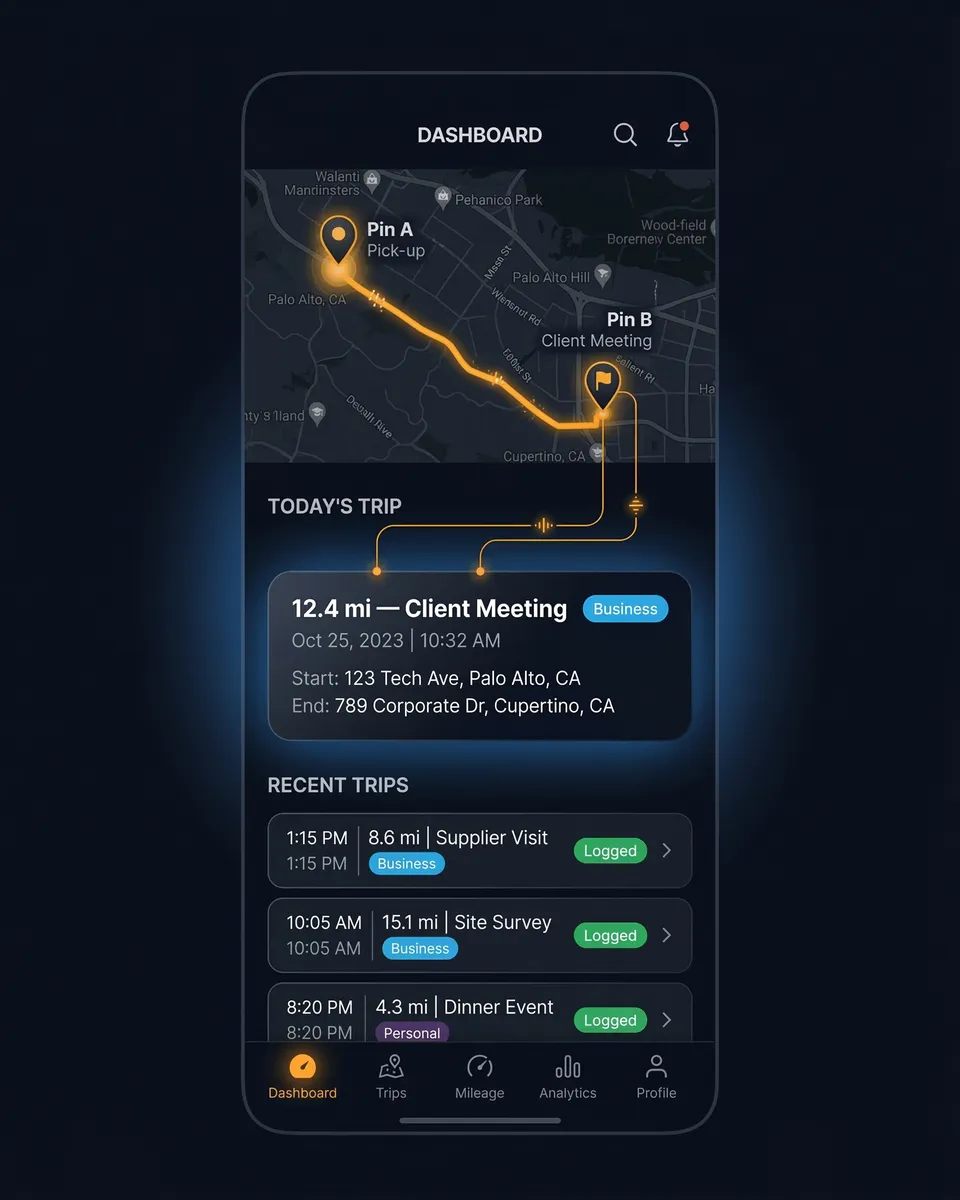
Record trips automatically with GPS, or add them by hand. Classify each drive as business or personal, set a rate per vehicle, and SparkReceipt works out the amount. It's live on iPhone, Android, and the web — in the same app that already scans your gas, parking, and toll receipts.
Business Owners in 175 Countries Trust SparkReceipt


Mileage Tracking Before and After SparkReceipt
See what changes when your mileage tracker lives in the same app as your receipts

Separate Apps
- One app for mileage, another for receipts, a spreadsheet to combine them
- Gas, parking, and toll receipts tracked separately from trips
- Scrambling to reconstruct trip logs at tax time
- Vehicle expenses and trips scattered across different tools
- Paying for two or three apps that don't talk to each other

SparkReceipt
- Kilometres, receipts, gas, parking, and tolls in one app
- GPS records every trip — classify each as business or personal
- Trips captured as you drive: date, route, distance, and purpose
- Amount worked out from a rate you set per vehicle
- AI receipt scanning and mileage tracking, side by side
How SparkReceipt Mileage Tracking Works
Record Trips by GPS or by Hand
Start, pause, resume, and stop a trip from the app — SparkReceipt uses your phone's GPS to record the route and distance. Pause for a coffee and the recorded route shows a real gap, not a phantom straight line across the break. On Android it keeps recording in the background, trips are saved even without a signal and sync when you're back online, and it picks up where it left off if your phone restarts mid-trip. Prefer manual control? Add a trip by hand after the fact.
Classify Business or Personal
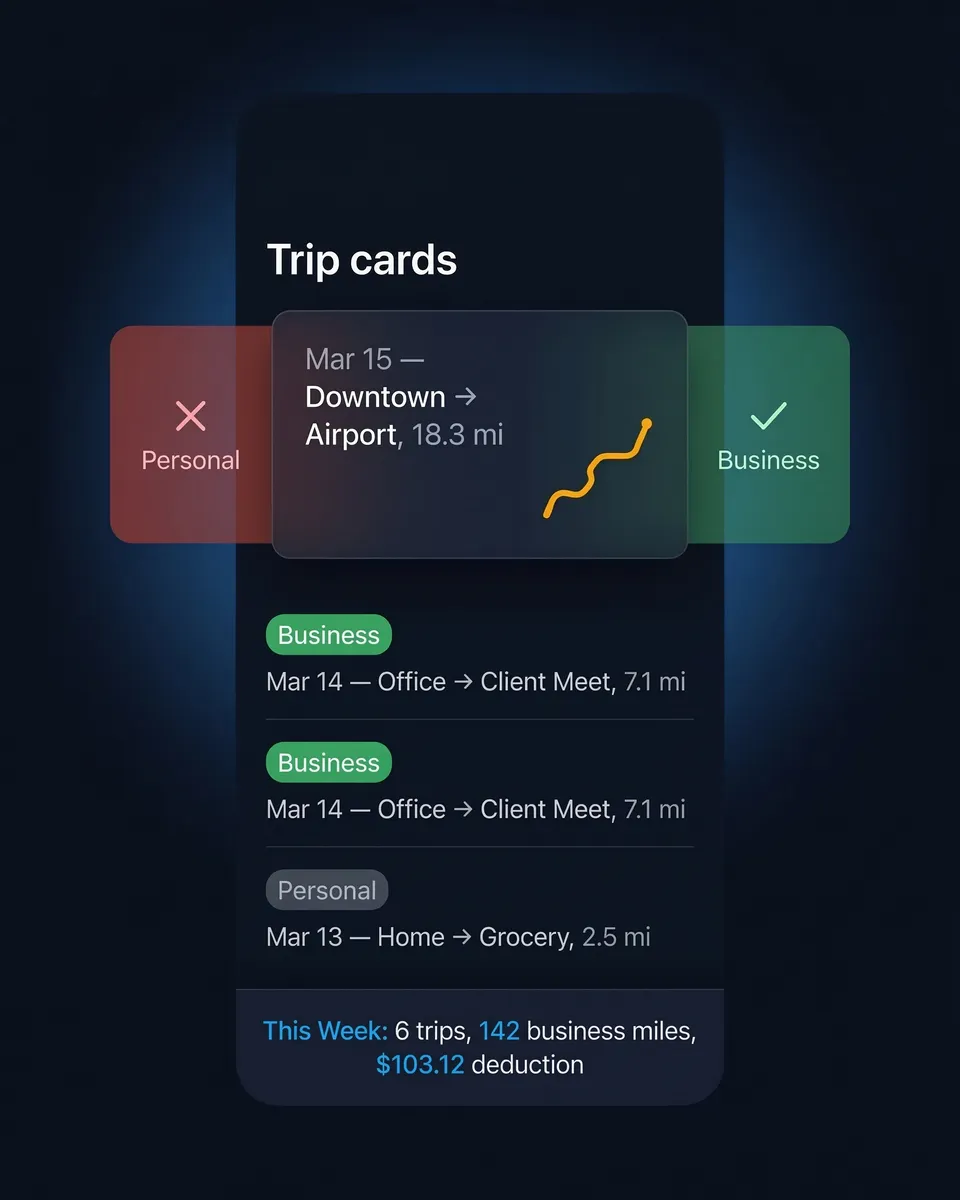
Mark each trip as business or personal — one at a time or in a batch. SparkReceipt geocodes your route and stops and can suggest a trip purpose for you; edit any of it if the map got something wrong. Every trip is fully editable afterwards — GPS-recorded ones too — so you can fix the vehicle, toggle round-trip, or correct the details. Driving there and back? Turn on round-trip to double the distance in one tap.
See What You Can Claim
Give each vehicle a rate, or set a default for your account. SparkReceipt multiplies each trip's distance by that rate — falling back to your account default when a vehicle has none — so every trip shows what it's worth, in a real currency you set for the account. Carpooling? Add a passenger count and an account passenger rate, and SparkReceipt adds a passenger reimbursement on top of the mileage. Distances appear in kilometres or miles, set automatically for your region.
Why Your Mileage Tracker Should Live With Your Receipts
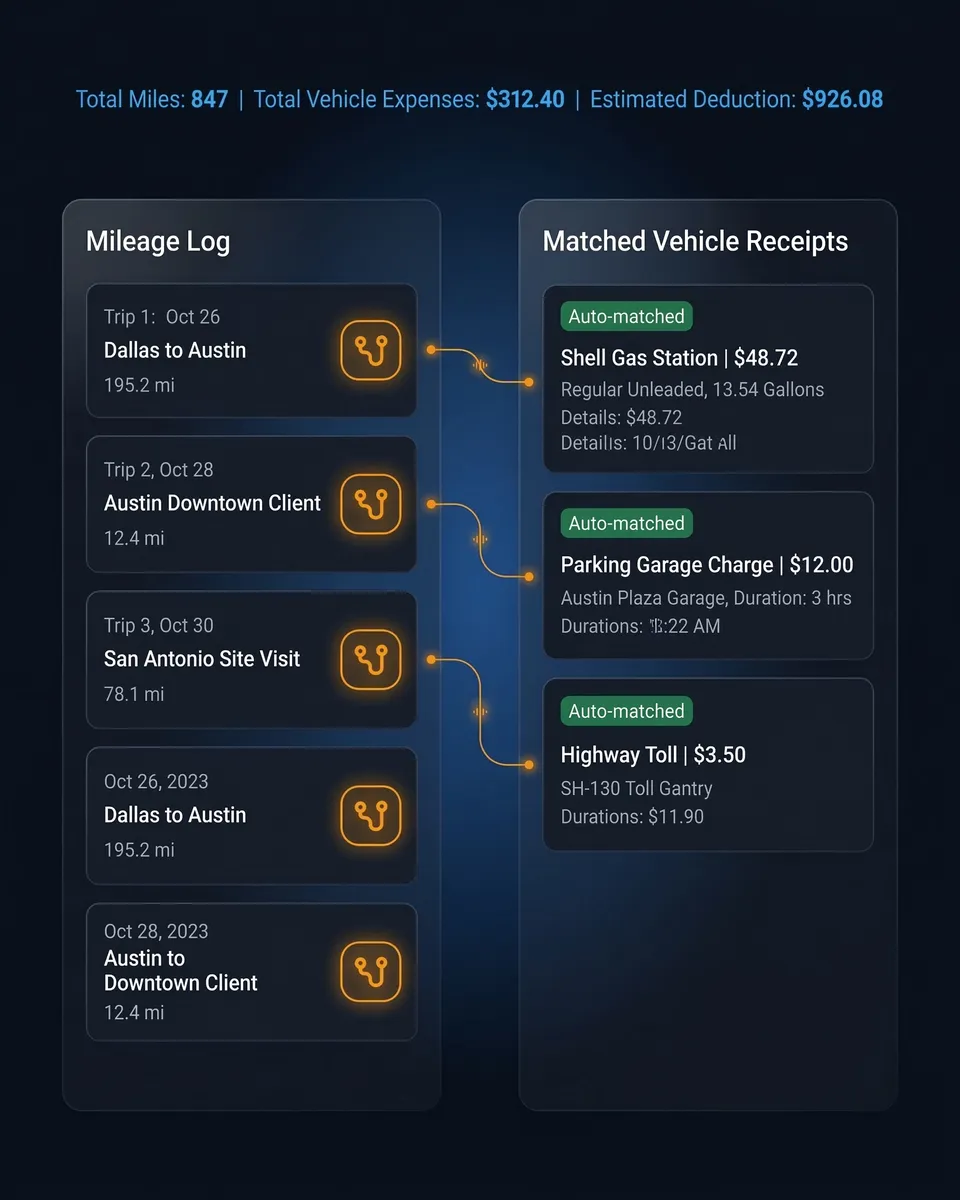
Most mileage tracker apps do one thing well: they log your kilometres. But kilometres are only part of the picture. Every business trip generates more than just mileage — there's the gas station fill-up, the parking downtown, the highway toll, the car wash before picking up a client, the oil-change receipt in the glovebox.
SparkReceipt keeps your trips and those receipts in one app — so every vehicle-related cost is in the same place when it's time to work out your motor-vehicle expenses.
2026 CRA Kilometre Rates: The Numbers That Matter
For 2026, the CRA's reasonable per-kilometre allowance is 73 cents per kilometre for the first 5,000 kilometres, then 67 cents per kilometre after that (in the provinces; the territories are 77¢/71¢). That's what an employer can pay you tax-free — at 5,000 km it comes to $3,650.
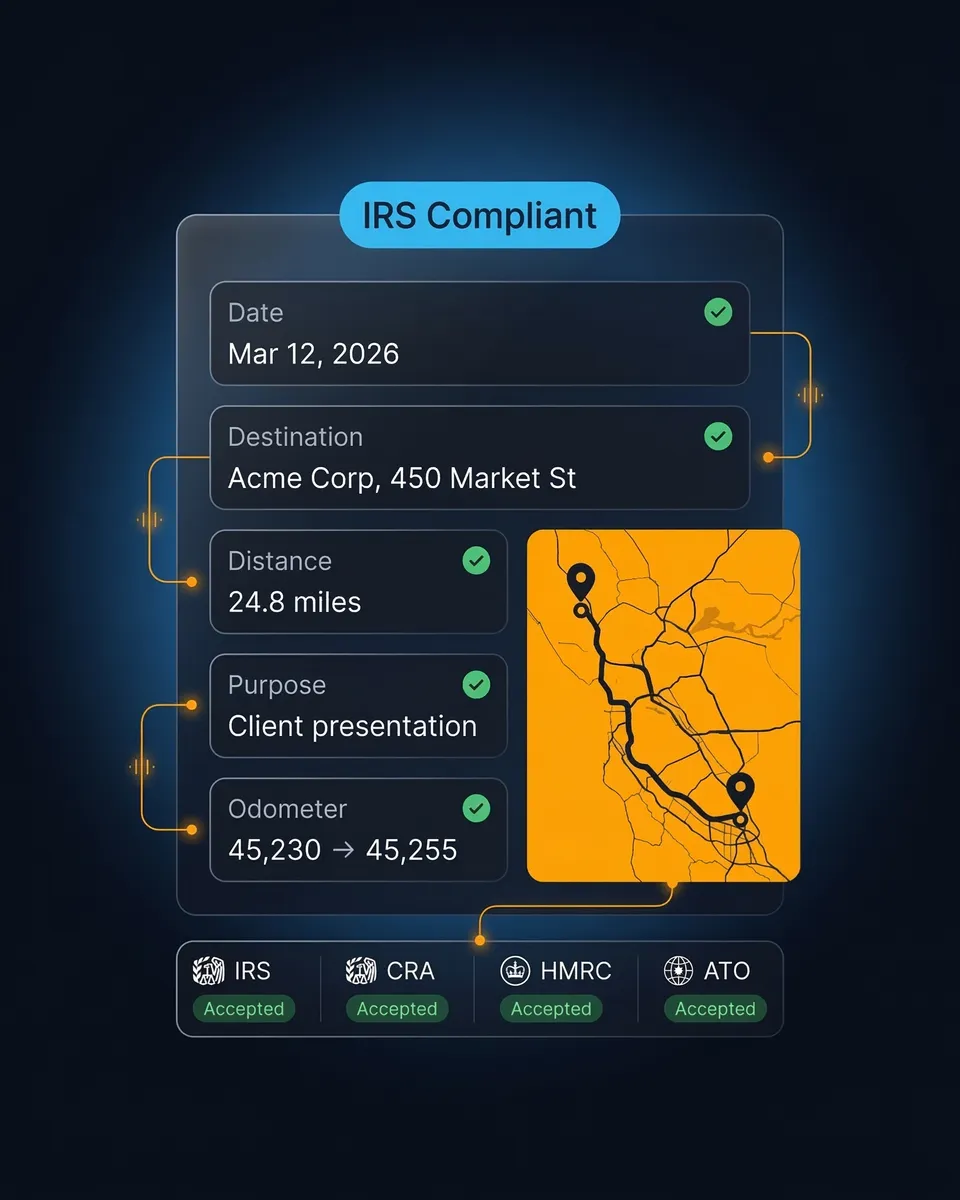
If you're self-employed, you report actual motor-vehicle expenses on form T2125, apportioned by the share of kilometres you drove for business. Either way you need a record of each business trip. SparkReceipt logs the date, route, distance, and purpose of every trip automatically with GPS — so the details are captured while they're fresh, not reconstructed months later.
Trip Details Captured as You Drive
Every trip is timestamped, mapped, and saved with the business purpose you set — one trip at a time or a whole batch at once. It all lives in the same account as your scanned receipts, on your phone and on the web.
Set a rate per vehicle and each trip shows what it's worth; leave the rate blank and SparkReceipt falls back to your account default. Just 100 business kilometres a month adds up to 1,200 km a year — the difference between a complete log and a guess at tax time — so recording every trip, by GPS or by hand, means nothing slips through.
Passengers, real currency, and a trip PDF
Amounts That Add Up the Way You Work
Amounts show in a real currency you set for the account — it starts from the account owner's preferred currency, so the numbers read the way your books do.
Carpooling counts too. Record how many passengers rode along, set an account passenger rate, and SparkReceipt adds a passenger reimbursement on top of the base mileage — with the mileage, passenger, and total amounts broken out so nothing is guesswork. Need it on paper? Download any trip as a PDF, on the web or your phone: it lays out the route, distance, purpose, vehicle, passenger count, and the full breakdown, ready to file or hand to whoever signs off.
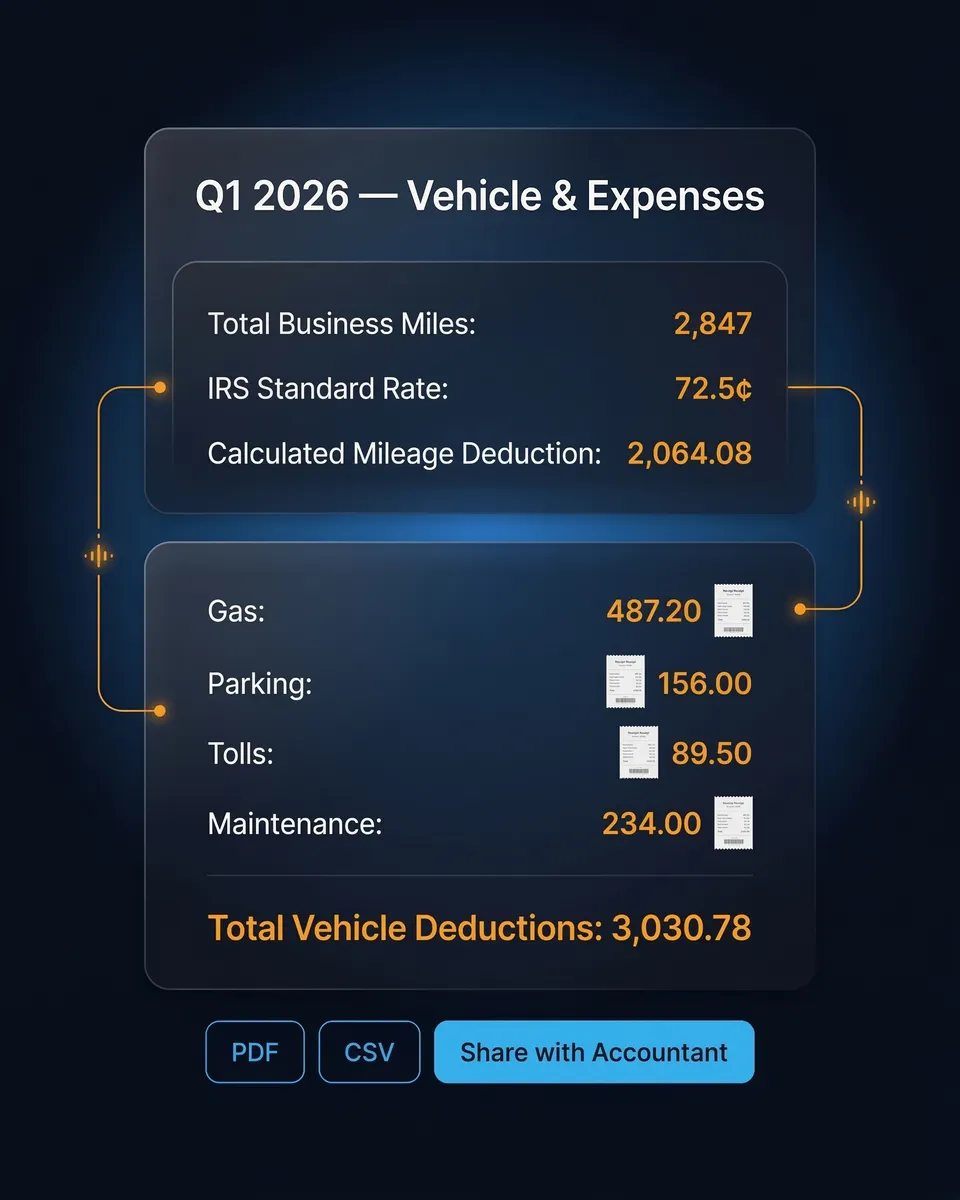
More Than a Mileage Tracker
SparkReceipt does more than track mileage. AI receipt scanner snaps and extracts data in seconds. Email receipt capture connects your inbox automatically. Bank statement extractor matches transactions to receipts. Automatic categorization sorts expenses into tax categories. 190 currencies with automatic exchange rate conversion. Invite your accountant or bookkeeper to review your reports.
Your receipts, expenses, income, and now your trips all live in one account — on iPhone, Android, and the web.
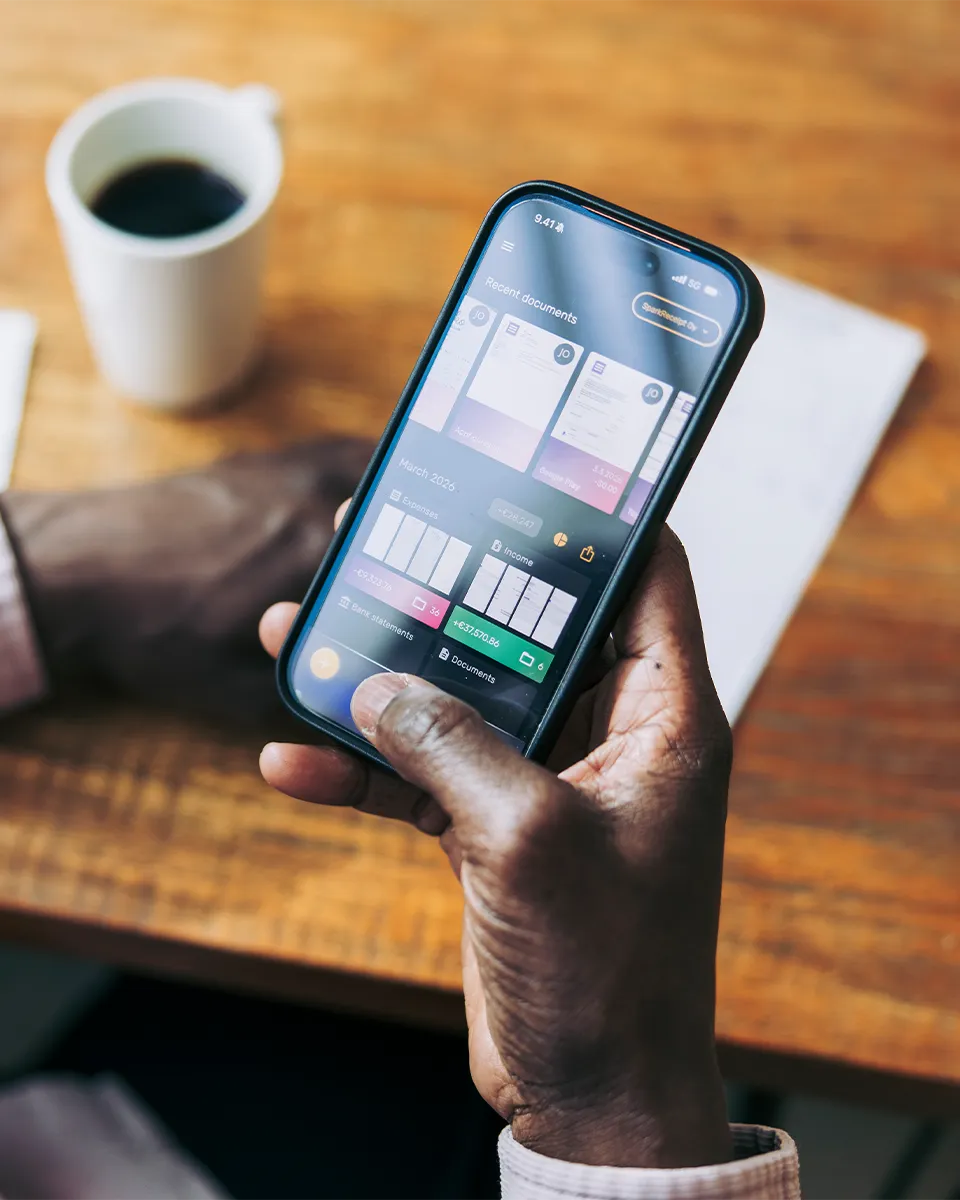
Built for Freelancers and the Self-Employed
If you're self-employed — a sole proprietor, a freelancer, an independent contractor, or a gig worker — you can deduct your business-use share of motor-vehicle expenses on form T2125. The number that drives it all is how many of your kilometres were for business.
SparkReceipt captures that split as you drive, then pairs it with the gas station receipts, parking charges, tolls, and maintenance costs its AI receipt scanner reads automatically — so your motor-vehicle claim is built from real records, not a rough estimate at year end.

Loved by Small Business Owners
“SparkReceipt takes care of the busy work, allowing me to quickly save receipts and create expense reports.”

Tim Heller
HellerWeather · United States
“SparkReceipt has been a game-changer for me! It's made organising my expenses and accounts effortless, saving me loads of time.”

Tracy Duggan
Business Coach · United Kingdom
“Thanks to you, I'm actually looking forward to my year end FOR THE FIRST TIME EVER, when I can surprise my accountant with my completed accounts.”

Abigail Dombey
Net Zero Associates Ltd · United Kingdom
Join 38,283 businesses that chose SparkReceipt — 4,620,044 receipts processed and counting.
Start Free TrialFrequently Asked Questions
Yes. Mileage tracking is live for every account on iPhone, Android, and the web — there's nothing to join or switch on. Free accounts can log 3 trips a month; Pro and Elite accounts get unlimited trips. There's no limit on the number of vehicles.
SparkReceipt uses your phone's GPS to record a trip from start to finish — you can pause, resume, and stop it, and on Android it keeps recording in the background. Trips are saved even without a signal and sync when you're back online. You can also add a trip by hand. Then classify each trip as business or personal, one at a time or in a batch.
SparkReceipt records the details of each business trip — the date, route, distance, and the purpose you set — captured as you drive rather than reconstructed later. You set your own mileage rate (per vehicle, or a default for your account), and each trip shows the amount at that rate in a currency you set. You can download any individual trip as a PDF with its route, distance, purpose, vehicle, passenger count, and breakdown. It doesn't include a built-in government rate table, and trips aren't rolled into the main expense-report or QuickBooks/Xero exports, so check your local rules — in Canada, the CRA — for exactly what your claim needs.
Each trip's amount is its distance multiplied by a rate you choose. Set a rate per vehicle, or an account-wide default; if a vehicle has no rate of its own, SparkReceipt uses the default. Amounts show in a currency you set for the account, which starts from the owner's preferred currency. Add a passenger count and an account passenger rate and SparkReceipt adds a passenger reimbursement on top, showing the mileage, passenger, and total amounts separately. Distances show in kilometres or miles, set automatically for your region. Set no rate at all and the trip still logs — it just won't show an amount until you add one.
For 2026, the CRA's reasonable per-kilometre allowance is 73 cents per kilometre for the first 5,000 kilometres and 67 cents per kilometre after that in the provinces (77¢ and 71¢ in the territories). At 5,000 km the tax-free allowance comes to $3,650. This is the rate an employer can reimburse tax-free; the self-employed instead deduct actual motor-vehicle expenses apportioned by business-use kilometres.
Self-employed people — sole proprietors, freelancers, independent contractors, and gig workers — deduct the business-use share of their motor-vehicle expenses on form T2125. Employees required to use their own vehicle for work may be able to claim allowable motor-vehicle expenses with a signed T2200 from their employer. Both cases depend on a kilometre log.
Because kilometres are only one part of your vehicle costs. Gas fill-ups, parking, tolls, car washes, and maintenance are all separate expenses that need receipts. Most mileage tracker apps don't capture these. SparkReceipt combines mileage tracking with AI receipt scanning — so every vehicle-related cost is captured in one app.
The CRA's per-kilometre rate (73¢/km for the first 5,000 km in 2026) is the tax-free amount an employer can pay an employee. If you're self-employed, you don't use that flat rate — you deduct your actual motor-vehicle expenses (gas, insurance, repairs, lease or capital cost allowance) times your business-use percentage, which comes straight from your kilometre log. Either way, a per-trip record is what makes the number defensible.
Track Your Kilometres and Expenses in One App
Get StartedExplore More Features
Mileage Calculator
Work out the CRA per-kilometre allowance
Receipt Scanner
Scan any receipt with AI in seconds
Expense Tracker
Track every business expense automatically
Email Receipts
Auto-import receipts from your inbox
Expense Reports
Generate reports in PDF, Excel, or CSV
SparkAgent
Your AI assistant for receipts and expenses
MCP Integration
Connect your own AI tool over MCP