
Can You Use Bank Statements as Receipts for HMRC?
 Written by Sampsa Vainio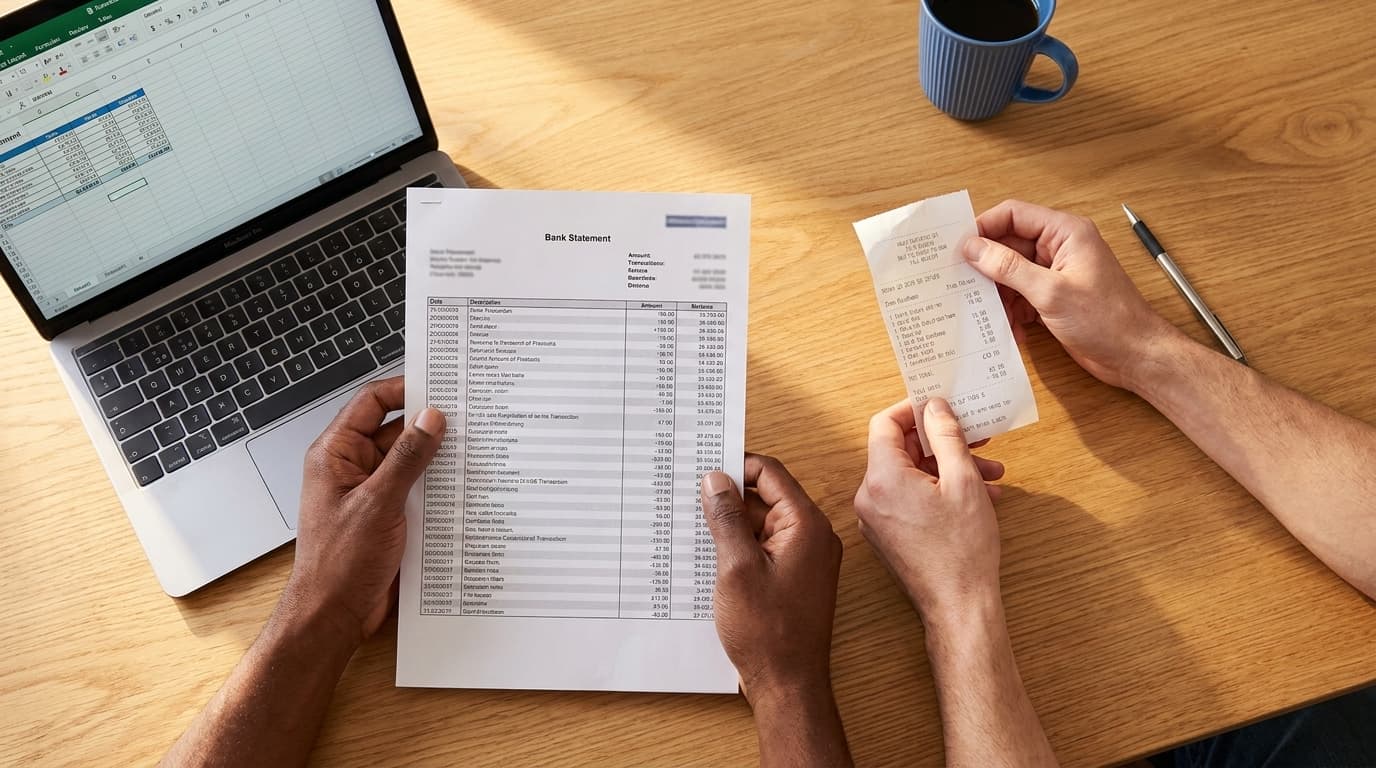
Yes, HMRC explicitly lists bank statements as valid records for self-employed people. But that is only half the answer. A bank statement proves you made a payment; it does not prove why you made it. HMRC's "wholly and exclusively" test requires proof of purpose, and that is the thing bank statements usually cannot provide. Here is exactly when they are enough, when they are not, and what to do if a receipt has gone missing.
Key Takeaways
- HMRC explicitly lists bank statements as valid record-keeping documents for self-employed people
- Bank statements prove payment (amount, date, payee), not purpose (what was bought and why it was for business)
- The "wholly and exclusively" test requires proof of purpose; without a receipt, HMRC can disallow the expense
- Some expenses, bank charges, identifiable subscription direct debits, are fine with a statement alone
- If a receipt is lost, contact the supplier for a duplicate before relying on the statement alone
- There is no HMRC de minimis threshold below which receipts are automatically unnecessary
What HMRC Says About Bank Statements as Records
GOV.UK's guidance on self-employed record-keeping is unambiguous. HMRC lists the following as valid proof of business expenses:
"Types of proof include: all receipts for goods and stock, bank statements, chequebook stubs, sales invoices, till rolls and bank slips."
Bank statements are on that list. They count as valid records. That is the clear "yes", HMRC accepts them as part of the documentation you keep.
HMRC requires self-employed people to retain records of all sales and income, all business expenses, and bank statements for at least five years after the 31 January submission deadline for the relevant tax year. Bank statements help satisfy that retention obligation.
But there is a difference between records HMRC accepts as part of your filing and records that survive scrutiny during a formal enquiry. That distinction is where most guidance falls short.
Why Bank Statements Alone Often Aren't Enough
To deduct a business expense on your Self Assessment, it must pass HMRC's "wholly and exclusively" test: the expense must have been incurred wholly and exclusively for the purposes of your trade.
A bank statement can show an HMRC officer that you paid £85 to Amazon on 14 February. It cannot show what you bought. That £85 could be printer cartridges for the office (deductible) or a birthday present for your child (not deductible). Without a receipt that shows what was purchased, you have no way to demonstrate business purpose, and the burden of proof sits with you, not HMRC.
Tax tribunals have consistently sided with HMRC in these situations. Cases following the Mediability v HMRC pattern found that bank statements alone were insufficient proof; expenses were disallowed because the nature of the expenditure could not be verified from the statement. "I paid it from my business account" is not the same as "I paid it for business."
The practical risk: a formal enquiry officer has discretion to decide what counts as "sufficient records," and when the only evidence for an expense is a bank entry to a general retailer, that judgment tends to fall against the taxpayer.
For a full overview of what HMRC requires and for how long, see our guide to HMRC's record-keeping requirements.
When a Bank Statement Is Enough
There are specific cases where a bank statement provides genuinely sufficient evidence, because the business purpose is unambiguous without needing a receipt.
Bank statements are generally sufficient for:
- Bank charges and fees, the bank statement is itself the document of record; no separate receipt exists for your bank's own charges
- Direct debits to identifiable business suppliers, a monthly payment labelled "XERO NZLIMITED" or "ADOBE SYSTEMS UK" makes business purpose obvious from the payee name
- Utility and premises costs, electricity from British Gas, broadband from BT, where you can separately establish the property is used for business
- HMRC payments, VAT, National Insurance contributions, and Corporation Tax debiting your account are self-evidently business in nature
- Payroll payments, corroborated by your payroll records, the purpose is clear
Bank statements are not sufficient for:
- Physical goods from any retailer, where the payee name does not reveal what was purchased
- Meals, entertainment, or client subsistence expenses
- Vehicle fuel (unless your mileage log covers the business purpose)
- Payments to general marketplaces, Amazon, eBay, Argos, where the purchase could be anything
If you want to see which transactions in your account already have matched receipts and which do not, SparkReceipt's AI receipt scanner captures receipts as you go so gaps never accumulate.
What to Do If You've Lost a Receipt
If a receipt is genuinely missing, work through these steps before defaulting to a bank statement alone:
-
Ask the supplier for a duplicate. Most retailers can reprint. SaaS tools typically re-send email receipts on request. A supplier who invoiced you can usually reissue the invoice. This is the cleanest outcome.
-
Check your email. Purchase confirmations, PDF attachments, and payment receipts are frequently buried rather than deleted. Search by vendor name or amount and check your Spam folder.
-
Check your expense app or accounting software. If you captured the receipt when it arrived, the record is there. Scanning receipts at the point of purchase with a tool like SparkReceipt's AI receipt scanner means you rarely face this problem.
-
Use the bank statement plus a contemporaneous written note. HMRC will generally accept this combination for lower-value expenses where your overall records are otherwise tidy. The note should record: date, amount, payee, what was purchased, and the specific business purpose.
-
Check contracts or subscription confirmations. For recurring costs, an original sign-up email or contract can establish business purpose even when individual invoices are missing.
The Practical Rule: Keep Both
Bank statements and receipts serve complementary functions. Treat them as a pair, not alternatives.
- Bank statement = proof of payment (amount, date, payee)
- Receipt = proof of purpose (what was bought and why it was for the business)
Together, they create an audit-proof record. Together, HMRC's test becomes straightforward to satisfy. Apart, each has gaps, a receipt with no matching bank entry can raise questions; a bank statement with no receipt leaves purpose open to challenge.
The simplest move: scan receipts as you get them. It takes less time to photograph a receipt than to reconstruct what a payment was for six months later. For the full picture of what expenses you can claim and what HMRC expects you to document, see our guide to allowable expenses as a sole trader.
Frequently Asked Questions
Can HMRC ask for my bank statements?
Yes. Under Section 20 of the Taxes Management Act 1970, HMRC can formally request bank statements during an enquiry. They use them to cross-check declared income and expenses against what moved through your account. This is separate from whether statements serve as sufficient expense proof on their own.
Is a bank statement a receipt for tax purposes?
HMRC lists bank statements as valid records, so they count as documentation. But a record and a receipt serve different functions. A receipt proves what was purchased; a bank statement proves what was paid. HMRC can still disallow an expense if the only evidence is a bank statement and the business purpose cannot be verified from that statement alone.
How much can I claim on tax without receipts?
HMRC publishes no formal threshold below which receipts are automatically unnecessary. For very small, obviously business-related expenses, officers sometimes use discretion. But there is no de minimis rule; any expense can be challenged without supporting documentation, regardless of the amount.
What records does HMRC require for self-employed people?
HMRC requires records of all sales and income, all business expenses, and bank statements. You must retain these for at least five years after the 31 January deadline for the relevant tax year. See our full guide to HMRC's record-keeping requirements for the complete list.
Can I use a bank statement for a VAT claim?
For VAT, the rules are stricter. You generally need a valid VAT invoice showing the supplier's VAT registration number, the amount of VAT charged, and details of the taxable supply. A bank statement alone is not sufficient to reclaim input VAT.
The Bottom Line
HMRC accepts bank statements as valid records, and for certain expenses with an obvious business purpose, they are all you need. For everything else, they prove you paid, not what you bought, and the "wholly and exclusively" test requires the latter.
Keep both. Capture receipts when you get them, and let your bank statement corroborate rather than carry the case.
Start Scanning Free with SparkReceipt's AI receipt scanner, photograph a receipt and AI extracts the vendor, amount, date, and tax automatically. 7-day free trial.
Note: Consult a qualified tax professional for advice specific to your situation.