
How to Register as a Sole Trader in the UK (2026)
 Written by Sampsa Vainio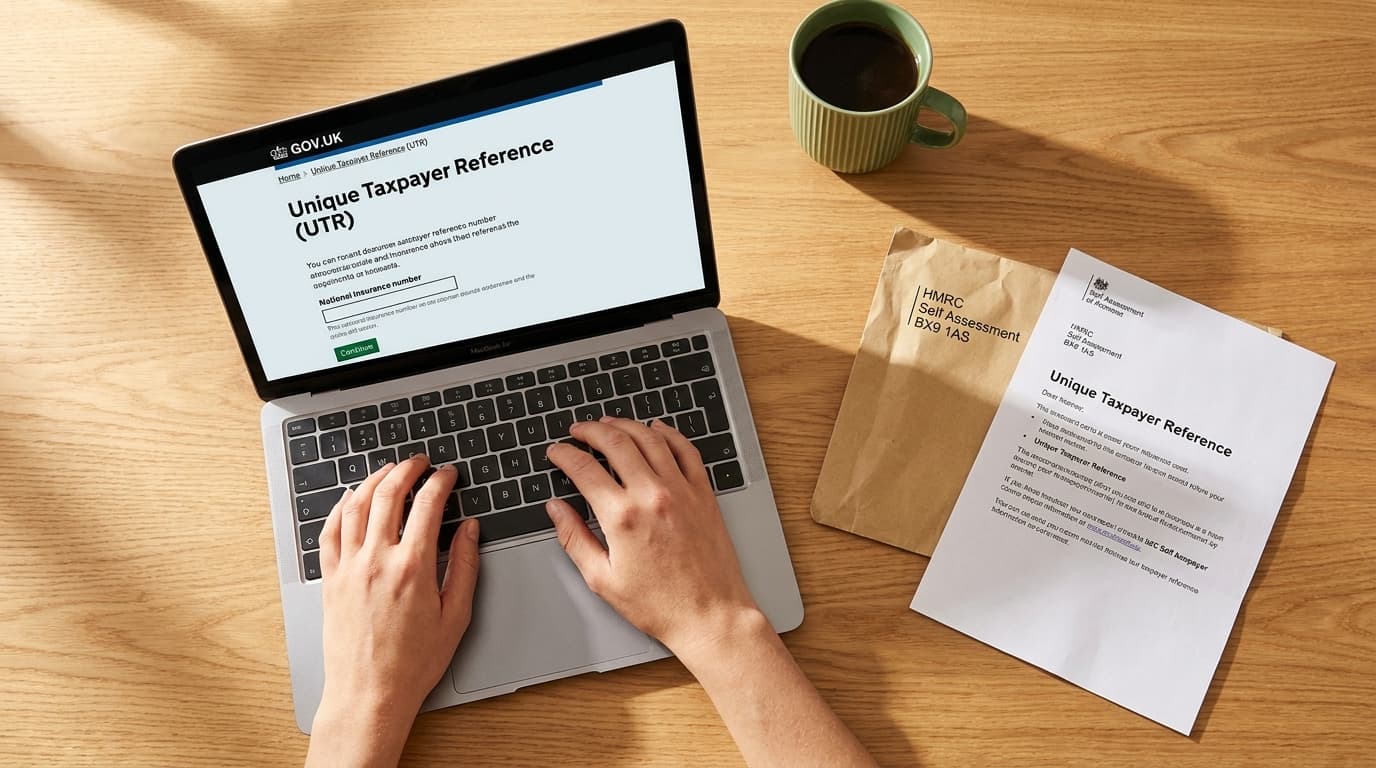
Registering as a sole trader in the UK takes about 10 minutes online via HMRC's Government Gateway. You register for Self Assessment, receive a Unique Taxpayer Reference (UTR) by post within 10 working days, and you're done.
What most guides stop there. What they don't tell you is what to set up in the following 30 days, and that's where most new sole traders get unstuck when their first tax return comes around.
This guide covers both: the registration process itself, and the financial groundwork that makes your first year as a sole trader a lot smoother.
Key Takeaways
- Register via HMRC's Government Gateway, it's free and takes 10 minutes
- You must register by 5 October following the end of the tax year in which you started trading
- Sole traders do not register with Companies House, that's for limited companies only
- Your UTR number arrives by post within 10 working days of registering
- Your record-keeping obligation starts the day you start trading, not the day you file your first tax return
- Class 2 National Insurance is no longer mandatory from April 2024, but you may still want to pay it voluntarily
What is a Sole Trader?
A sole trader is the simplest legal business structure in the UK. You and your business are legally the same entity, you trade in your own name (or a business name), keep all the profits, and are personally responsible for any debts the business incurs.
This unlimited personal liability is the main trade-off against a limited company, where your personal assets are generally protected if the business fails. For most freelancers, tradespeople, and early-stage self-employed professionals, the sole trader structure is the practical starting point: no formation costs, no annual accounts to file at Companies House, no separate corporation tax return.
Do You Need to Register as a Sole Trader?
You must register with HMRC if:
- You earn more than £1,000 from self-employment in a tax year (April 6 to April 5). This is HMRC's trading allowance; income below this threshold doesn't trigger a registration requirement, though you can register voluntarily.
- You're running a side business alongside employment. Your employer's PAYE covers your employment income, but your self-employed income must be declared separately via Self Assessment.
- You need to prove self-employment, for example, to claim Tax-Free Childcare.
- You want to pay voluntary Class 2 National Insurance contributions to build State Pension qualifying years.
Not sure whether you're employed or self-employed? HMRC's employment status checker runs through the key indicators: whether you set your own hours, provide your own equipment, and can substitute someone else to do the work.
When Do You Need to Register?
The deadline is 5 October following the end of the tax year in which you started trading.
If you started trading any time between April 6, 2025 and April 5, 2026, you must register by 5 October 2026.
If you started in the 2026/27 tax year (after April 6, 2026), you have until 5 October 2027.
Missing this deadline can result in a penalty, typically up to £100 for late registration. More importantly, late registration delays your UTR number and can compress the time you have to get your records in order before your first Self Assessment filing.
There's no penalty for registering early. If you've just decided to go self-employed, registering straight away is the sensible move.
How to Register as a Sole Trader, Step by Step
Step 1: Create a Government Gateway Account
Go to gov.uk/become-sole-trader and select "Register as a sole trader."
You'll need:
- An email address
- Your National Insurance number
- A form of ID for the identity check (typically your passport or UK driving licence)
If you already have a Government Gateway account (for example, from a previous tax return or HMRC online services), use that rather than creating a new one.
Time required: 5–10 minutes.
Step 2: Register for Self Assessment
Once logged in, select "I am self-employed" and work through the registration form. You'll be asked for:
- Your full name and address
- Your National Insurance number
- The date you started self-employment (this determines which tax year your first return covers)
- A brief description of your business, "freelance graphic designer", "electrician", "sole trader selling handmade goods" is perfectly sufficient
Submit the form. HMRC processes your registration and sends your UTR by post.
Step 3: Wait for Your UTR Number
Your Unique Taxpayer Reference (UTR) is a 10-digit number that HMRC assigns to you as a taxpayer. It looks like this: 1234567890. You'll use it every time you file a Self Assessment return and when corresponding with HMRC about your self-employed income.
Your UTR arrives by post within 10 working days. If it hasn't arrived after 3 weeks, call HMRC on 0300 200 3310 (Monday to Friday, 8am--6pm). Have your National Insurance number ready.
Keep this letter somewhere safe. Unlike many government documents, the UTR doesn't change, it's yours for life.
Step 4: Set Up Your HMRC Online Account
Once your UTR arrives, return to your Government Gateway account and enrol for Self Assessment online. This unlocks your personal tax account, where you can:
- File your annual Self Assessment return
- View your payment history
- Check your tax calculation
- Set up payment plans if needed
Do Sole Traders Register with Companies House?
No. Companies House is the registrar for limited companies (Ltd) and limited liability partnerships (LLPs). Sole traders are not registered legal entities, you and your business are the same person in the eyes of the law.
As a sole trader, you have no company number, no obligation to file annual accounts at Companies House, and no £12 formation fee to pay. You simply register with HMRC for Self Assessment.
This trips up a surprising number of people, partly because "register your business" advice online often conflates sole traders and limited companies. If a service is charging you to "register your business" as a sole trader, you don't need it. HMRC registration is free.
If you want to protect a specific business name, preventing anyone else from trading under it, you would need to form a limited company, since only company names are reserved at Companies House. Sole trader trading names are not protected.
Choosing a Trading Name as a Sole Trader
You can trade under your own name or use a business name, "Jane Smith" or "JS Creative" are both fine. No registration is required for a trading name.
There are some restrictions. Your trading name cannot:
- Include "Limited", "Ltd", "LLP", or "PLC"
- Suggest a connection to the government or a local authority
- Be offensive or contain a sensitive word (like "British", "Royal", or "Chartered") without approval
- Be identical or very similar to an existing registered trademark
Even when trading under a business name, your real name must still appear on any formal business documents, invoices, contracts, and official correspondence. A sole trader invoice from "JS Creative" needs to include "Jane Smith, Sole Trader" or similar somewhere on the document.
Your Obligations Once Registered
Self Assessment Tax Returns
You'll file a Self Assessment return each year. The key dates:
- Tax year end: 5 April
- Paper return deadline: 31 October (rarely used)
- Online return deadline: 31 January the following year
- Payment deadline: 31 January (same date as the online filing deadline)
For example: the 2025/26 tax year ends 5 April 2026. Your online return and payment are due by 31 January 2027.
One thing that catches many new sole traders in their second year: payment on account. If your first year's tax bill exceeds £1,000, HMRC requires you to pre-pay two installments toward the following year's bill, 50% on 31 January and 50% on 31 July. This means your second January payment can be up to 150% of what you expected. Budget for it from your first year of trading.
National Insurance
As a sole trader, you pay two types of National Insurance:
Class 4 NICs, paid via Self Assessment on your profits:
- 6% on profits between £12,570 and £50,270 (2026/27 rates)
- 2% on profits above £50,270
Class 2 NICs, a flat-rate voluntary contribution of £3.45 per week. From April 2024, Class 2 NICs are no longer automatically required for most self-employed people. However, you may want to pay them voluntarily to build up qualifying years toward your State Pension. Each qualifying year you gain now is worth approximately £6.32 per week in future State Pension. For detailed NI guidance, see our guide to self-employed National Insurance.
VAT
You do not need to register for VAT unless your taxable turnover exceeds £90,000 in any rolling 12-month period. If you cross that threshold, you must register within 30 days.
You can register voluntarily below the threshold, which is sometimes worth doing if your customers are VAT-registered businesses; they can reclaim the VAT you charge, and you can reclaim VAT on your purchases. But for most sole traders starting out, compulsory VAT registration is some way off.
The First 30 Days: Your Financial Setup Checklist
Registration is straightforward. What shapes your first year as a sole trader is what you set up in the weeks that follow. These five tasks take a few hours total and avoid a lot of pain later:
1. Open a separate business bank account
Not legally required, but practically essential. Mixing personal and business transactions makes your Self Assessment significantly harder to prepare and makes it nearly impossible to give your accountant useful records. Most business bank accounts for sole traders are free for the first year.
2. Set up an expense tracking system
Your record-keeping obligation starts the day you start trading, not the day you register with HMRC, and not the first time you file a return. Every business expense you want to claim as an allowable deduction needs a receipt. Start capturing receipts from your first business purchase. See our full guide to allowable deductions as a sole trader.
Use a business expense tracker to log expenses as you go. Trying to reconstruct six months of purchases from bank statements at January 31 is possible but painful.
3. Note your official trading start date
This determines which tax year your first return covers. If you started trading on 1 March 2026, your first tax year is 2025/26 (ending 5 April 2026), even though you only traded for five weeks. Make sure your registration with HMRC reflects the correct start date.
4. Save your Government Gateway credentials
You'll need them each January. Save them in a password manager, not a sticky note.
5. Set calendar reminders
Two dates matter most: 31 January (Self Assessment filing and payment) and 5 April (tax year end). Set annual recurring reminders now. The 31 January deadline catches out sole traders who forget that "next January" arrives faster than expected.
Frequently Asked Questions
How long does it take to register as a sole trader?
The online registration takes about 10 minutes. Your UTR number then arrives by post within 10 working days. In practice, allow up to 3–4 weeks before you have everything needed to access your full Self Assessment account online.
Is there a fee to register as a sole trader?
No. Registering with HMRC as a sole trader is completely free. You do not need to use a formation agent, an online "business registration" service, or any paid tool to register. HMRC's Government Gateway handles the whole process at no charge.
Can I be employed and self-employed at the same time?
Yes, and it's common. Your employer handles income tax and National Insurance on your employment income through PAYE. You register separately for Self Assessment to declare your self-employed income and calculate any additional tax owed. You won't pay tax twice on the same income, HMRC accounts for what you've already paid through PAYE.
What is a UTR number and where will I use it?
A UTR (Unique Taxpayer Reference) is a 10-digit number HMRC assigns when you register. You'll use it on every Self Assessment return, in any correspondence with HMRC about your tax affairs, and if you hire an accountant (they'll need it to set up your account). It doesn't change, the same number stays with you throughout your working life.
Do I need an accountant to register as a sole trader?
No. Registration is free and takes 10 minutes on GOV.UK, no accountant needed. Where an accountant adds genuine value is in preparing your Self Assessment return, particularly if you have complex expense categories, income from multiple sources, or your profits cross the point where marginal rates matter. For many sole traders in their first year, the return is straightforward enough to complete independently.
What expenses can I claim as a sole trader?
HMRC allows deductions for expenses that are "wholly and exclusively" for business purposes, things like professional fees, travel, software subscriptions, equipment, and marketing costs. See our full guide to self-employed expenses in the UK for a complete list of allowable deductions and what HMRC won't allow.
Getting Started
Registering as a sole trader is genuinely one of the easier interactions you'll have with HMRC. The form is straightforward, the UTR arrives within a fortnight, and you're set to invoice legitimately from day one.
The part that requires more thought is everything that comes after. Set up your expense tracking system before your first invoice goes out, keep every receipt, and your first Self Assessment return will be an exercise in data entry rather than archaeology.
If you want to estimate your tax bill before your first return comes around, setting aside 25–30% of your profit each month is a reliable rule of thumb until you have your first Self Assessment figure.
Ready to get the financial side organised? Get Started with SparkReceipt's expense tracker, built for UK sole traders who'd rather spend 10 minutes a month on their books than 10 hours in January.