
How to Convert a Bank Statement to Excel or CSV: 4 Methods That Work
 Written by Sampsa Vainio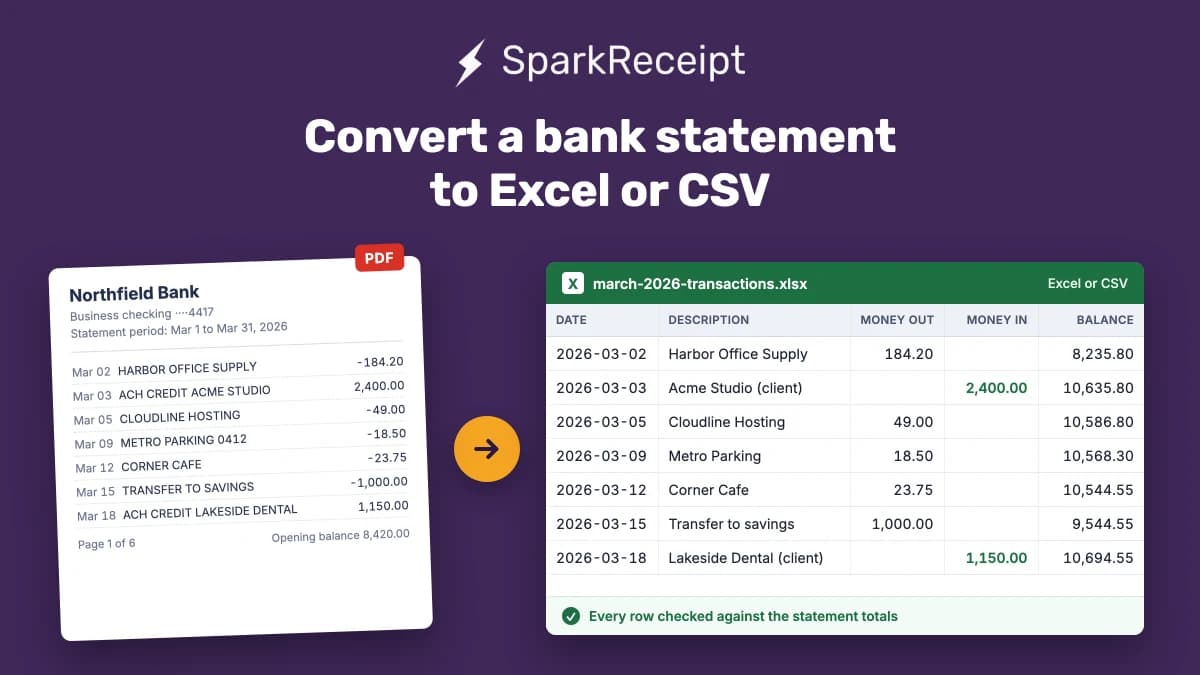
Your accountant wants the transactions in a spreadsheet. Your bank gave you a PDF. This guide covers four ways to convert a bank statement to Excel or CSV, starting with the free ones, and it is honest about where each one stops working: scanned statements, tables that run across many pages, and Excel on a Mac.
The short version:
- Check your bank first. Many banks let you download transactions as CSV or Excel, and that file is cleaner than anything you can pull out of a PDF.
- If you only have a PDF and you use Excel on Windows, try Excel's built-in PDF import: Data > Get Data > From File > From PDF.
- If the statement is one or two pages, copy and paste can be quicker than either.
- If the statement is scanned, runs to dozens of pages, or you do this every month, use a tool that extracts the transactions for you. That is what SparkReceipt's bank statement extractor does, and it exports the result to Excel or CSV.
How to convert a bank statement to Excel: which method fits?
| Your situation | Best method | Handles scanned statements? |
|---|---|---|
| Your bank offers a CSV or Excel download for the period | Method 1: download it | Not needed |
| Digital PDF, a few pages, Excel on Windows | Method 2: Excel's PDF import | No |
| Excel for Mac, Excel for the web, or Google Sheets | Method 1, 3 or 4 (none of them import PDFs) | Depends on the method |
| One or two pages, needed once | Method 3: copy and paste | No |
| Scanned or photographed statement | Method 4: AI extraction | Yes |
| Long statements, several accounts or currencies, every month | Method 4: AI extraction | Yes |
Method 1: Download the bank statement as CSV or Excel
Before you convert anything, log in to online banking and look for Download, Export or Statements and documents next to your transaction history. Pick the date range, then choose CSV or Excel if it is offered. A file that comes straight from the bank has one row per transaction and no page headers to clean up, so it beats every PDF method on accuracy.
Two things catch people out:
- How far back you can export varies by bank. Recent months are usually there; older periods are often available as PDF statements only. That is how most people end up needing the other methods.
- Opening the CSV by double-clicking can scramble it. Excel guesses the formats. A date like 03/04/2026 can flip between March and April, and amounts written with a decimal comma can arrive as text. Use Data > From Text/CSV instead, check the preview, and set the date and number columns yourself.
In Google Sheets, use File > Import. Sheets accepts CSV and Excel files. It cannot import a PDF, so a PDF statement has to be converted first.
Method 2: Import a PDF bank statement into Excel with Power Query
Excel on Windows can read tables out of a PDF. It works well on a short, digitally generated statement.
- Open a blank workbook.
- Go to Data > Get Data > From File > From PDF.
- Select the statement and click Import.
- In the Navigator window, Excel lists the tables and pages it found. Select the table that holds your transactions. Tick Select multiple items if the transactions are spread over several tables.
- Click Transform Data to open the Power Query editor. Remove the header and footer rows, and set the column types: date for the date, decimal number for the amounts.
- Click Close & Load to place the clean table on a sheet.
This import is part of Excel 2016 and later on Windows, including Microsoft 365. It is not included in Excel for Mac or Excel for the web, which is why the From PDF option is simply missing for many people.
Where the Excel import stops working
- Long statements. Excel tries to join a table that continues over several pages, but statements rarely cooperate. Repeated column headers, page totals and "balance brought forward" rows land inside your data, and you often end up with several tables to append by hand. Microsoft's own documentation suggests loading large PDFs a few pages at a time to avoid timeouts.
- Descriptions that wrap onto a second line. One transaction becomes two rows, the second with no date or amount. Microsoft documents this as well, and the fix is manual: fill down, then group the rows back together.
- Scanned or photographed statements. Power Query reads the text stored inside the PDF. A scan is a picture of text, so there is no table for it to find until the file has been through OCR.
- Debits and credits. Some banks print one signed amount column, others print separate money in and money out columns. You will need a formula to turn them into a single amount you can total.
If your statement is short and clean, Method 2 is free and good enough. If you hit two or more of the problems above, the cleanup takes longer than the conversion.
Method 3: Copy and paste
For a one or two page statement, select the transaction table in your PDF viewer, copy it, and paste it into Excel. If everything lands in one column, select it and use Data > Text to Columns to split on spaces or tabs.
Expect to fix the result by hand. Descriptions with spaces in them break the columns, and negative amounts often lose their sign. It is a reasonable last resort for twenty transactions and a poor one for two hundred.
Method 4: Convert the bank statement to Excel with AI extraction
When the statement is scanned, long, in another language or currency, or simply something you deal with every month, a dedicated extractor saves the most time. Here is how to convert a bank statement to Excel with SparkReceipt.
- Upload the statement. In the web app, choose Add new bank / credit card statement in the sidebar. PDF, CSV and Excel files all work, up to 24 MB each, and credit card statements are handled the same way. If the PDF is password protected, remove the password first.
- Let the extraction run. It starts on its own. The AI reads the document, pulls out every transaction line, and then checks those lines against the statement's own totals, so a missed row shows up instead of hiding. You can leave the page while it works.
- Review the transactions. Open View transactions. Fix any line the statement got wrong, delete transfers between your own accounts, or use Add new transaction for one that is missing.
- Export to Excel or CSV. Click Export, or select only the lines you want and export those. In the Select export format dialog, choose Excel or CSV. Tick Include matched document files if you want the receipts in the same download.
There are no templates to set up for your bank. Statements are read in any language and in 190 currencies, which matters if you bank in more than one country.
What you get that a converter does not give you
A spreadsheet of transactions tells you what you spent. It does not tell you whether you can prove it. After extraction, SparkReceipt matches each transaction to the receipts and invoices already in your account and flags the ones with nothing behind them, so you can see what is missing before tax time rather than during it. The Transaction Manager keeps track of that reconciliation, and the lines you keep can become categorized expense and income entries that flow into your reports and exports or get published to QuickBooks Online or Xero. Your accountant can join your account for free and work from the same data.
If your bank is in the United States, you can skip statements altogether and connect the account so transactions arrive on their own.
What it is not
SparkReceipt is not a free one-off file converter, and we would rather say so here than after you sign up. It is paid software with a 7-day free trial. Statement extraction runs on credits, one per extracted transaction line, and your plan includes credits that renew every month. The help center explains how extraction credits work. If you need one statement converted once and your bank offers a CSV download, Method 1 is the right answer and it costs nothing.
Check the numbers before you trust the spreadsheet
Whichever method you use, spend two minutes on this before the file goes to your accountant:
- Balance check. Opening balance, plus money in, minus money out, should equal the closing balance printed on the statement. If it does not, a row is missing, duplicated or has the wrong sign.
- Row count. Count the transactions on the first and last page of the PDF and compare them with the matching rows in the sheet. Page breaks are where rows go missing.
- Dates. Sort by date. Anything that lands in the wrong month was read in the wrong format.
- Overlaps. If you combine several statements, check the days where one ends and the next begins for duplicated rows.
Before you upload a statement anywhere
A bank statement shows your account number, your balance and everyone you paid. Before you upload one to any online converter, find out who runs the service, where the files are stored, how long they are kept and whether you can delete them. For SparkReceipt, those answers are on our security page: data is encrypted in transit and at rest, files are stored in the EU, you can delete your documents, and we do not sell your data.
Converting other PDFs: receipts and invoices
Bank statements are the hard case because they are long tables. If what you have is a folder of PDF receipts and invoices, the job is different: each file is one expense, and you want one spreadsheet row per document with the merchant, date, amount and tax. Our guide to scanning receipts into Excel covers that workflow, and the same export options apply.
Frequently Asked Questions
Often, yes. First check whether your bank lets you download the same period as CSV or Excel, which is free and the most accurate option. If you only have a PDF and use Excel on Windows, the built-in import under Data > Get Data > From File > From PDF is also free. Free online converters exist too, but check who runs them before you upload a document that shows your account number and balance. SparkReceipt is paid software with a 7-day free trial.
If you have a CSV file from your bank, use Data > From Text/CSV, check the preview, and set the date and amount columns before loading. If you have a PDF and Excel on Windows, use Data > Get Data > From File > From PDF, pick the transaction table in the Navigator window, clean it in the Power Query editor, and click Close & Load.
Excel's PDF import is part of Power Query on Windows, in Excel 2016 and later including Microsoft 365. It is not included in Excel for Mac or Excel for the web. On those versions you need a CSV from your bank, or a tool that converts the PDF first.
Yes. Most banks that offer an export offer CSV, and CSV is the safest format for accounting software and Google Sheets. In SparkReceipt, the Select export format dialog offers both CSV and Excel for the transactions extracted from a statement.
Not with Excel's own import, which reads the text stored inside a PDF. A scanned or photographed statement is an image, so it needs OCR or AI extraction first. SparkReceipt reads scanned and digital PDFs, extracts every transaction, and checks the extracted lines against the statement totals before you export.
Google Sheets imports CSV and Excel files through File > Import, but it cannot import a PDF. Download a CSV from your bank if you can. If you only have a PDF, convert it first with one of the methods in this guide, then import the resulting CSV or Excel file.
SparkReceipt does not use per-bank templates. The AI adapts to each statement layout, reads statements in any language, and handles 190 currencies. Credit card statements work the same way as bank statements.
Stop converting by hand. If you convert a bank statement to Excel every month, upload each statement to SparkReceipt, let the AI extract and check the transactions, and export to Excel or CSV in a couple of clicks. In the United States you can connect the bank account instead, so there is no statement to convert at all.