
Tax Invoice Requirements in Australia: What Must Be On It
 Written by Sampsa Vainio
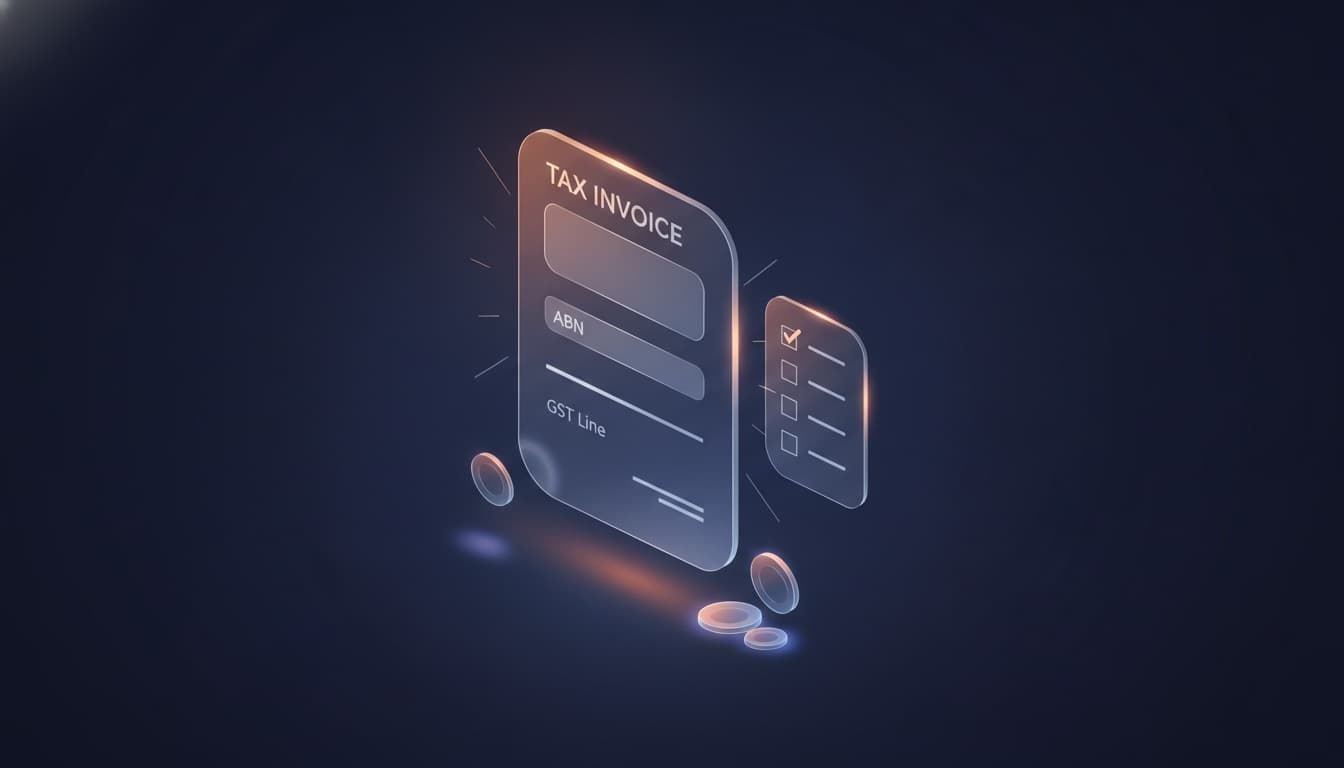
What a tax invoice must show: the short answer
A valid tax invoice for a sale under $1,000 must show seven things: that the document is meant to be a tax invoice, the seller's identity, the seller's ABN, the date it was issued, a description of what was sold (with quantity and price), the GST payable, and which sales are taxable. Once a sale reaches $1,000, it must also show the buyer's identity or ABN. Only a business registered for GST issues a "tax invoice"; an unregistered business issues a plain invoice.
This guide walks through each of those requirements, explains when you have to issue a tax invoice, and covers the side most invoice-template articles skip: what the tax invoices you receive need to show before you can claim a GST credit on them.
What a tax invoice is, and when you must issue one
A tax invoice is a specific document the Australian Taxation Office defines for GST purposes. It does two jobs at once: it records a sale, and it lets a GST-registered buyer claim back the GST built into the price. That second job is why the ATO sets rules for what it must contain, and why it is different from an ordinary invoice.
Whether you issue a tax invoice or a plain invoice depends on one thing: your GST registration. Per the ATO's guidance on setting up your business invoices, if you are registered for GST your invoices should be headed "tax invoice"; if you are not registered, your invoices must not use those words, because there is no GST for a buyer to claim. You are required to register for GST once your business turnover reaches the $75,000 threshold, and you register against your ABN.
If you are registered for GST and a customer asks you for a tax invoice, you must give them one within 28 days of the request. The one exception is a sale of $82.50 (including GST) or less, where you are not obliged to issue a tax invoice at all.
The seven details on a tax invoice under $1,000
For a taxable sale of less than $1,000, the ATO requires the document to carry enough information to clearly show these seven things.
| # | Requirement | What it looks like |
|---|---|---|
| 1 | It is a tax invoice | The words "Tax invoice", usually as the heading |
| 2 | The seller's identity | Your business or trading name |
| 3 | The seller's ABN | Your 11-digit Australian Business Number |
| 4 | The date issued | The date on the invoice |
| 5 | What was sold | A description of the goods or services, with quantity and price |
| 6 | The GST payable | The GST amount, or a line stating the total includes GST |
| 7 | The taxable sales | Which items on the invoice are taxable |
Most of these are self-explanatory, but two catch people out. The ABN is not optional decoration: leave it off and, under the no-ABN withholding rule, a business paying you more than $75 (excluding GST) has to withhold 47% and send it to the ATO. And requirement seven matters when an invoice mixes taxable and GST-free items: the invoice has to make clear which lines carry GST, so the buyer can work out the credit.
What changes once a sale reaches $1,000
For a taxable sale of $1,000 or more, the same seven requirements apply, plus one: the tax invoice must also show the buyer's identity or ABN. A tax invoice for $1,000 or more that names only the seller is not valid, and a GST-registered buyer cannot use it to claim the credit until the seller reissues it with the buyer's details.
The $1,000 line is measured on the GST-inclusive total of the sale, not per line item, so a $1,100 invoice crosses it even if no single item does. If you regularly sell to other businesses, the safe habit is to capture the buyer's name or ABN on every tax invoice, regardless of value, so a later reprint is not needed.
Showing the GST amount the right way
Requirement six gives you two ways to show GST, and both are valid. You can state the GST amount as a separate line, or, when the GST is exactly one-eleventh of the total price, you can state "Total price includes GST".
The one-eleventh figure trips people up. GST in Australia is 10%, but on a GST-inclusive total it works out to one-eleventh, not one-tenth. A tax invoice for $220 that includes GST carries $20 of GST ($220 ÷ 11 = $20). A $82.50 purchase includes $7.50 of GST ($82.50 ÷ 11 = $7.50). If your invoice mixes taxable and GST-free items, the GST is no longer one-eleventh of the total, so you cannot use the "total includes GST" shorthand; you have to show the actual GST amount.
The buyer's side: what you need to claim a GST credit
The requirements above are about the invoices you send. The invoices you receive decide whether you can claim GST credits on your own purchases, and this is the half that the invoice-template guides tend to skip.
The rule from the ATO's guidance on when you can claim a GST credit is a threshold, and it is the same $82.50 figure again. For a purchase that cost more than $82.50 (including GST), you must hold a valid tax invoice before you claim the credit on your BAS. For a purchase of $82.50 or less, you do not need a tax invoice, but you should keep some record of it, such as a cash-register docket or a receipt, in case the ATO asks. This is why receipts for small purchases still belong in your records even when no tax invoice was issued.
Three practical points follow from that threshold:
An invoice missing one detail is not automatically dead. Under the ATO ruling GSTR 2013/1, if a document that is meant to be a tax invoice is missing some information, you can still treat it as valid when the missing detail can be clearly worked out from other documents the supplier gave you. If it cannot, you can ask the supplier for a correct tax invoice, and they must provide one within 28 days.
There is a four-year limit. The ATO's time limit on GST credits ends four years after the due date of the BAS for the period in which you could first have claimed the credit. Miss that window and the credit is gone, a reason not to let a shoebox of supplier invoices sit unprocessed.
Sometimes the buyer issues the invoice. In specific arrangements the ATO allows the purchaser to raise the tax invoice instead of the seller: a recipient-created tax invoice, or RCTI. It needs a written agreement between both parties, and the ATO must have determined that the type of goods or services can be invoiced this way. An RCTI also has to show the buyer's identity or ABN even when the sale is under $1,000.
Common misconceptions
"Every invoice I send is a tax invoice." Only if you are registered for GST. A business under the $75,000 threshold and not voluntarily registered issues a plain invoice with no GST and no "tax invoice" heading, because there is no GST credit for the buyer to claim.
"A receipt and a tax invoice are the same thing." They overlap but are not identical. A receipt proves you paid; a tax invoice carries the seven details the ATO requires so a GST credit can be claimed. A supermarket docket for a $60 purchase can double as your evidence because it sits under the $82.50 line, but a $900 supplier bill has to meet the full tax-invoice requirements.
"If the invoice is wrong, the GST credit is lost." Not necessarily. If the only problem is a missing detail you can establish from another document, you can treat the invoice as valid; otherwise you have 28 days to get a corrected one from the supplier before you need the ATO's permission to claim.
How SparkReceipt helps with the invoices you receive
Meeting the requirements on invoices you send is a template job you set up once. Staying on top of the invoices you receive, so every one is valid and nothing lapses past the four-year limit, is the part that eats time. SparkReceipt reads a photographed or emailed supplier invoice and pulls out the fields that decide a GST claim: the supplier, their ABN, the date, the GST amount, and the total. It files each one as a categorised, GST-aware expense, so when you prepare a BAS the tax invoices are already in order and searchable rather than stacked in a drawer, and the supplier detail stays attached to each record the way the ATO's record-keeping rules expect. It reads receipts and invoices in any currency, which helps when some suppliers are overseas and issue no Australian tax invoice at all. See pricing for plan details, including the free accountant seat.
Frequently asked questions
Do I have to issue a tax invoice if I am not registered for GST? No. If you are not registered for GST you must not issue a "tax invoice", because there is no GST for the buyer to claim. You issue a plain invoice showing your details, a description, and the amount, with no GST line.
What is the difference between a tax invoice and a regular invoice? A regular invoice is a request for payment. A tax invoice is a request for payment that also meets the ATO's requirements, including the seller's ABN and the GST amount, so a GST-registered buyer can claim the GST as a credit. Only a GST-registered seller issues tax invoices.
Do I need a tax invoice for small purchases? Not for a purchase of $82.50 (including GST) or less. You can claim the GST credit on it without a tax invoice, but keep a receipt or docket as evidence. Above $82.50, you need a valid tax invoice before you claim.
What must a tax invoice show for a sale of $1,000 or more? The same seven details required under $1,000, plus the buyer's identity or ABN. Without the buyer's details, a tax invoice for $1,000 or more is not valid for claiming a GST credit.
How is the GST worked out on a tax invoice? GST is 10%, but on a GST-inclusive total it is one-eleventh of the price. On a $220 tax invoice the GST is $20. The invoice can either state that amount or, when GST is exactly one-eleventh of the total, say "Total price includes GST".
What if a supplier's tax invoice is missing information? If the missing detail can be clearly worked out from another document the supplier gave you, you can treat the invoice as valid. If not, ask the supplier for a corrected tax invoice; they must provide one within 28 days of your request.
Key takeaways
- A valid tax invoice under $1,000 must show seven things: that it is a tax invoice, the seller's identity, the seller's ABN, the date, a description of what was sold, the GST payable, and which sales are taxable.
- At $1,000 or more, it must also carry the buyer's identity or ABN, measured on the GST-inclusive total of the sale.
- Only a business registered for GST issues a "tax invoice"; below the $75,000 registration threshold and unregistered, you issue a plain invoice with no GST.
- To claim a GST credit you need a valid tax invoice for any purchase over $82.50 including GST; at or below that, a receipt is enough.
- GST credits expire four years after the BAS due date for the period you could first have claimed them, so process supplier invoices promptly rather than letting them pile up.