Your bank statements are the most honest document in your business. They don’t care about projections, estimates, or intentions — they show exactly what happened: what came in, what went out, and when.
For freelancers and small business owners, regular bank statement analysis is the closest thing to a cash flow early warning system.
Why Bank Statements Matter for Cash Flow
Receipts and invoices tell you about individual transactions. Bank statements tell you about patterns:
- Is your account balance trending up, down, or flat month over month?
- Which weeks of the month are cash-heavy vs. cash-light?
- Are there recurring charges you don’t recognize?
- How long does it typically take for client payments to arrive?
- What’s your real monthly burn rate — not what you think it is, but what the bank says it is?
These patterns are invisible if you only check your balance. They become obvious when you analyze the full statement.
The Monthly Bank Statement Review
Set aside 20 minutes each month to review your statements. Here’s what to look for:
1. Net Cash Flow
Total deposits minus total withdrawals for the month. This single number tells you whether your business generated or consumed cash. Track it month over month — a downward trend is an early warning sign even if individual months look fine.
2. Deposit Patterns
When do payments actually arrive? If most deposits land in the last week of the month but most expenses hit in the first week, you have a timing mismatch that creates artificial cash crunches. Knowing this lets you plan accordingly.
3. Recurring Charges
Go through every recurring debit. Do you recognize each one? Are any higher than expected? Common discoveries:
- Software subscriptions you forgot about
- Plans that auto-upgraded
- Free trials that converted to paid
- Services you stopped using but never cancelled
4. Unusual Transactions
Any charges significantly larger or smaller than normal? Duplicate charges? Charges from vendors you don’t recognize? These could be errors, fraud, or forgotten purchases — all worth investigating.
5. Average Daily Balance
Look at your lowest balance point during the month. This is your cash flow floor — the tightest your cash position got. If this number is below one month of expenses, you’re operating with insufficient buffer.
From Bank Statements to Cash Flow Insights
Calculate Your True Burn Rate
Add up all outflows for the last 3 months and divide by 3. This is your real monthly cost of doing business — including things you might have missed in manual expense tracking. Compare this to what you thought you were spending. Most freelancers find the actual number is 10-20% higher than their estimate.
Identify Your Cash Flow Cycle
Plot your balance at the start and end of each week for 2-3 months. You’ll see a pattern: maybe cash peaks mid-month after retainer payments and dips at month-end when subscriptions and rent hit. Understanding your cycle lets you time large purchases and payment reminders strategically.
Catch Missing Receipts
Cross-reference bank statement charges against your tracked expenses. Any charge on the statement without a matching receipt is a gap in your expense tracking — and potentially a missed tax deduction.
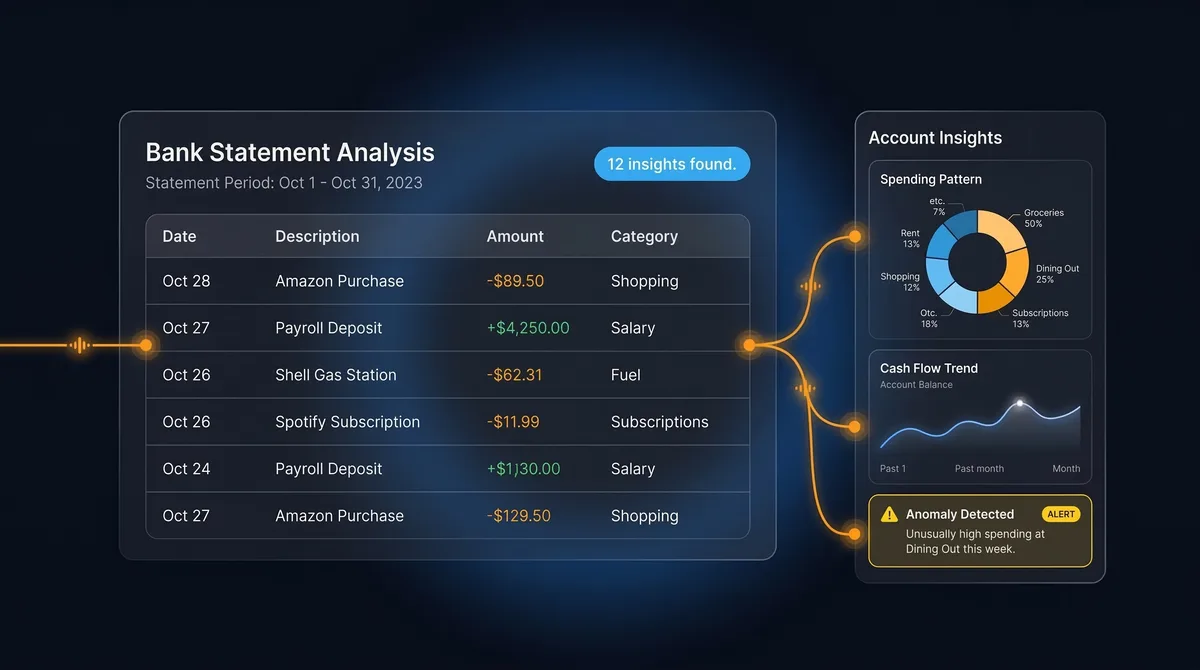
This is where SparkReceipt’s bank statement extractor saves significant time. Upload your statements and AI automatically extracts every transaction, matches it against existing receipts, and flags anything unmatched. What would take an hour manually takes minutes.
Red Flags in Your Bank Statements
Watch for these warning signs:
- Declining average balance — Month-over-month drops mean you’re spending more than you’re earning or collecting slower
- Increasing number of small charges — Subscription creep is eating your cash flow
- Overdraft or low balance alerts — If these happen more than once, it’s a systemic cash flow issue
- Deposits becoming less frequent — Client concentration risk or pipeline problems
- Growing gap between invoice dates and deposit dates — Clients are paying slower
Automating Your Bank Statement Analysis
Manual review works, but automation catches more and takes less time:
- Upload statements monthly to SparkReceipt — AI extracts and categorizes every transaction
- Review the categorized data — Sorted expenses reveal patterns faster than raw statement review
- Check for gaps — Any bank charges without matching receipts? Track them down.
- Share with your accountant — Clean, categorized bank data helps your accountant advise on cash flow strategy and catch tax deductions
Building the Habit
The best time to review your bank statement is the 1st of the month, right after the previous month closes. Combine it with your monthly cash flow forecast — the bank statement review gives you actual data to compare against your predictions.
Over time, you’ll develop an intuitive sense for your cash flow rhythm. You’ll know which months are tight, which clients pay reliably, and exactly how much buffer you need. That intuition starts with consistently looking at the data.
Key Takeaways
- Bank statements reveal cash flow patterns that individual receipts can’t
- Review monthly: net cash flow, deposit patterns, recurring charges, unusual transactions
- Calculate your true burn rate — it’s probably 10-20% higher than you think
- Watch for red flags: declining balances, subscription creep, slower deposits
- Automate with bank statement extraction to catch gaps and save time
- Cross-reference against tracked expenses to ensure no deductions are missed
Related reading: Cash Flow Management for Freelancers and Small Business: The Complete Guide