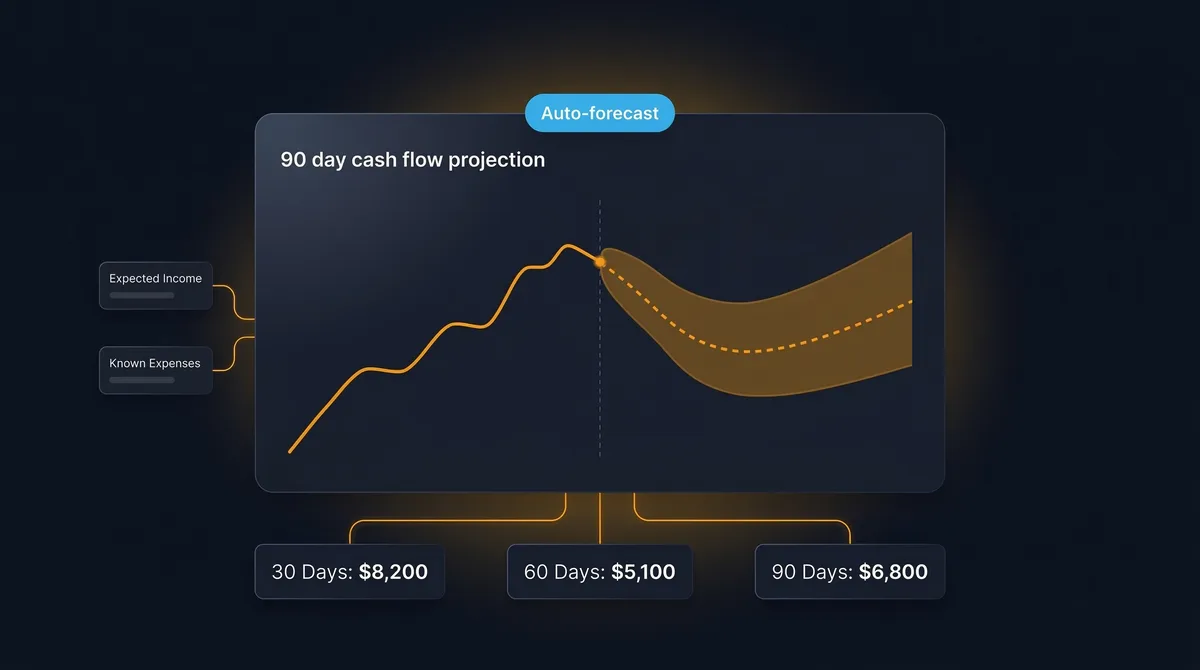
Cash flow forecasting sounds like something that requires an accounting degree and a complex spreadsheet. It doesn’t. At its simplest, it answers one question: Will I have enough cash to cover my expenses for the next 30, 60, and 90 days?
If you can answer that question with reasonable confidence, you can avoid 90% of cash flow crises.
Why Self-Employed Professionals Need Cash Flow Forecasting
When you have a salary, cash flow is predictable: X amount arrives on the 1st and 15th. When you’re self-employed, nothing is guaranteed. Income varies month to month. Clients pay on their own schedule. Expenses cluster unpredictably.
A simple forecast gives you:
- Early warning — See cash gaps 30-60 days before they hit
- Decision confidence — Know whether you can afford that new tool, hire, or investment
- Tax readiness — Plan for quarterly estimated payments without scrambling
- Stress reduction — Replace anxiety with data. When you can see the future, you can prepare for it.
The 5-Line Cash Flow Forecast
Forget 50-row spreadsheets. Here’s all you need:
Line 1: Current Cash Position
Your bank balance today. Check it right now. This is your starting point.
Line 2: Expected Income (Next 30/60/90 Days)
List only confirmed income — signed contracts, sent invoices, and retainer agreements. Don’t include “maybes” or proposals that haven’t been accepted. Be conservative.
For each expected payment, note:
- Client name
- Amount
- Expected payment date (based on invoice terms, not wishful thinking)
Line 3: Fixed Expenses
Monthly costs that don’t change regardless of revenue:
- Rent / mortgage (if home office, business portion)
- Insurance
- Software subscriptions
- Loan payments
- Recurring services (bookkeeping, hosting, etc.)
If you track expenses with SparkReceipt, you already have this data categorized. Pull your average from the last 3 months.
Line 4: Variable Expenses
Costs that fluctuate based on activity:
- Supplies and materials
- Travel
- Subcontractor payments
- Marketing and advertising
- One-time purchases you know are coming
Use your average from the last 3 months as a baseline. Adjust up or down based on what you know is coming.
Line 5: Tax Reserve
If you haven’t already set aside taxes from received payments, add your quarterly estimated tax payment to the forecast. For most self-employed professionals, this is 25-30% of net profit.
The Formula
Cash Position + Expected Income − Fixed Expenses − Variable Expenses − Tax Reserve = Projected Cash at End of Period
Calculate this for 30, 60, and 90 days. If the number goes negative at any point, you have a cash flow gap to address — and you’ve found it early enough to do something about it.
What to Do With Your Forecast
If the Forecast Is Positive
- Maintain or build your cash reserve
- Consider investing in growth (new tools, marketing, training)
- Pay down any outstanding debt
If the Forecast Shows a Gap
- Speed up inflows — Follow up on outstanding invoices, offer early payment discounts, send invoices for any completed work
- Delay outflows — Postpone non-essential purchases, negotiate extended terms with vendors
- Generate quick revenue — Reach out to past clients, offer a limited-time package, pick up short-term project work
- Tap reserves — This is what your cash reserve is for. Use it, then rebuild.
The Monthly Forecast Habit
Update your forecast on the 1st of every month. It takes 15-20 minutes:
- Check bank balance — Your new starting point
- Update expected income — Add new contracts, remove received payments, adjust dates for late payers
- Review expenses — Check last month’s actual expenses against your forecast. Were they higher or lower? Adjust accordingly.
- Check tax obligations — Is a quarterly payment coming up?
- Calculate and assess — Run the formula. Flag any months that look tight.
Making Your Forecast More Accurate
The quality of your forecast depends entirely on the quality of your expense data. If you’re guessing at expenses, your forecast is a guess too.
This is where automated expense tracking pays off. When SparkReceipt captures every receipt via camera, email, and bank statement upload, you have real expense data to forecast from — not estimates.
After 3 months of complete expense tracking, your forecasts become remarkably accurate because you’re working with real patterns instead of assumptions.
Common Forecasting Mistakes
- Counting chickens — Don’t include income from proposals that haven’t been accepted or clients who haven’t signed
- Ignoring seasonality — If December is always slow, your December forecast should reflect that
- Forgetting annual expenses — Insurance renewals, annual subscriptions, and quarterly taxes can blindside you
- Not updating — A forecast from 3 months ago is useless. Update monthly.
- Over-complicating — Five lines is enough. Don’t build a spreadsheet you won’t maintain.
Key Takeaways
- Cash flow forecasting answers one question: Do I have enough cash for the next 30/60/90 days?
- Use the 5-line framework: cash position, expected income, fixed expenses, variable expenses, tax reserve
- Update monthly on the 1st — it takes 15-20 minutes
- If you see a gap, act early: speed up inflows, delay outflows, tap reserves
- Accurate forecasts require accurate expense data — automate tracking to get this right
Related reading: Cash Flow Management for Freelancers and Small Business: The Complete Guide