Cash flow is the single biggest reason small businesses fail. Not bad products. Not lack of demand. 82% of business failures cite cash flow problems as the primary cause.
Yet most freelancers and small business owners don’t actively manage cash flow — they react to it. Money comes in, money goes out, and the balance gets checked when something feels wrong.
This guide changes that. Whether you’re a freelancer managing irregular income or a small business owner juggling payroll and vendor payments, you’ll learn how to understand, track, and improve your cash flow — starting with the fundamentals.
What Is Cash Flow?
Cash flow is the movement of money in and out of your business over a specific period. It’s not how much you’ve earned (that’s revenue) or how much you’ve profited (that’s net income). Cash flow is about timing — when money actually arrives in your account versus when it leaves.
There are three types of cash flow:
- Operating cash flow — Money from your core business activities. Client payments coming in, rent and supplies going out.
- Investing cash flow — Money spent on or received from assets. Buying equipment, selling a vehicle.
- Financing cash flow — Money from loans, credit lines, or owner investments.
For most freelancers and sole proprietors, operating cash flow is what matters most. It answers the question: Is my actual work generating enough cash to cover my actual expenses?
Cash Flow vs. Profit: Why They’re Not the Same
This is where most people get confused. You can be profitable on paper and still run out of cash.
Here’s a simple example: You complete a $10,000 project in January. Your expenses for January are $4,000. On paper, you made $6,000 in profit. But if your client doesn’t pay until March, you still need $4,000 in cash to cover January’s expenses — and another $4,000 for February.
Profit is an accounting concept. Cash flow is a survival concept. You can’t pay rent with an unpaid invoice.
Related reading: Cash Flow vs. Profit: What Freelancers Need to Know
Why Cash Flow Problems Hit Freelancers Harder
Freelancers and self-employed professionals face a unique set of cash flow challenges that traditional small businesses don’t:
- Irregular income — No fixed paycheck. One month you earn $12,000, the next $3,000.
- Late payments — 25% of freelancers wait over a year to get paid. The average outstanding invoice per small business is $17,500.
- Quarterly tax obligations — You need cash reserves for estimated tax payments four times a year.
- No accounts payable department — You’re the one chasing invoices, paying bills, and tracking expenses.
- Mixed personal and business expenses — Especially common for home-office freelancers, making it harder to see the real business cash flow picture.
These aren’t excuses — they’re structural realities that require a different approach to cash flow management than what most business advice offers.
The Cash Flow Management Framework
Effective cash flow management comes down to four activities:
1. Know What You Spend
You cannot manage cash flow if you don’t know where your money goes. This sounds obvious, but most freelancers dramatically underestimate their expenses because they don’t track them systematically.
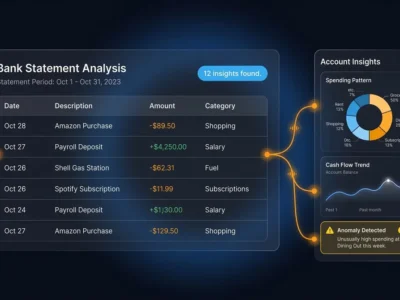
The fix: Track every business expense automatically. Use an AI receipt scanner to capture purchases as they happen. Connect your email inbox to catch digital receipts. Upload bank statements to fill in the gaps. When your expense data is complete, your cash flow picture becomes clear.
2. Know What You’re Owed
Outstanding invoices are the most common source of cash flow gaps. Track every invoice, know when each is due, and follow up immediately when payments are late.
Tips that actually work:
- Send invoices immediately upon delivery — not at month-end
- Offer a small discount (2-3%) for early payment
- Require deposits or milestone payments for large projects
- Set clear payment terms (Net 15 is better than Net 30 for cash flow)
3. Time Your Outflows
Not every expense needs to be paid immediately. Where possible:
- Negotiate longer payment terms with vendors
- Use credit cards strategically (pay in full monthly) to delay outflows by 30 days
- Schedule recurring payments to align with your income cycle
- Build a cash reserve equal to 3 months of operating expenses
4. Forecast and Plan
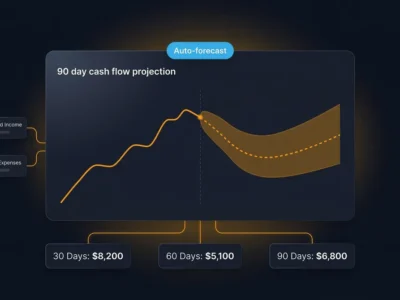
Cash flow forecasting doesn’t have to be complicated. At its simplest, it’s answering: Based on what I know today, will I have enough cash to cover the next 30, 60, and 90 days?
Start with:
- Your current bank balance
- Expected income (confirmed projects and invoices)
- Known expenses (rent, subscriptions, loan payments)
- Variable expenses (based on your average from the last 3 months)
- Tax obligations (quarterly estimated payments)
Related reading: Cash Flow Forecasting for Self-Employed: No Spreadsheet Needed
How Expense Tracking Powers Cash Flow Management
Here’s the insight most cash flow advice misses: you can’t manage the outflow side of cash flow without accurate, categorized expense data.
When your expenses are organized, you can:
- Spot patterns — See which months have higher spending and plan accordingly
- Find waste — Identify subscriptions, tools, or services you’re paying for but not using
- Forecast accurately — Use real historical data instead of guessing
- Prepare for taxes — Know exactly what you’ll owe before the quarterly deadline hits
- Share with your accountant — Give them clean data so they can advise on cash flow strategy
This is where SparkReceipt fits in. It’s not a cash flow forecasting tool — it’s the foundation that makes forecasting possible. When every receipt is scanned, every expense is categorized, and every bank statement is reconciled, you have the complete picture you need to manage cash flow with confidence.
Common Cash Flow Mistakes (and How to Avoid Them)
Mistake 1: Confusing Revenue With Cash
A signed contract is not cash in your account. Don’t commit to expenses based on expected revenue — only on received payments.
Mistake 2: Ignoring Small Recurring Expenses
That $29/month SaaS tool. The $15 cloud storage. The $49 co-working day pass. Individually small, but collectively they can add up to hundreds per month. Track them all.
Mistake 3: No Cash Reserve
Without a buffer, one late payment can cascade into missed bills, late fees, and stress. Build toward 3 months of operating expenses as a cash reserve.
Mistake 4: Waiting Until Tax Season to Review Expenses
If you only look at your expenses once a year, you’re managing cash flow blind for 11 months. Review monthly at minimum.
Related reading: Cash Flow Problems: Why Small Businesses Fail (and How to Fix It)
Cash Flow by Business Type
Cash flow patterns vary dramatically depending on what you do:
- Freelance writers and designers — Project-based income with gaps between projects. Key: maintain a pipeline and invoice immediately.
- Consultants — Often larger but less frequent payments. Key: retainer agreements and milestone billing.
- E-commerce sellers — Revenue is more consistent but inventory ties up cash. Key: manage inventory turns and supplier terms.
- Real estate agents — Highly irregular commission income. Key: large cash reserves and strict personal spending discipline.
- Gig workers — Frequent small payments but high vehicle and supply costs. Key: track every expense to maximize deductions.
Related reading: The Complete Guide to Expense Tracking for Freelancers
The Monthly Cash Flow Check-In
Set aside 30 minutes each month to review your cash flow. Here’s what to do:
- Review last month’s expenses — Were they higher or lower than expected? Any surprises?
- Check outstanding invoices — Who owes you money? Follow up on anything overdue.
- Look at your bank balance trend — Is it growing, shrinking, or flat compared to last month?
- Forecast the next 30 days — What’s coming in? What’s going out? Any big expenses ahead?
- Adjust if needed — Delay non-essential purchases, send overdue reminders, or line up new work if income is light.
This single habit catches cash flow problems before they become crises.
Tools That Help
You don’t need expensive accounting software to manage cash flow as a freelancer. Here’s a practical stack:
- SparkReceipt — AI receipt scanning, expense categorization, bank statement extraction, and accountant sharing. Captures the expense side of your cash flow automatically.
- Your bank’s app — For monitoring your actual cash position daily.
- A simple spreadsheet — For your monthly cash flow forecast (expected income minus expected expenses).
- Your invoicing tool — Whatever you use to bill clients. Make sure it tracks payment status.
The goal is visibility, not complexity. If you can see what’s coming in, what’s going out, and what’s sitting in unpaid invoices — you can manage your cash flow.
Key Takeaways
- Cash flow is about timing, not profitability. You can be profitable and still run out of cash.
- 88% of small businesses face regular cash flow disruptions — it’s the norm, not the exception.
- The foundation of cash flow management is knowing what you spend. Automate expense tracking to get this right.
- Build a 3-month cash reserve to absorb the inevitable gaps.
- Do a monthly cash flow check-in — 30 minutes that prevents surprises.
- Freelancers face unique challenges (irregular income, late payments, quarterly taxes) that require a tailored approach.
Related Articles
- Cash Flow vs. Profit: What Freelancers Need to Know
- How to Improve Cash Flow as a Freelancer
- Cash Flow Problems: Why Small Businesses Fail (and How to Fix It)
- How to Track Expenses for Better Cash Flow
- Late Payments and Cash Flow: A Freelancer’s Survival Guide
- Cash Flow Forecasting for Self-Employed: No Spreadsheet Needed
- Bank Statement Analysis: Your Cash Flow Early Warning System
- Managing Cash Flow When You Earn in Multiple Currencies