Every freelancer has been there: a great month on paper, but somehow the bank account tells a different story. That disconnect between profit and cash flow is one of the most dangerous traps in self-employment.
Understanding the difference isn’t just accounting theory — it’s the key to avoiding the cash crunches that derail freelance careers.
The Simple Difference
Profit = Revenue minus expenses over a period of time. It tells you whether your business is economically viable.
Cash flow = The actual movement of money in and out of your accounts. It tells you whether you can pay your bills right now.
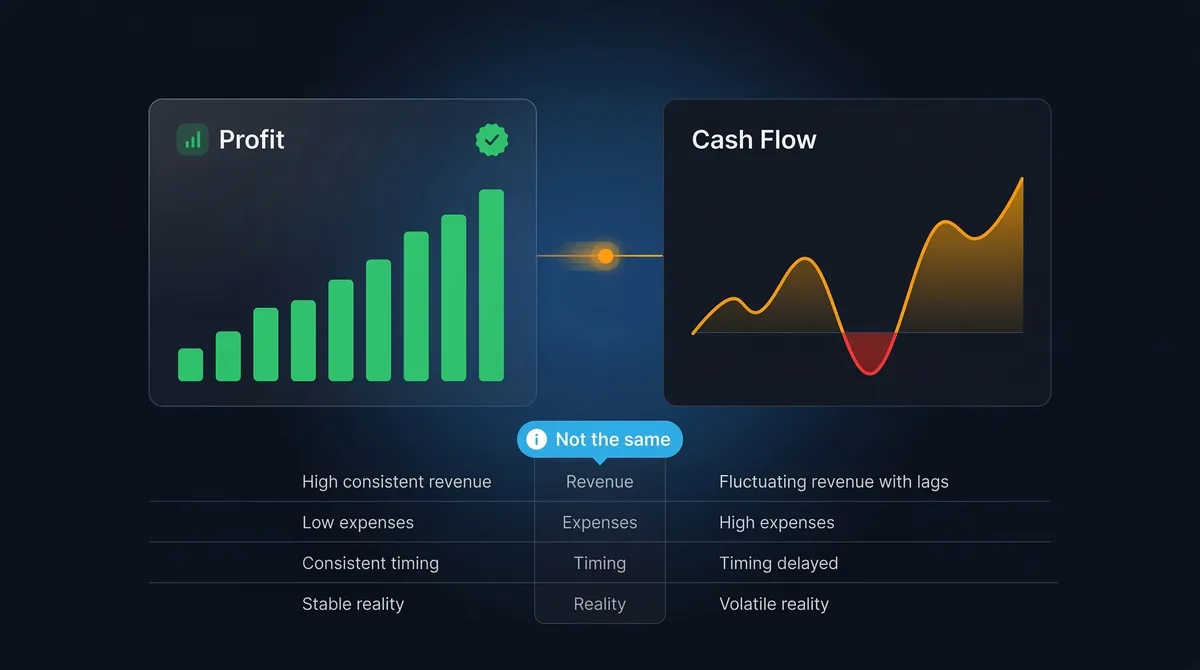
Here’s the critical distinction: profit is calculated using accrual accounting — revenue counts when it’s earned, expenses count when they’re incurred. Cash flow tracks when money actually moves. These two things rarely happen at the same time.
Why Profitable Freelancers Run Out of Cash
The most common scenarios:
1. The Payment Gap
You complete a $15,000 project in January and invoice with Net 30 terms. Your January expenses are $5,000. Profit: $10,000. Cash received in January: $0. You need $5,000 in cash to survive until the payment arrives.
2. The Tax Trap
You earned $120,000 this year with $70,000 in expenses. Profit: $50,000. But you owe roughly $15,000 in self-employment tax plus income tax. If you didn’t set aside cash for quarterly estimates, a “profitable” year ends with a tax bill you can’t pay.
3. The Growth Paradox
Business is booming — you need to invest in new equipment, hire a subcontractor, or pay for a bigger workspace. All profitable decisions long-term, but each one drains cash in the short term.
4. The Seasonal Swing
Annual profit looks great, but Q1 is always slow while Q4 is packed. Without cash reserves built during busy months, you’re scrambling every January through March.
How to Track Both
Most freelancers track neither systematically. Here’s a practical approach:
For Profit
- Track all revenue (invoiced, not just received)
- Track all expenses with an AI receipt scanner — every purchase, subscription, and business cost
- Review your profit monthly: total invoiced minus total expenses
For Cash Flow
- Track your bank balance weekly
- Monitor outstanding invoices — know exactly who owes you and when
- List upcoming expenses for the next 30, 60, and 90 days
- Set aside 25-30% of every payment received for taxes
The Freelancer’s Cash Flow Formula
Here’s a simple formula to check your cash position:
Current bank balance + Expected payments this month − Known expenses this month − Tax reserve = Available cash
If that number is negative or uncomfortably close to zero, you have a cash flow problem — regardless of what your profit says.
When Profit and Cash Flow Diverge: Red Flags
- Accounts receivable growing faster than revenue — You’re earning more but collecting slower
- Consistent end-of-month scrambles — Profitable months still feel tight
- Using credit cards to bridge gaps — A sign that cash timing is off
- Dipping into tax reserves — The most dangerous red flag of all
Practical Steps to Align Cash Flow With Profit
- Invoice immediately — Don’t wait until month-end. Send invoices the day work is delivered.
- Shorten payment terms — Net 15 instead of Net 30. Or offer 2% early payment discounts.
- Require deposits — 25-50% upfront on projects over $2,000.
- Build a cash reserve — 3 months of operating expenses. This is non-negotiable.
- Track expenses in real-time — Use SparkReceipt to capture every expense as it happens, not at quarter-end.
- Separate tax money immediately — When a payment hits, move 25-30% to a separate tax account.
The Bottom Line
Profit tells you if your business model works. Cash flow tells you if your business survives. As a freelancer, you need to watch both — but if you can only focus on one, focus on cash flow. A profitable business that runs out of cash is still a failed business.
The foundation for both is the same: know exactly what you spend. When every expense is tracked and categorized, you can see both your profitability and your cash position clearly.
Related reading: Cash Flow Management for Freelancers and Small Business: The Complete Guide