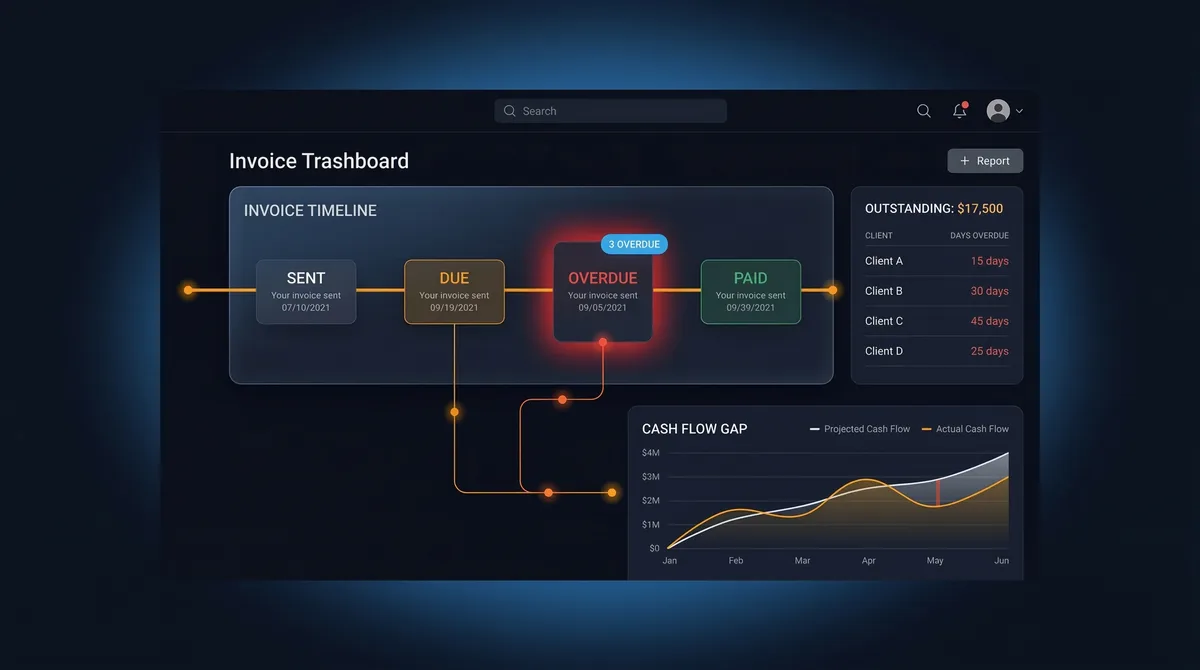
Late payments are the single biggest threat to freelance cash flow. The average small business has $17,500 in outstanding unpaid invoices at any given time. One in four freelancers reports waiting over a year for payment.
You can’t always control when clients pay. But you can build systems that protect your cash flow when they don’t.
The Real Cost of Late Payments
A late payment isn’t just an inconvenience — it’s a cascading financial event:
- Immediate cash gap — Bills are due whether your client pays or not
- Opportunity cost — Money tied up in unpaid invoices can’t be invested in growth
- Credit card interest — If you bridge the gap with debt, you’re paying for your client’s tardiness
- Stress and distraction — Time spent chasing payments is time not spent on billable work
- Tax timing issues — You may owe estimated taxes on income you haven’t yet received
A single $5,000 invoice paid 60 days late can trigger a chain reaction that affects your cash flow for months.
Before the Invoice: Prevention
Set Clear Payment Terms Upfront
Payment terms should be agreed before work begins — not discovered on the first invoice. Include in your contract or proposal:
- Payment due date (Net 15 is better than Net 30 for cash flow)
- Accepted payment methods
- Late payment fees (1.5% monthly is standard)
- Deposit requirements
Require Deposits
For projects over $2,000, require 25-50% upfront. This accomplishes three things: it provides immediate cash flow, it demonstrates client commitment, and it reduces your exposure if the client disappears.
Use Milestone Billing
Never wait until project completion to invoice. Break work into phases — discovery, draft, revision, final delivery — and bill at each milestone. A $10,000 project should generate 3-4 invoices, not 1.
Vet New Clients
Ask for references from other freelancers. Check how established the business is. Trust your instincts — if a client pushes back on standard payment terms before work begins, that’s a red flag.
During the Invoice: Best Practices
Invoice Immediately
Send the invoice the day you deliver. Every day you delay is a day added to your payment timeline. If you deliver on the 1st and invoice on the 15th with Net 30 terms, you won’t see cash until day 45 at the earliest.
Make Payment Easy
Accept multiple payment methods — bank transfer, credit card, PayPal, or whatever your clients prefer. The fewer obstacles between your invoice and their payment, the faster you get paid.
Be Crystal Clear
Include on every invoice: exact amount due, due date, payment methods, project reference, and your contact info. Ambiguity causes delays — “I need to check with accounting” is often code for “your invoice is missing information.”
After the Due Date: Collection
The Follow-Up Schedule
- Day 1 overdue — Friendly reminder email. “Just a quick note that invoice #123 was due yesterday. Let me know if you need anything to process it.”
- Day 7 — Second reminder with the invoice attached again. “Following up on the below — is there anything holding up payment?”
- Day 14 — Phone call or direct message. Email is easy to ignore; a conversation is harder.
- Day 30 — Formal notice. Reference your late payment terms. Mention that late fees will begin accruing.
- Day 60+ — Consider pausing any ongoing work. Send a final demand letter with a deadline.
Keep Records
Document every communication about payment. Save emails, note phone call dates and what was discussed. If a dispute ever escalates, you’ll need this paper trail.
Building Cash Flow Resilience
Even with perfect invoicing practices, some clients will pay late. Build resilience into your business:
The Cash Reserve
Maintain 3 months of operating expenses in a separate account. This is your buffer against late payments. Build it by setting aside 10-15% of every payment received.
Diversify Your Client Base
If one client represents more than 30% of your revenue, a single late payment from them can crater your cash flow. Aim for no single client exceeding 25% of total income.
Track Everything
Use SparkReceipt to track every expense automatically — when you know exactly what your monthly costs are, you know exactly how much cash reserve you need and how long you can survive a payment delay. Upload bank statements monthly to keep the picture complete.
Mix Income Types
Combine project work (lumpy, unpredictable) with retainer agreements (steady, predictable). Even one retainer client providing $2,000/month gives you a reliable baseline that covers core expenses regardless of what other clients do.
When to Fire a Client
Some clients are chronically late payers. The math is simple: if the cost of chasing payments (your time, stress, and cash flow disruption) exceeds the profit from the work, it’s time to move on.
Signs it’s time to let go:
- Consistently pays 30+ days late despite reminders
- Requires multiple follow-ups for every invoice
- Disputes charges after work is delivered
- Their late payments have caused you to miss your own obligations
Key Takeaways
- $17,500 is the average outstanding invoices per small business — late payments are the norm
- Prevention beats collection: deposits, milestone billing, and clear terms
- Follow up systematically — Day 1, 7, 14, 30, 60
- Build a 3-month cash reserve as your buffer against late payers
- Diversify clients so no single late payment can break you
- Track expenses to know your exact monthly cash needs
Related reading: Cash Flow Management for Freelancers and Small Business: The Complete Guide