
Business Receipts UK: What You Need to Keep and How to Organise Them
 Written by Sampsa Vainio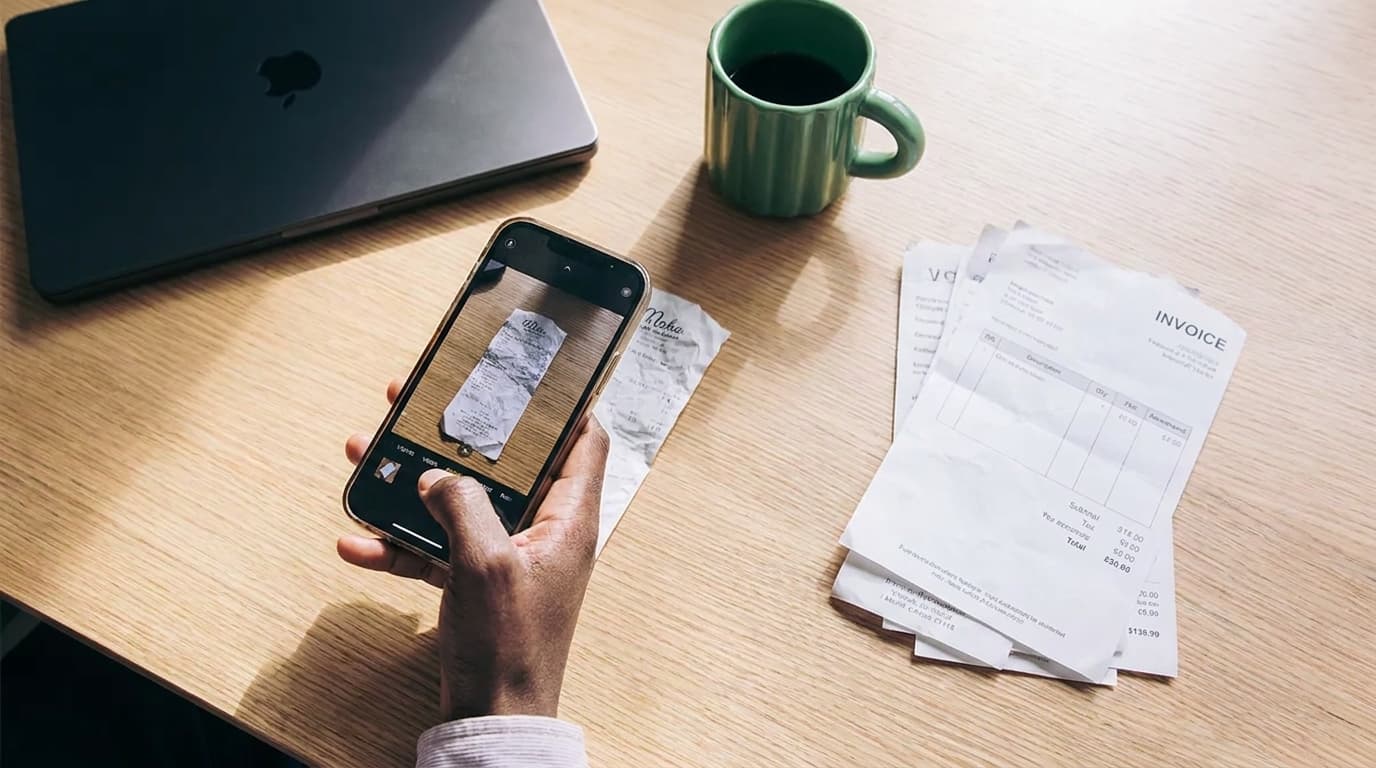
HMRC requires self-employed people to keep records of all business expenses, and business receipts are the primary proof. But knowing you need to keep them and knowing what makes a receipt valid, how long to keep it, and how to organise it are four different things. This guide covers all four.
Key Takeaways
- HMRC accepts receipts, bank statements, invoices, and till rolls as valid proof of business expenses
- A valid receipt must show: date, supplier name, description of what was bought, and amount paid — and the supplier's VAT number if they are VAT-registered
- Self-employed sole traders must keep records for 5 years after the 31 January Self Assessment deadline — not 6 (that applies to limited companies and VAT-registered businesses)
- HMRC accepts digital copies — photographs, scans, and PDFs are fine; paper originals are not required for most everyday receipts
- From April 2026, self-employed people with income above £50,000 must keep digital records under Making Tax Digital for Income Tax
What Information Must a Business Receipt Contain?
This is the question most guides skip. Knowing you must keep a receipt is not the same as knowing what that receipt must actually show.
For a receipt to satisfy HMRC's requirements, it should include:
- Date of the purchase
- Supplier's name and address
- Description of the goods or services purchased
- Amount paid
If the supplier is VAT-registered, you also need:
- Supplier's VAT registration number
- The amount of VAT charged, shown separately
The reason this matters is HMRC's "wholly and exclusively" test. To deduct a business expense on your Self Assessment, you must show the expense was wholly and exclusively for the purposes of your trade.
A bank statement shows you paid £120 to an office supplies retailer. A receipt shows you bought an ergonomic keyboard for your home office. Only the receipt establishes the business purpose. See our full guide to when bank statements are and aren't enough.
A note on VAT receipts under £250: For VAT purchases below £250, a simplified VAT receipt showing the supplier's VAT number and the total price including VAT is acceptable. You do not need a full VAT invoice for small purchases. Above £250, a full VAT invoice showing the VAT amount separately is required to reclaim input tax.
Which Business Receipts Do You Need to Keep?
Keep a receipt for every business expense you plan to claim as a deduction on your Self Assessment. HMRC's own guidance lists the following as valid proof of business expenses:
"Types of proof include: all receipts for goods and stock, bank statements, chequebook stubs, sales invoices, till rolls and bank slips."
The receipts you need will depend on the expenses you claim, but commonly include: office supplies, equipment purchases, professional fees, software subscriptions, travel costs, marketing expenses, and premises costs such as utilities and broadband.
Where bank statements may be sufficient (and a separate receipt is less critical):
- Bank charges and fees — the statement is its own record
- Monthly direct debits to clearly identifiable business suppliers (your accounting software, your cloud storage provider, a named business utility)
- HMRC payments (VAT, National Insurance, tax payments)
For anything else — physical goods from any retailer, meals, client entertainment, vehicle fuel, or any payment where the payee name doesn't make the business purpose obvious — a receipt is what you need. The burden of proof sits with you, not HMRC.
For the complete list of expenses you can claim, see our guide to allowable expenses as a sole trader.
How Long Do You Need to Keep Business Receipts?
If you are self-employed and file a Self Assessment tax return, you must keep your business records for five years after the 31 January Self Assessment deadline for the relevant tax year.
Example: For the 2025/26 tax year (which ends 5 April 2026), your Self Assessment filing deadline is 31 January 2027. You must keep all receipts and records for that tax year until at least 31 January 2032.
Two situations where a longer period applies:
- VAT-registered businesses: six years from the date of the VAT return
- Limited companies: six years from the end of the accounting period
A number of popular guides quote six years as the standard retention period for self-employed people. This is incorrect — six years is the rule for VAT and limited company records. Sole traders filing a standard Self Assessment are the five-year group.
HMRC can issue penalties of up to £3,000 for inadequate records if they conduct a formal enquiry and your documentation is insufficient. See our guide to HMRC's record-keeping requirements for the complete picture.
Paper vs Digital: What HMRC Accepts
HMRC fully accepts digital records. A clear photograph of a paper receipt taken on your phone, a PDF downloaded from an email, or a screenshot of an online order confirmation all count as valid records — provided the image is legible, complete, and backed up.
You do not need to keep the paper original of an everyday business receipt if you have a good digital copy.
Two exceptions where paper originals must be retained:
- Dividend vouchers and interest certificates (required in original form under company law)
- Certain legal documents specific to your business arrangements
For everything else — till receipts, purchase invoices, supplier receipts, email confirmations — digital copies are sufficient. Back them up in at least two places (cloud storage plus a local copy).
Making Tax Digital for Income Tax
The shift to digital record-keeping is becoming mandatory under Making Tax Digital for Income Tax (MTD ITSA):
- April 2026: Self-employed people with income above £50,000 must keep digital records and submit quarterly updates to HMRC using MTD-compatible software
- April 2027: Threshold drops to £30,000
- April 2028: Threshold drops to £20,000
If you are approaching any of these thresholds, setting up a digital receipt system now avoids a forced switch later. The habit of photographing receipts when you receive them is the foundation of an MTD-compliant system.
Three Ways to Organise Your Business Receipts
There is no single right method — the right approach depends on your transaction volume and how much time you want to spend on bookkeeping each month.
Approach 1: The Physical Folder
Paper receipts go into a folder or labelled envelope, organised by month. At Self Assessment time you sort, total, and enter them. Free and simple. Falls apart when thermal receipts fade, receipts go through the wash, or six months of paper accumulates before you look at it.
Best for: fewer than 15 business expenses per month; someone who prefers paper and files it promptly.
Approach 2: Spreadsheet and Email Folder
Forward digital receipts to a dedicated email folder. Photograph paper receipts and save the file with a consistent naming convention (2026-06-14-SUPPLIER-AMOUNT.pdf). Log every transaction in a spreadsheet by date and category. Costs nothing. Takes 30–60 minutes per month if you stay on top of it; much longer if you let it slip.
Best for: comfortable with spreadsheets, willing to spend time on the system, and can maintain the discipline consistently.
Approach 3: Receipt Capture App
Photograph a receipt the moment you receive it. The app extracts vendor, date, amount, and category automatically from the image and stores everything in a searchable record. Email receipts can be forwarded directly.
No manual entry. No lost thermal receipts. Records are searchable and HMRC-ready if you are ever asked. SparkReceipt's AI receipt scanner does this in under 10 seconds per receipt. 7-day free trial.
Best for: anyone who wants their records to be accurate and accessible without spending time on them each month.
What to Do If You Have Lost a Receipt
If a receipt is missing, work through these steps before accepting the loss:
-
Ask the supplier for a duplicate. Most retailers can reprint; most SaaS providers can re-send an email receipt. Any supplier who invoiced you can usually reissue the invoice.
-
Check your email. Search by vendor name or transaction amount. Check your Spam folder.
-
Check your expense app or accounting software. If you captured the receipt when it arrived, it is already there.
-
Use the bank statement plus a contemporaneous written note. For lower-value expenses where your overall records are otherwise tidy, HMRC generally accepts this combination. The note should record: date, amount, payee, what was purchased, and the business purpose.
-
For recurring costs, the original subscription confirmation or contract can establish business purpose even when individual invoices are missing.
Frequently Asked Questions
Can HMRC ask to see my business receipts?
Yes. During a formal enquiry, HMRC can request any business records, including receipts, bank statements, invoices, and purchase records. You must be able to produce records for the current tax year and the previous four years. Penalties for inadequate records can reach £3,000.
Do I need to keep original paper receipts?
Not for most expenses. HMRC accepts digital copies — photographs, scans, PDFs, and email receipts — for everyday business transactions, provided the image is legible and complete. Paper originals are required only for certain documents such as dividend vouchers.
What happens if I don't keep receipts?
HMRC can disallow any business expense you cannot substantiate with adequate records. In a formal enquiry, undocumented expenses can be added back to your taxable income and taxed accordingly, along with any interest or penalties. For serious or persistent failures to maintain records, HMRC can issue penalties of up to £3,000.
Does Making Tax Digital affect how I keep receipts?
From April 2026, self-employed people with qualifying income above £50,000 must keep records digitally using MTD-compatible software and submit quarterly updates to HMRC. The income threshold drops to £30,000 in April 2027 and £20,000 in April 2028. If you are approaching these thresholds, moving to a digital receipt system now means you will not need to change your workflow when the requirement kicks in.
Organise Your Receipts Before They Become a Problem
A business receipt that tells HMRC what was bought and why it was for the business, kept for five years in a format you can actually find — that is what HMRC's record-keeping rules reduce to.
The system you build around that is less important than the habit: capture the receipt when you get it, not six months later when you are trying to reconstruct what happened from bank statements.
Start Scanning Free — SparkReceipt's AI receipt scanner captures vendor, date, amount, and category from any receipt in under 10 seconds. 7-day free trial.
Note: This article covers general HMRC guidance for self-employed people. Consult a qualified tax professional for advice specific to your situation.