



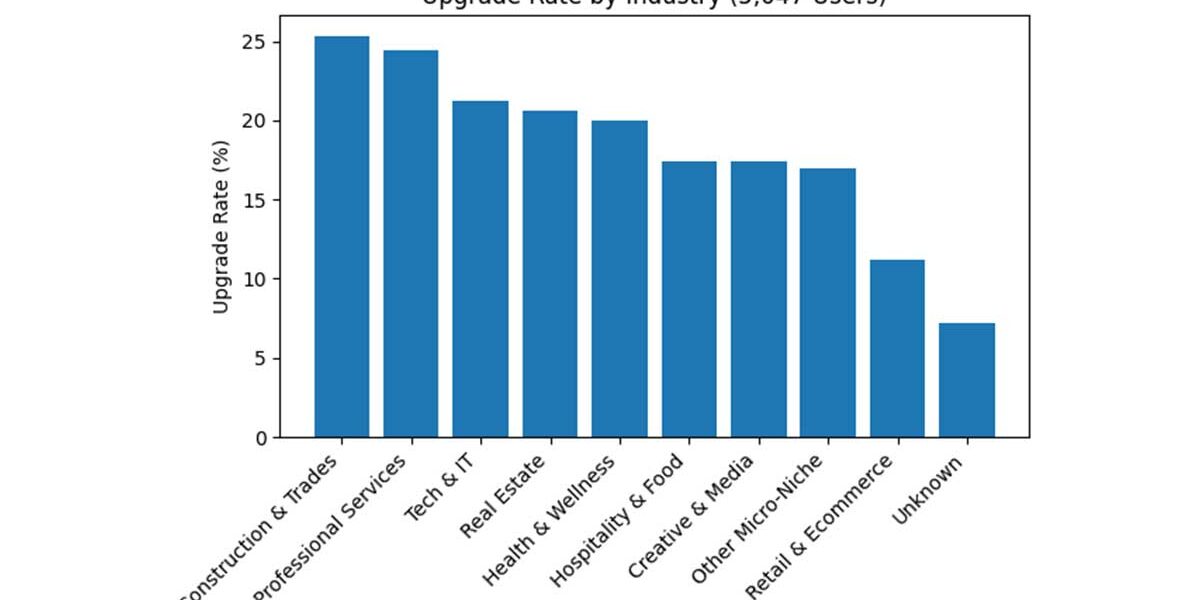
Professional services firms (2-10 employees), construction businesses, and real estate operators benefit most from receipt automation, with upgrade rates of 32.5%, 23-27%, and 20-22% respectively. The common factor is expense complexity — these industries manage diverse receipts across multiple projects, clients, or properties, making automated expense tracking essential for tax optimization and profitability.
Introduction
When we started building SparkReceipt, we didn’t set out to create “just another receipt scanner.”
We kept seeing the same pattern:
Small business owners were spending hours every month dealing with receipts – not because it was hard, but because it was fragmented.
Shoeboxes. Email threads. Spreadsheets. Accountant reminders.
And always, the stress before tax season.
So instead of guessing who we were really helping most, we decided to look at the data.
We analyzed onboarding responses from the latest 5,047 new SparkReceipt users to understand:
- Which industries truly benefit from receipt automation
- Which businesses actually upgrade
- And where automated expense tracking creates real financial impact
What we found confirmed something important.
SparkReceipt isn’t for everyone.
But for certain types of small businesses, it’s transformative.
The Data: Not All Small Businesses Struggle Equally
Across all users, we found a major difference in how different industries adopt and pay for automated receipt tracking.
Highest Converting Business Segments
- Professional services (2-10 employees) → 32.5% upgrade rate
- Construction businesses → 23-27% upgrade rate
- Real estate operators → 20-22% upgrade rate
Meanwhile:
- Users who didn’t specify an industry upgraded at just 7%
That’s a 3-4x difference.
What Does “Upgrade Rate” Mean?
Upgrade rate refers to the percentage of users who start on the free plan and then choose to move to a paid plan.
For example, a 32% upgrade rate means that out of 100 businesses who sign up, 32 decide the software delivers enough value to pay for it.
A higher upgrade rate usually indicates:
- A stronger pain point
- Clearer return on investment
- Better product-market fit
In short: the businesses that upgrade more often are the ones who truly benefit from automation.
Why Contractors, Consultants & Property Operators Upgrade More
The businesses that convert best share one thing:
Expense complexity.
Let’s break it down.
Construction & Trades
Contractors deal with:
- Fuel receipts
- Materials and tools
- Subcontractor expenses
- VAT-heavy purchases
- Paper-based supplier receipts
Every lost receipt is lost deductible value.
For contractors, automated receipt scanning and expense tracking isn’t a “nice-to-have.”
It directly impacts tax optimization and profitability.
That’s why construction sole proprietors showed nearly 27% upgrade rates.
Consultants, Agencies & Professional Services
Small professional teams (2-10 employees) had the highest conversion rate overall.
Why?
- Travel expenses
- Client meals
- Software subscriptions
- Digital invoices across email
- Ongoing accountant collaboration
These businesses need structured expense management software – not just a basic scanner.
When automation reduces admin time and improves financial clarity, the ROI is immediate.
Real Estate Operators
Property managers and landlords manage:
- Maintenance expenses
- Renovations
- Utilities
- Contractor invoices
- Tax reporting across properties
For real estate businesses, accurate expense tracking isn’t optional. It’s operational infrastructure.
The Sweet Spot: Small Service Businesses (2-10 Employees)
One of the strongest patterns in our analysis wasn’t just industry – it was business size.
Across multiple industries, companies with 2-10 employees consistently showed the highest upgrade rates.
These businesses typically:
- Have real expense volume
- Feel tax pressure
- Work with external accountants
- Need shared visibility across the team
- Care about profitability tracking
They’re too big for spreadsheets – but not big enough for complex enterprise systems.
This is exactly where modern receipt automation delivers maximum value.
How High-Value Industries Can Get Even More From SparkReceipt
From our data, three industries consistently stand out:
- Construction
- Professional services
- Real estate
For these businesses, two features become especially powerful: Tags and Linked Accounts.
Using Tags to Turn Expenses Into Operational Insight
Most businesses categorize expenses (fuel, materials, software, etc.).
But high-performing businesses go one level deeper.
With Tags, you can organize receipts across operational dimensions.
For example:
Contractors can tag by:
- Project name
- Job site
- Vehicle
- Client
Consultants can tag by:
- Client account
- Billable vs non-billable
- Internal department
Real estate operators can tag by:
- Property address
- Unit number
- Maintenance category
Instead of simply knowing you spent €2,000 on fuel, you can see:
Fuel → Project A vs Project B
Maintenance → Property 1 vs Property 2
That’s when receipt tracking stops being accounting – and starts becoming decision-making data.
Using Linked Accounts to Separate Workspaces
For businesses operating multiple entities or cost centers, clarity requires separation.
SparkReceipt’s Linked Accounts feature allows you to create separate sub-accounts (workspaces) under one main login.
Each Linked Account has:
- Its own receipts
- Its own documents
- Its own users
- Its own settings
Completely independent from other accounts.
This is especially useful if you:
- Run multiple businesses
- Want to separate business and personal finances
- Manage multiple properties
- Operate different legal entities
- Need separate access for different accountants
For example:
- A contractor with two companies can keep expenses fully separated.
- A real estate operator can manage each entity independently.
- A consultant can keep a holding company and operating company distinct.
All without needing separate logins.
You control everything from one dashboard – but maintain full structural separation.
For high-complexity businesses, this structure prevents accounting confusion later.
And that’s one of the hidden reasons these industries upgrade more often.
They don’t just need storage.
They need architecture.
SparkReceipt Is Built for Businesses – Not Shoeboxes
After analyzing more than 5,000 businesses, one thing became clear:
Receipt automation isn’t about convenience. It’s about control.
The businesses that upgrade aren’t casual users. They’re contractors protecting margins. Consultants reducing chaos. Property operators managing dozens of deductibles. They upgrade because the numbers justify it.
If you’re running a service-based business and still managing receipts manually, you’re not just losing time. You’re losing clarity. And clarity compounds.
That’s exactly why we built SparkReceipt the way we did – for serious small businesses that treat expense tracking as infrastructure.
If that sounds like you, I’d love for you to try it.
Try SparkReceipt free
AI-powered receipt scanner and expense tracker for small business.
Get started