
Tax Filing Deadline Canada 2027: Every Date for Your 2026 Return
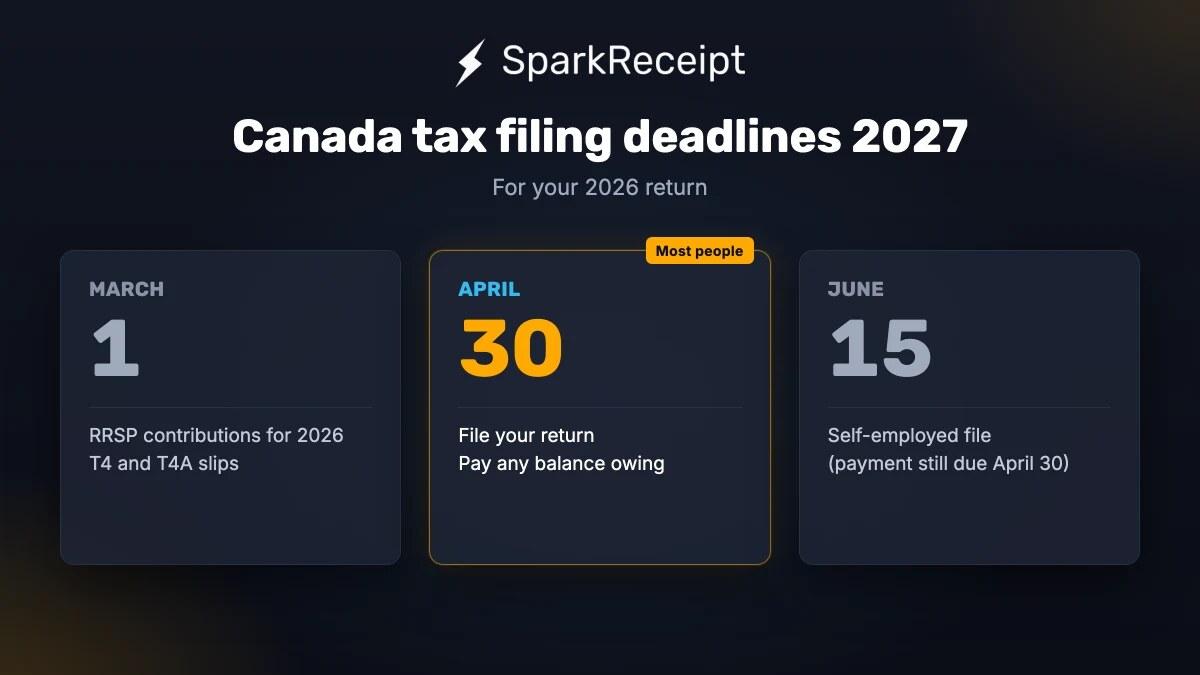
TL;DR: The tax filing deadline in Canada for your 2026 return is Friday, April 30, 2027. If you or your spouse or common-law partner earned self-employment income, you have until Tuesday, June 15, 2027 to file, but any balance owing is still due April 30. RRSP contributions for 2026 and T4 and T4A slips are due Monday, March 1, 2027. Below is every 2027 date, who it applies to, and what a missed one costs.
When are taxes due in Canada? For most people the answer is one date, April 30. The calendar gets busier once you run a business: GST/HST, instalments, slips for workers you paid, and a corporate return each have their own deadline. This guide lists the Canadian federal dates for the 2027 filing season, which covers your 2026 tax year, and links the guide for each one.
The tax filing deadline in Canada for 2027, at a glance
The dates below come from the CRA's 2027 tax deadlines for businesses and self-employed individuals and its RRSP deduction limit page. When a due date falls on a Saturday, Sunday or public holiday the CRA recognizes, a return or payment counts as on time if the CRA receives it, or it is postmarked, by the next business day. That rule is why two dates below are a Monday.
| Date (2027) | What is due | Who it applies to |
|---|---|---|
| Mon, Mar 1 | Last day for RRSP contributions you deduct on your 2026 return | Anyone with RRSP room |
| Mon, Mar 1 | T4 and T4A slips and summaries for 2026 (February 28 is a Sunday) | Employers, and anyone who paid fees reported on a T4A |
| Mon, Mar 1 | Balance owing for a corporation with a December 31 year-end (two months after year-end) | Corporations that don't qualify for the three-month rule |
| Mon, Mar 15 | First 2027 instalment | People who pay tax by instalments |
| Wed, Mar 31 | Balance owing for a Canadian-controlled private corporation claiming the small business deduction (three months after year-end) | Qualifying CCPCs |
| Wed, Mar 31 | GST/HST annual return and payment, December 31 year-end | Annual filers who are not self-employed individuals |
| Fri, Apr 30 | 2026 personal income tax return, and payment of any balance owing | Most individuals |
| Fri, Apr 30 | Payment of any balance owing, including GST/HST for annual filers | Self-employed individuals |
| Tue, Jun 15 | 2026 return for self-employed individuals and their spouses or common-law partners; GST/HST annual return | Self-employed individuals with a December 31 year-end |
| Tue, Jun 15 | Second 2027 instalment | Instalment payers |
| Wed, Jun 30 | T2 corporate return for a December 31 year-end (six months after year-end); T5018 slips for a calendar-year reporting period | Corporations; construction businesses that paid subcontractors |
| Wed, Sep 15 | Third 2027 instalment | Instalment payers |
| Wed, Dec 15 | Fourth 2027 instalment | Instalment payers |
April 30: the tax filing deadline for most Canadians
For employees, retirees and students, April 30, 2027 is both the filing deadline and the payment deadline for the 2026 return. Interest on any unpaid balance starts on May 1, whether or not you have filed.
File by April 30 even if you can't pay in full. The late-filing penalty is charged on top of the interest, so filing on time and paying what you can costs less than filing late. Filing on time also keeps benefit and credit payments, such as the GST/HST credit and the Canada child benefit, from being interrupted, because the CRA works them out from your return. Quebec residents also file a provincial return with Revenu Québec, with the same April 30 and June 15 dates.
June 15: the self-employed tax deadline in Canada
If you earned business income as a sole proprietor or partner in 2026, the self-employed tax deadline in Canada is June 15, 2027. The same date applies to your spouse or common-law partner. The extra six weeks are for filing only. The balance owing is still due April 30, and interest runs from May 1 on anything unpaid. The only exception the CRA lists is a business whose spending was mainly tax shelter investments, which files by April 30.
Most of the extra work sits on Form T2125, where you report your business income and expenses, and on your CPP contributions, which you pay at both the employee and employer rate (the self-employed CPP guide has the 2026 figures). The self-employed tax calculator estimates the April 30 payment from your profit, so you can pay on time even if you file in June.
The November 2026 federal Budget proposes moving both self-employed dates to May 15, starting with 2027 returns filed in 2028 (Budget 2026 tax measures). It does not change the dates for your 2026 return.
March 1: the RRSP deadline and T4 and T4A slips
RRSP deadline. Contributions you make by March 1, 2027 can be deducted on your 2026 return. Your own limit is 18% of your 2025 earned income (CRA) up to the 2026 dollar limit of $33,810, plus any unused room from earlier years. The figure is printed on your latest notice of assessment and in CRA My Account. A self-employed person's earned income includes net business income, so a good business year raises next year's room.
T4 and T4A slips. Information returns are due the last day of February. February 28, 2027 is a Sunday, so the 2026 T4 and T4A slips and summaries are due March 1. If a client paid you fees for services, the amount may arrive on a T4A slip in box 048. Report your actual business income on the T2125 whether or not a slip arrives.
When does tax season start in Canada?
The CRA expects the 2027 filing season to open on February 22, 2027, when NETFILE starts accepting 2026 returns (CRA tax tip on NETFILE sign-in). You can file any time from then until your deadline. Filing early gets a refund to you sooner. The CRA usually sends the notice of assessment within two weeks of an online return.
Business deadlines: GST/HST, instalments, corporations and T5018
GST/HST. Monthly and quarterly filers file and pay one month after each period ends. Annual filers file and pay three months after their fiscal year-end, so March 31, 2027 for a December 31 year-end. The exception is a self-employed individual with a December 31 year-end, who pays by April 30 and files by June 15. The GST/HST return guide walks the return line by line.
Instalments. If your net tax owing is more than $3,000 ($1,800 in Quebec) this year and in one of the two previous years, the CRA expects quarterly instalments on March 15, June 15, September 15 and December 15. The CRA instalments guide explains the three ways to work out the amount, and the Budget 2026 proposal to raise the threshold from 2028.
Corporations. A corporation files its T2 return within six months of its year-end, which is June 30, 2027 for a December 31 year-end. Its balance owing is generally due two months after year-end, or three months for a Canadian-controlled private corporation that claimed the small business deduction and meets the CRA's conditions. Whether incorporating changes these dates for you is one of the questions in sole proprietorship vs corporation.
T5018. A construction business that paid subcontractors reports them on T5018 slips within six months of the end of its reporting period, which is June 30, 2027 for a calendar-year period.
What happens if you miss the tax deadline
Three charges can apply, and they stack (CRA, interest and penalties on late taxes):
- Interest on any balance owing, compounded daily from May 1, 2027, whether or not you file. It also applies to late or short instalments.
- The late-filing penalty, only if you owe tax: 5% of the balance owing plus 1% for each full month the return is late, for up to 12 months.
- The repeat penalty: if you were charged a late-filing penalty in one of the three previous years and the CRA sent you a demand to file, it rises to 10% of the balance plus 2% a month, for up to 20 months.
If you are due a refund, a late return costs you no penalty, but the refund and any benefits wait until you file. The CRA can also reassess a return for several years after its notice of assessment, so the record retention rules matter well after the deadline.
How to be ready before April 30
The return is a summary of a year of receipts, so filing goes faster when those receipts are already sorted. A receipt scanner captures each receipt as you get it and reads the merchant, date, amount and GST/HST. The expense tracker files each one into a category that matches a T2125 expense line. When you or your accountant sit down to file, an expense report gives the category totals with the original receipt images attached, which is the record the CRA asks for if it reviews your return. SparkReceipt does not file returns; it keeps the records your return is built from, and your accountant joins free on every plan.
Canada tax deadline FAQ
For the 2026 tax year, most people must file and pay by Friday, April 30, 2027. Self-employed individuals and their spouses or common-law partners file by Tuesday, June 15, 2027, but still pay any balance owing by April 30.
Monday, March 1, 2027. Contributions made by then can be deducted on your 2026 return, up to your deduction limit. The 2026 dollar limit is $33,810; your personal limit is on your notice of assessment.
No. The June 15 deadline is for filing only. Any balance owing is due April 30, 2027, and the CRA charges interest from May 1 on anything unpaid.
File on time anyway. The late-filing penalty (5% of the balance plus 1% a month) only adds to the interest, so filing by the deadline and paying what you can costs less. The CRA offers payment arrangements for the rest, and the notice of assessment shows the balance it has on record.
The CRA expects NETFILE to open for 2026 returns on February 22, 2027. You can file from then until your deadline.
The tax filing deadline in Canada for 2026 returns is April 30, 2027 for most people and June 15, 2027 for the self-employed and their spouses or common-law partners. Payment of any balance is due April 30 in both cases.
Key takeaways
- The tax filing deadline in Canada for 2026 returns is April 30, 2027. Self-employed people file by June 15, 2027 but pay by April 30.
- March 1, 2027 is the RRSP deadline for 2026 and the due date for T4 and T4A slips, because February 28 is a Sunday.
- Interest on unpaid tax starts May 1. The late-filing penalty starts at 5% of the balance owing plus 1% a month.
- GST/HST annual filers with a December 31 year-end file by March 31, unless they are self-employed individuals, who pay by April 30 and file by June 15.
- The Budget 2026 proposal to move self-employed dates to May 15 starts with 2027 returns, not your 2026 return.