Skip to content

Bookkeeping Software That Keeps the Books and Works Out Your GST/HST

Your receipts, invoices and bank lines already sit in SparkReceipt. The Ledger turns them into double-entry books, checks them every day and works out your GST/HST return line by line.

Trial balance, balance sheet, profit and loss and the journal, on the accrual and the cash basis, built from the documents you already capture. No second program to re-enter them into before the filing deadline.

7-day free trial. Cancel any time.

Business Owners in 175 Countries Trust SparkReceipt

Tracy DugganRobert ConnollyRafael RoaFrédéric ThériaultPierce Mooney
4.8on the App Store · 4.6 on Google Play · 2,700+ ratings
4,620,044Receipts Processed
38,283Businesses Worldwide
190Currencies Handled
175Countries

Bookkeeping in Two Programs vs. in the Ledger

Same receipts, same bank, one place for the books

Business owner copying receipts into a separate bookkeeping program

Receipts here, books somewhere else

  • Every receipt re-entered into a second program before it counts
  • A supplier bill claimed twice as an ITC, found after you filed
  • No idea whether the quarter is finished or still missing a statement
  • Figures that disagree with what your accountant has
  • Year end means a week of emails and spreadsheets
Business owner checking a balanced ledger in SparkReceipt

The Ledger

  • Each receipt, invoice and bank line becomes journal entries on its own
  • Daily checks flag anything booked twice or missing and point to the fix
  • GST/HST return lines worked out for the period you pick
  • Your balances compared with your accountant's, month by month
  • Year-end close moves the result to equity in one step

How the Ledger Keeps Your Books

1

Capture As You Do Now

Scan receipts, forward invoices, connect your inbox, upload bank statements, or connect your Canadian bank directly. Nothing about how you capture documents changes.

2

The Ledger Records Each One

Every expense, sales document, bank line and expense claim becomes a balanced journal entry on the right ledger account, with its GST, HST, PST or QST split out. Your Categories become the income and expense accounts of your chart of accounts.

3

Check, Close, Report

Checks run every day and propose fixes you can preview and undo. Each month shows what it still waits on, you close it when it is ready, and the GST/HST return lines are there when the period ends.

Your GST/HST return, line by line, from your own records

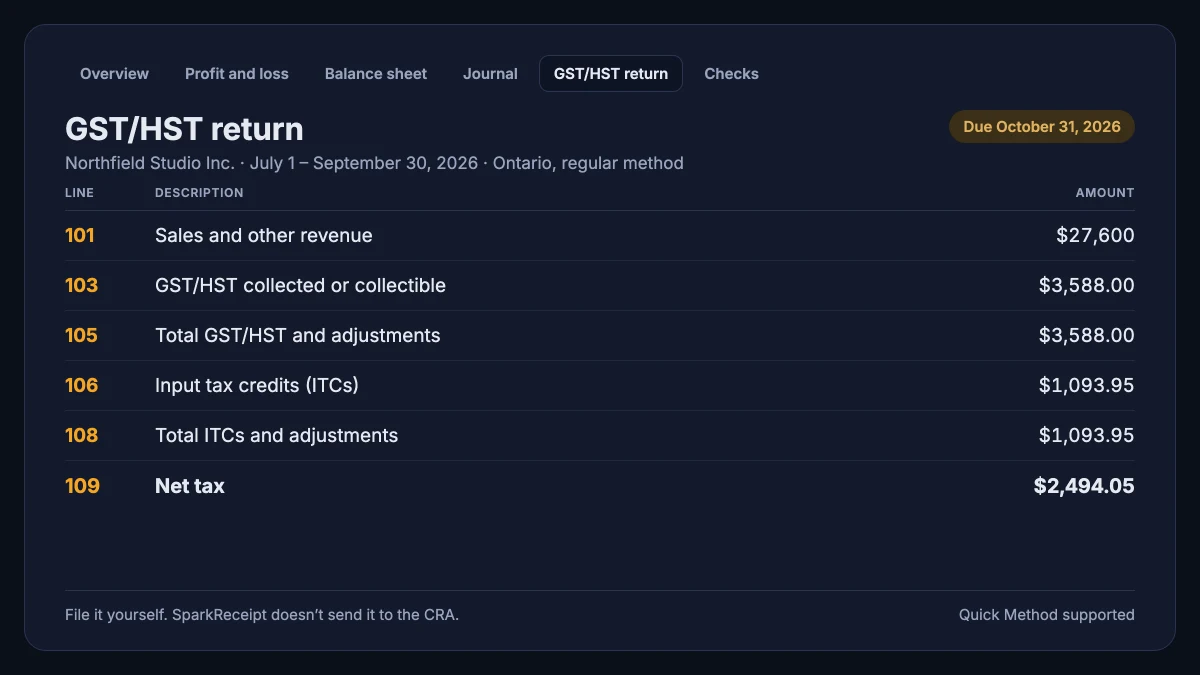
The Ledger adds up the GST/HST on every sale and purchase for the period you pick and lays it out as the lines of your return: line 101 sales, 103 GST/HST collected, 106 input tax credits and 109 net tax, with the self-assessed tax and the balance to remit or the refund the CRA owes you. Monthly, quarterly and annual filers are covered, and the due date is shown for each period. Open any line to see the documents behind it.

On the Quick Method, set your remittance rate and the Ledger works out line 101 and the remittance, including the Quick Method credit, and shows the part of the GST/HST your customers paid that becomes your income. In Quebec the return is laid out for Revenu Québec's form FPZ-500. QST and PST are kept apart, since you report them to your province.

SparkReceipt does not file the return. You file it yourself, and we suggest going through the figures with your accountant first, as the Ledger itself says on the page. How to file a GST/HST return walks through the CRA's side.

GST/HST return page in the SparkReceipt Ledger with lines 101 to 109 for a quarter, net tax and the due date

Profit and loss, balance sheet and trial balance, up to date

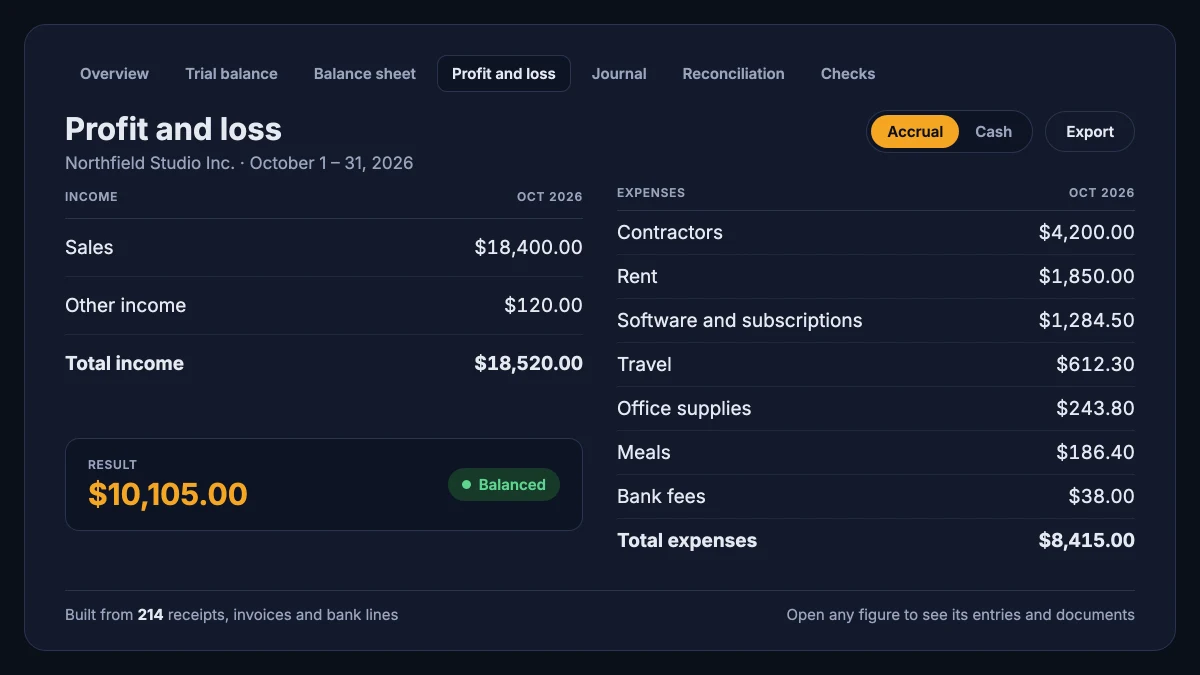
The Ledger keeps a double-entry journal of everything in your account and builds the reports from it: a trial balance, a balance sheet, a profit and loss statement, the journal itself and your chart of accounts. Pick any period and open any figure to see the entries and the receipts behind it.

Your books are kept on both the accrual and the cash basis at once, so you switch between them with one click. The CRA has no cash method for GST/HST, so use the accrual figures for the return; the cash vs. accrual guide explains where each one applies. Each bank, card and payment account gets its own ledger account, and the Reconciliation page puts its ledger balance next to its latest statement's closing balance.

Profit and loss report in the SparkReceipt Ledger with an accrual and cash switch

Checks that find the mistakes, and fixes you can undo

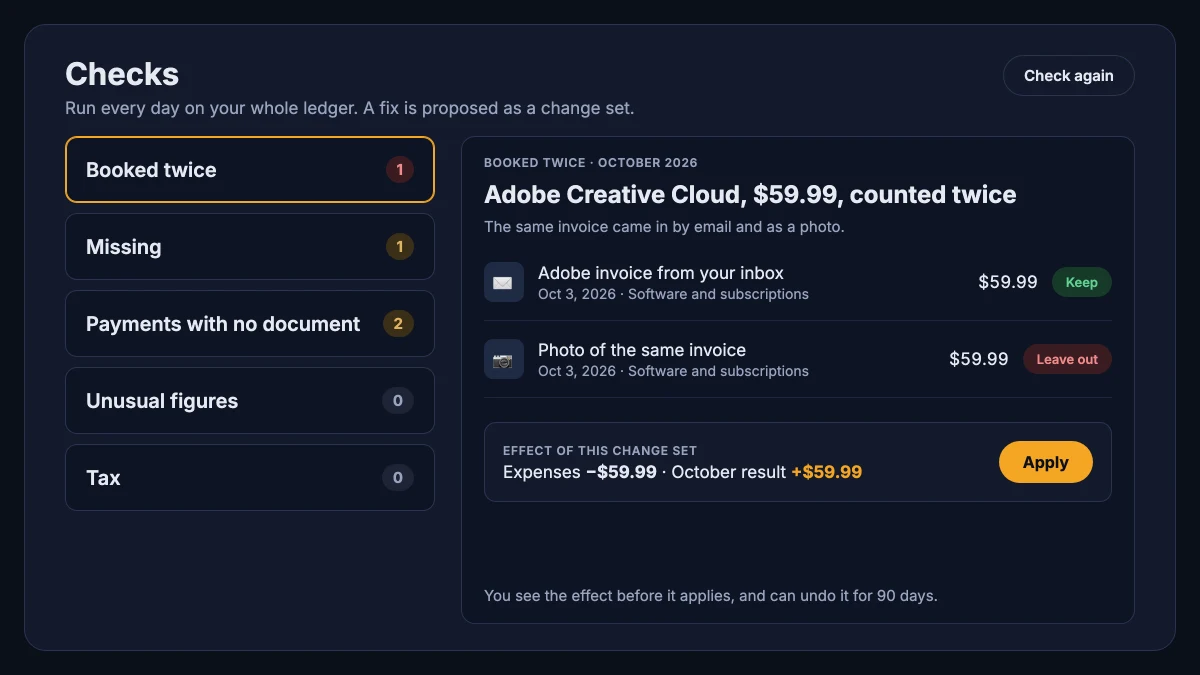
Most bookkeeping errors are not arithmetic. They are a bill counted twice because it arrived by email and as a photo, a bank statement left out, or a payment with no document behind it. Each one moves your profit and your input tax credits. The Ledger runs its Checks every day and sorts what it finds into lists: booked twice, missing, payments with no document, unusual figures and tax lines that need a look.

When a check knows the fix, it proposes it as a change set. You see what it does to your result before it applies, apply it in one click, and undo it for 90 days if you change your mind.

Ledger checks listing a cost booked twice, with a proposed change set showing its effect on the result before it is applied

Your books next to your accountant's, month by month

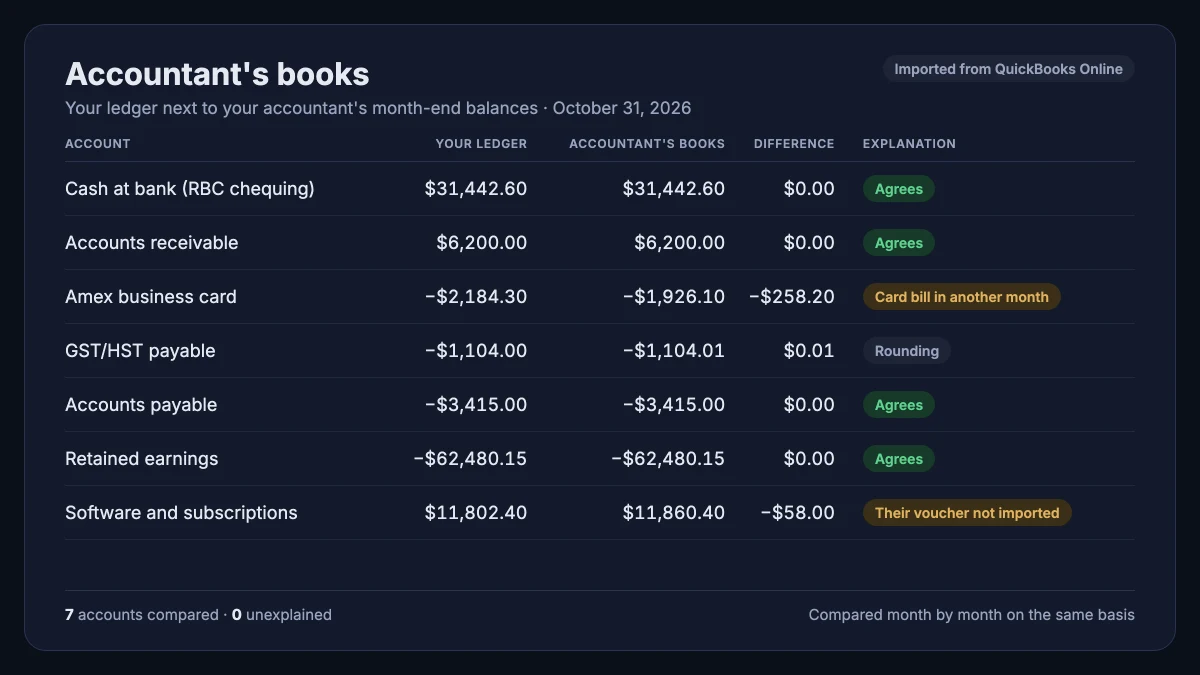
Many Canadian businesses have an accountant keeping the official books. The Accountant's books page imports their month-end balances, from a file out of any accounting program or straight from a connected QuickBooks Online or Xero account, and compares them with your Ledger month by month. Each difference gets an explanation: rounding, a card bill in another month, tax settled in another month, or a note of your own. The differences go to your accountant as a memo, a PDF or a CSV file.

That is how we run our own company. SparkReceipt keeps its books in the Ledger and checks them every month against our accountant's books. Your accountant joins your account free with the Accountant role and sees the same Ledger you do.

Accountant's books page comparing the SparkReceipt Ledger's month-end balances with balances imported from QuickBooks Online, with each difference explained

Month-end close, period locks and a year-end close in one step

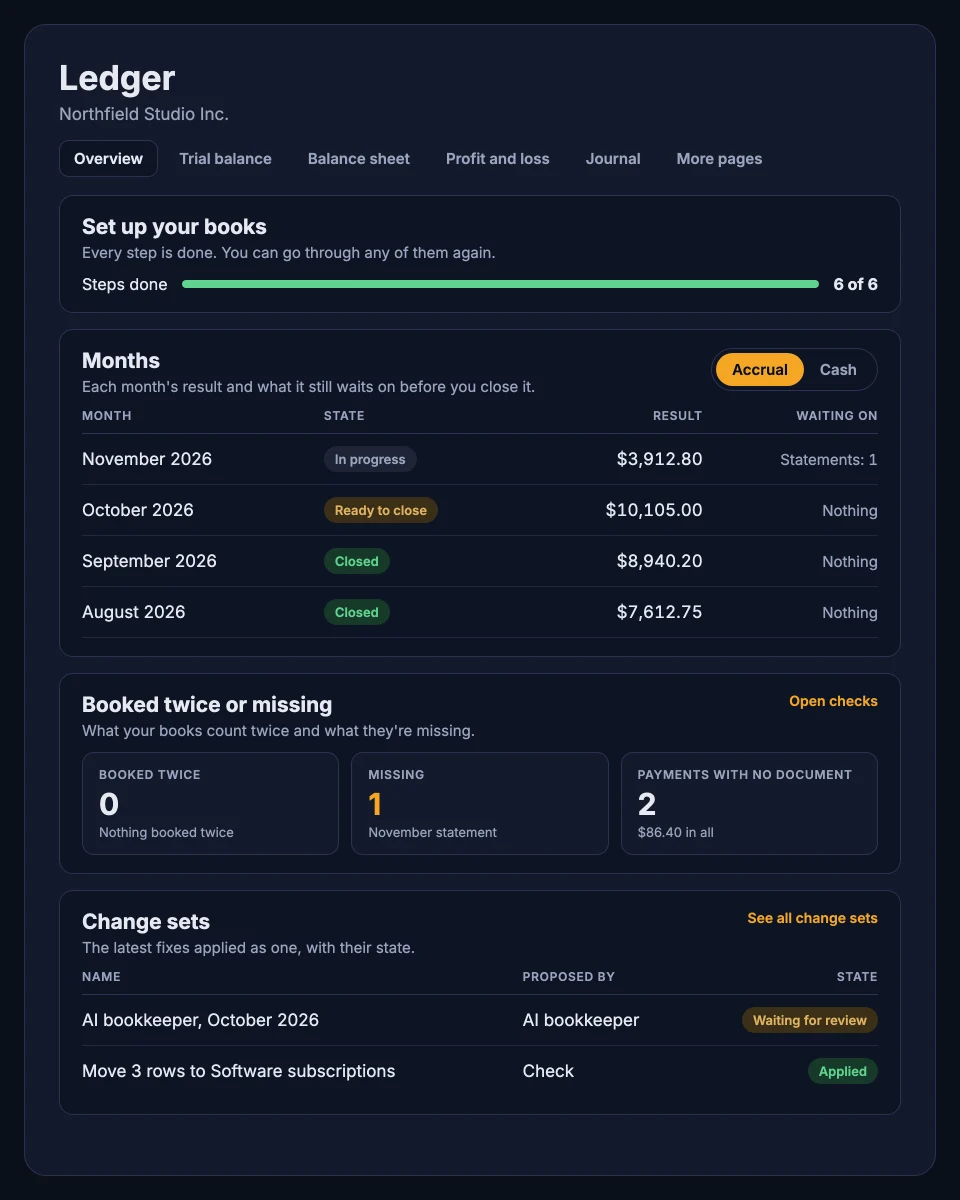
The Months list shows each month's result and what it still waits on. When a month reads Ready to close, close it, and a reminder email tells you when last month is waiting. Period locks keep a filed period fixed: a receipt that turns up later is booked as an adjustment on the first open day, so the return you already filed does not change under you.

At the end of your fiscal year, Year-end close takes income and expenses to zero and moves the year's result into equity: retained earnings for a corporation, or the owner's or partners' capital for a sole proprietor or partnership. When your accountant works in another program, export the journal as a CSV for any program, a QuickBooks Online journal import, an IIF file for QuickBooks Desktop or a Xero manual journal.

Business owner closing the month in SparkReceipt

What bookkeeping software should do for a Canadian small business

Bookkeeping has two halves. The first is capture: getting every receipt, invoice and bank line into one place with the right date, amount, sales tax and category. The second is the books: a double-entry ledger where every transaction lands on two accounts, a trial balance that proves they agree, and the reports your accountant, your bank and the CRA ask for.

Most bookkeeping software makes you do the first half by hand so it can do the second. SparkReceipt started with the first half: receipt scanning, email receipts, the bank statement extractor and a direct bank feed for Canadian banks. The Ledger adds the second half on top, so a receipt you scanned this morning is in your profit and loss and your next GST/HST return this afternoon.

When you compare bookkeeping software in Canada, five things decide whether it saves you time:

  • The books come from the documents. Each document and bank line becomes its journal entries on its own, and the receipt stays attached to the entry, which is the documentation the CRA asks for to support an input tax credit.
  • It catches mistakes before the CRA does. A duplicate bill overstates the ITCs you claim. The Ledger's checks look for duplicates and missing statements every day.
  • It works out the GST/HST return. The lines of the return for each period, on the regular method or the Quick Method, at the rate for your province.
  • It keeps both bases. Cash and accrual books side by side, so the profit and loss on either basis is a click away.
  • It works with your accountant. Your accountant joins free, sees the same Ledger and compares it with their own books.

Who the Ledger is for

Sole proprietors get a profit figure they can trust all year, not only when the T2125 is due, and a balance sheet when the bank asks for one.

GST/HST registrants have the return worked out from the same records they keep anyway, with every line traceable to its documents. Not registered yet? Read GST/HST registration first.

Corporations with an accountant keep the books current between year ends, see the same figures as the accountant and hand over months that are already checked and closed.

If you keep your books in QuickBooks Online or Xero and want to stay there, keep doing so: SparkReceipt still publishes each receipt there with the image attached, and the Ledger can compare its balances with theirs.

More in the Ledger

  • Bank lines booked for you. A tax payment, a loan repayment or money to or from the owner goes to its balance sheet account, and the booking waits for your yes.
  • Loans. Add a business loan on the Loans page, and the Ledger books its interest every month and splits each payment into principal and interest.
  • Fixed assets. Turn on Depreciate this purchase on an Expense, and the Ledger books its depreciation for each financial year of its useful life.
  • The AI bookkeeper. Every night it goes through your open months and proposes its fixes as a change set for each month. Nothing changes until you apply it.
  • Financial statements. At year end the Ledger makes the profit and loss and balance sheet in your country's layout, as a PDF or an Excel file.
  • The mobile app. The reports, checks, change sets and month close work in the iOS and Android app too.

How to start

Open the Ledger in the web app or the mobile app and a short setup asks a few questions once, such as your filing period, when your fiscal year starts and how you handle the tax you charge, and every Ledger page works while you answer them.

Receipts and Bookkeeping in One Subscription

Capture, matching and the Ledger in one account.

Your accountant joins free

Your first user is included. Each extra user: $1.17/month, billed $14 annually.

Your accountant joins free

Pro

For side hustles.

$8.25/mo

Total for 1 user · $99.00 billed annually

+ VAT/GST where applicable

Get Started

7-day free trial

50 documents / month

For receipts and invoices

  • AI scanning and categorization
  • One connected email inbox
  • One live bank feed connection
  • Bank statement extraction and matching
  • Mileage tracking and expense reports
  • QuickBooks Online, Xero and more
Recommended

Elite

For small businesses with 1 to 40 people.

$14.92/mo

Total for 1 user · $179.00 billed annually

+ VAT/GST where applicable

Get Started

7-day free trial

Unlimited documents*

Everything in Pro, plus:

  • Line-item extraction on every receipt
  • Several connected email inboxes
  • Several live bank feed connections
  • AI Fields for the details you need
  • AI rules for categorizing and filing
  • Accounting export templates
  • Trips start when your phone connects to your car

Founder-led setup

Joel Ojala

Joel Ojala, co-founder, sets up SparkReceipt with you, tailored to how you work.

$550one-time setup

+ Elite for 1 user: $14.92/mo, billed annually

$729.00 today, then $179.00 a year

+ VAT/GST where applicable

Get set up with Joel

Annual plan only · No free trial

Everything in Elite

Plus a 60-minute session with Joel and one follow-up. In the session:

  • Your process, mapped at a high level
  • Logins for your team, and any extra users you need
  • Set up inbox scanning for receipts and invoices
  • Connect bank / upload your first statement
  • The phone app for paper receipts
  • Expense categories and your accounting integration
  • Anything else you'd like to go through

Unlimited linked accounts on every plan.

Compare all features

Pro

  • 1 user included. Add teammates any time for a flat fee per user, your accountant joins free on top, unlimited linked accounts
  • 50 documents per month (receipts and invoices, mass upload up to 100 at once)
  • AI scanning and categorization
  • Automatic email receipt scanning from one connected inbox (Gmail, Outlook, IMAP)
  • Bank statement extraction and receipt matching (PDF, CSV, Excel)
  • The Ledger: double-entry books with profit and loss, balance sheet, month close and GST/HST return figures
  • One live bank feed connection
  • Mileage tracker: GPS or manual trips, with per diem
  • Expense claims: submit receipts and trips, approve, mark paid
  • SparkAgent AI assistant, or connect your own AI over MCP
  • Integrations: QuickBooks Online, Xero, Zapier, Make, Pabbly, plus webhooks and API
  • Expense reports and exports: PDF, Excel, CSV, ZIP; 190 currencies

Elite

  • Everything in Pro, plus:
  • Unlimited documents: receipts and invoices, mass upload up to 100 at once
  • Line-item extraction on every receipt
  • Several connected email inboxes with automatic scanning
  • Several live bank feed connections
  • AI Fields: tell the AI exactly what to pull from every document
  • Plain-English AI rules: tell the AI how to categorize and file automatically
  • Trips start when your phone connects to your car
  • Export templates for Sage 50, DATEV, Wave, and Sage 200

Founder-led setup

  • A 60-minute setup session with Joel, co-founder, plus one follow-up session
  • Together we set up your process, team logins, inboxes, bank statements, categories and integrations
  • Everything in Elite, billed annually
  • 1 user included. Add teammates any time for a flat fee per user

Unlimited document scanning on Elite is subject to fair use. Bank statement extraction uses monthly renewable credits. Historical email imports include a free allowance; larger imports use credits, with the cost shown before you start.

Frequently Asked Questions

Bookkeeping software records a business's income and expenses as accounting entries and turns them into reports: a general ledger, a trial balance, a profit and loss statement and a balance sheet. In SparkReceipt, the Ledger builds those entries from the receipts, invoices, bank lines and expense claims already in your account, so you do not re-enter them in a second program.

No. The Ledger works out the lines of the return and the net tax for the period and shows the due date. You file it with the CRA yourself, or with Revenu Québec in Quebec, and we suggest going through the figures with your accountant first. How to file a GST/HST return covers the steps.

Yes. Set your remittance rate from the CRA's table and the Ledger works out the return on the Quick Method, including its credit. It also shows the part of the GST/HST your customers paid that the Quick Method lets you keep, which is income for your business.

Pro and Elite. Both start with a 7-day free trial, and your accountant joins free with the Accountant role.

The account owner, admins and your accountant, in the web app and the mobile app. Members, Supervisors and Contributors do not see it.

Yes. Every document and bank line becomes a balanced journal entry with a debit and a credit, on ledger accounts from your chart of accounts. The trial balance shows the two sides agree, and the Checks flag anything that would throw them off.

You can keep them. SparkReceipt still publishes each receipt to QuickBooks Online or Xero with the image attached, and the Ledger can import your month-end balances from them to compare. If you would rather keep receipts and books in one place, the Ledger gives you the reports, the GST/HST return lines and the month and year-end close.

Yes. Your subscription includes 1 user, and your accountant joins free with the Accountant role. They see the same Ledger, can import their own month-end balances to compare, and can export the journal as a CSV, a QuickBooks Online journal import, an IIF file or a Xero manual journal.

Both. The Ledger keeps every entry on the accrual and the cash basis at the same time, and one click switches the reports between them. Use the accrual figures for the GST/HST return, because the CRA has no cash method for GST/HST.

Lock the period once you have filed. Its entries then stay as you reported them, and a later fix is booked as an adjustment on the first open day after the period, so it lands in your next return. Checks that find a mistake propose a change set you can preview, apply and undo for 90 days.

Yes. Pick the date your books start, then import opening balances from Procountor, Xero, QuickBooks Online or a trial balance file, or enter them by hand with suggestions from your bank statements. Journal entries dated from your start date on can be imported from a CSV or Excel file.

Yes. SparkReceipt keeps its own company books in the Ledger and compares them every month with its accountant's books, using the same Accountant's books page you get.

Keep the Receipts. Get the Books.

Get Started
Get Started