Skip to content

Bookkeeping Software That Keeps the Books and Works Out Your VAT

Your receipts, invoices and bank lines already sit in SparkReceipt. The Ledger turns them into double-entry books, checks them every day and lays out your VAT return box by box.

Trial balance, balance sheet, profit and loss and the journal, on the accrual and the cash basis, built from the documents you already capture. No second program to retype them into before the quarter ends.

7-day free trial. Cancel any time.

Business Owners in 175 Countries Trust SparkReceipt

Tracy DugganRobert ConnollyRafael RoaFrédéric ThériaultPierce Mooney
4.8on the App Store · 4.6 on Google Play · 2,700+ ratings
4,620,044Receipts Processed
38,283Businesses Worldwide
190Currencies Handled
175Countries

Bookkeeping in Two Programs vs. in the Ledger

Same receipts, same bank, one place for the books

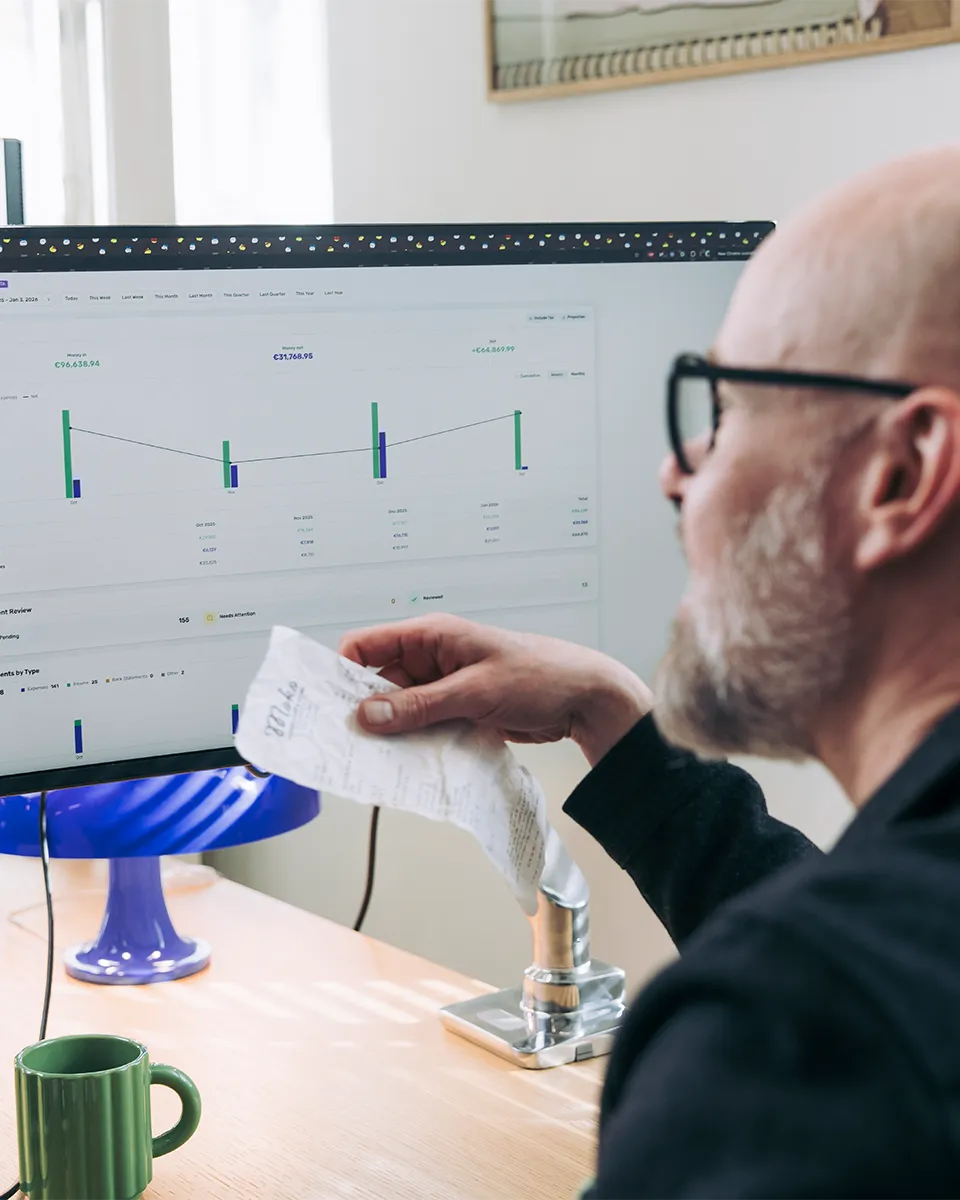
Business owner copying receipts into a separate bookkeeping program

Receipts here, books somewhere else

  • Every receipt keyed into a second program before it counts
  • A supplier bill counted twice, found after the VAT return went in
  • No idea whether the quarter is finished or still missing a statement
  • Figures that disagree with what the accountant has
  • Year end means a week of emails and spreadsheets
Business owner checking a balanced ledger in SparkReceipt

The Ledger

  • Each receipt, invoice and bank line becomes journal entries on its own
  • Daily checks flag anything booked twice or missing and point to the fix
  • VAT return boxes 1 to 9 worked out for the period you pick
  • Your balances compared with the accountant's, month by month
  • Year-end close moves the result to equity in one step

How the Ledger Keeps Your Books

1

Capture As You Do Now

Scan receipts, forward invoices, connect your inbox and upload bank statements from any UK bank. Nothing about how you capture documents changes.

2

The Ledger Records Each One

Every expense, sales document, bank line and expense claim becomes a balanced journal entry on the right ledger account, with its VAT split out. Your Categories become the income and expense accounts of your chart of accounts.

3

Check, Close, Report

Checks run every day and propose fixes you can preview and undo. Each month shows what it still waits on, you close it when it is ready, and the VAT return figures are there when the quarter ends.

VAT return figures, box by box, from your own records

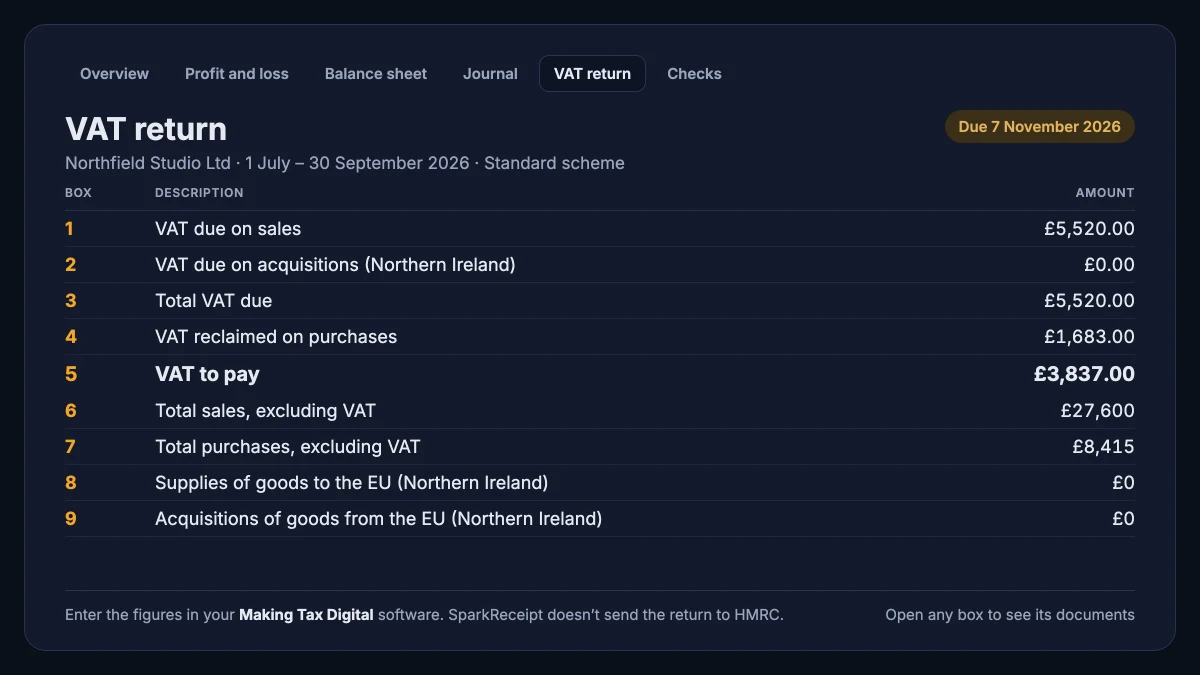
The Ledger adds up the VAT on every sale and purchase for the period you pick and lays it out the way HMRC's return asks for it: boxes 1 to 5 in pounds and pence, boxes 6 to 9 in whole pounds, with the due date for the period. Monthly, quarterly or annual periods all work, and so does the Flat Rate Scheme, with the percentage you set for your trade. Open any box to see the documents behind it.

SparkReceipt does not send the return to HMRC. You enter the figures in your Making Tax Digital software, and we suggest going through them with your accountant before you file, as the Ledger itself says on the page. The digital records behind each figure stay linked to the receipt, which is what MTD record keeping asks of you.

VAT return page in the SparkReceipt Ledger with boxes 1 to 9 for a quarter, VAT to pay in box 5 and the due date

Profit and loss, balance sheet and trial balance, up to date

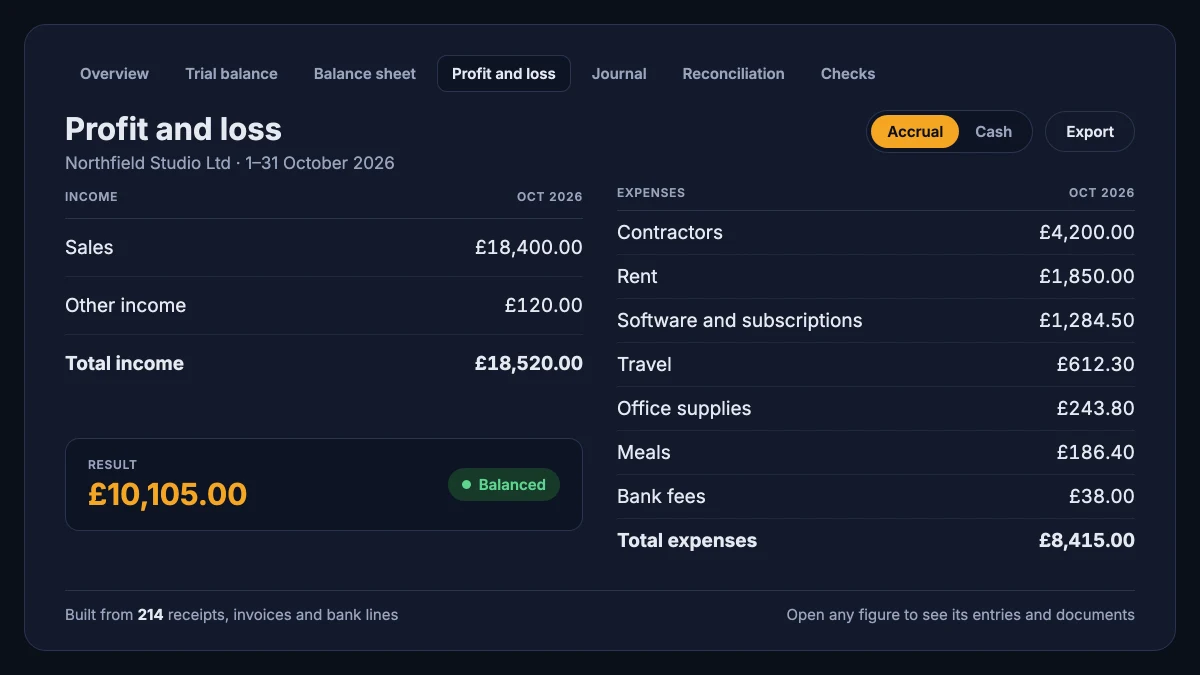
The Ledger keeps a double-entry journal of everything in your account and builds the reports from it: a trial balance, a balance sheet, a profit and loss account, the journal itself and your chart of accounts. Pick any period and open any figure to see the entries and the receipts behind it.

Your books are kept on both the accrual and the cash basis at once, so a sole trader on the cash basis and a limited company on accruals use the same Ledger, and switching takes one click. Each bank, card and payment account gets its own ledger account, and the Reconciliation page puts its ledger balance next to its latest statement's closing balance.

Profit and loss report in pounds in the SparkReceipt Ledger with an accrual and cash switch

Checks that find the mistakes, and fixes you can undo

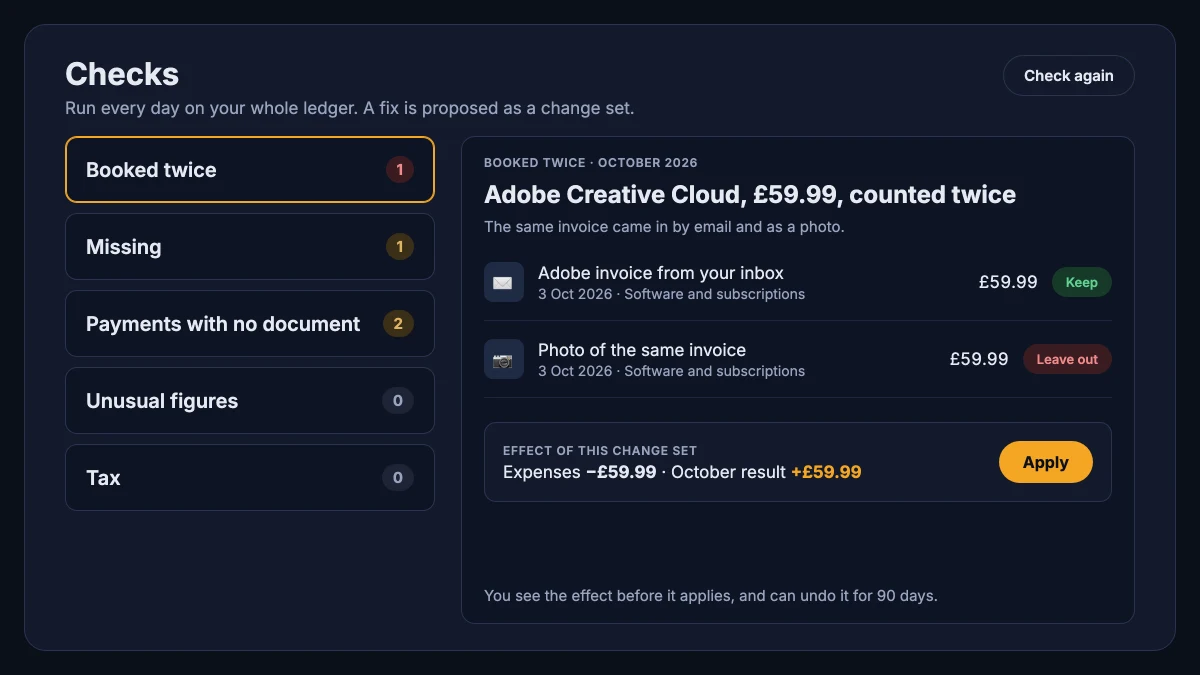
Most bookkeeping errors are not arithmetic. They are a bill counted twice because it arrived by email and as a photo, a bank statement left out, or a payment with no document behind it. Each one moves your profit and your VAT. The Ledger runs its Checks every day and sorts what it finds into lists: booked twice, missing, payments with no document, unusual figures and VAT lines that need a look.

When a check knows the fix, it proposes it as a change set. You see what it does to your result before it applies, apply it in one click, and undo it for 90 days if you change your mind.

Ledger checks listing a cost booked twice, with a proposed change set showing its effect on the result before it is applied

Your books next to your accountant's, month by month

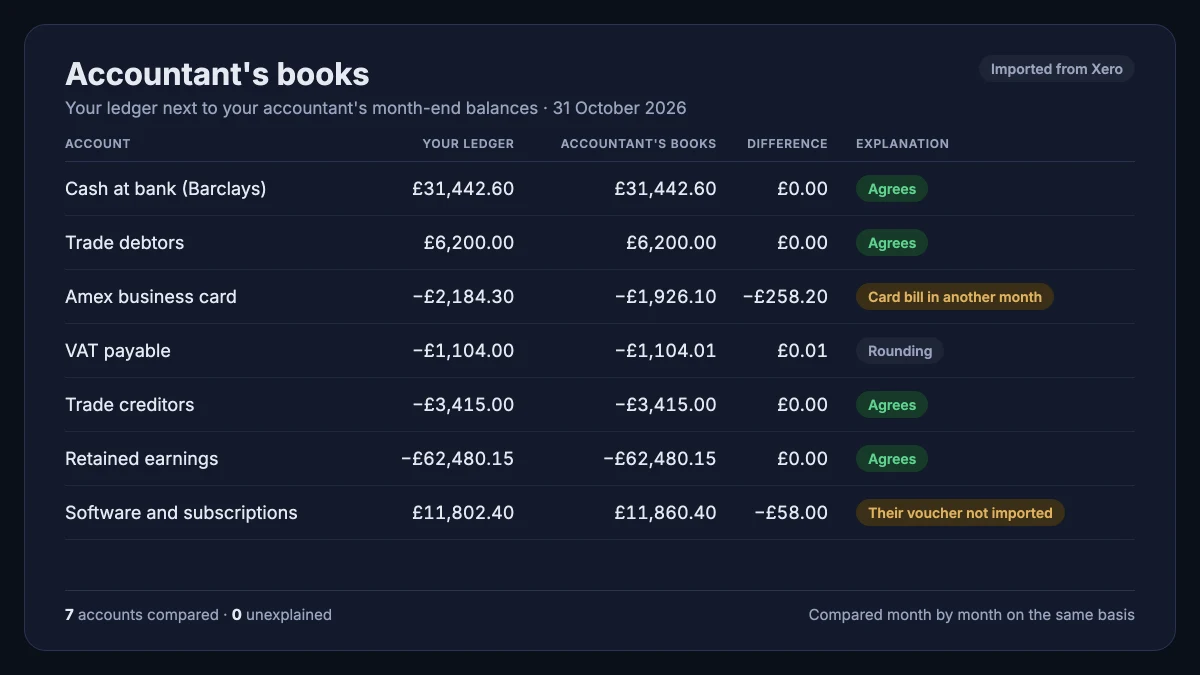
Many UK businesses have an accountant keeping the official books. The Accountant's books page imports their month-end balances, from a file out of any accounting program or straight from a connected Xero or QuickBooks Online account, and compares them with your Ledger month by month. Each difference gets an explanation: rounding, a card bill in another month, VAT settled in another month, or a note of your own. The differences go to your accountant as a memo, a PDF or a CSV file.

That is how we run our own company. SparkReceipt keeps its books in the Ledger and checks them every month against our accountant's books. Your accountant joins your account free with the Accountant role and sees the same Ledger you do.

Accountant's books page comparing the SparkReceipt Ledger's month-end balances in pounds with balances imported from Xero, with each difference explained

Month-end close, period locks and a year-end close in one step

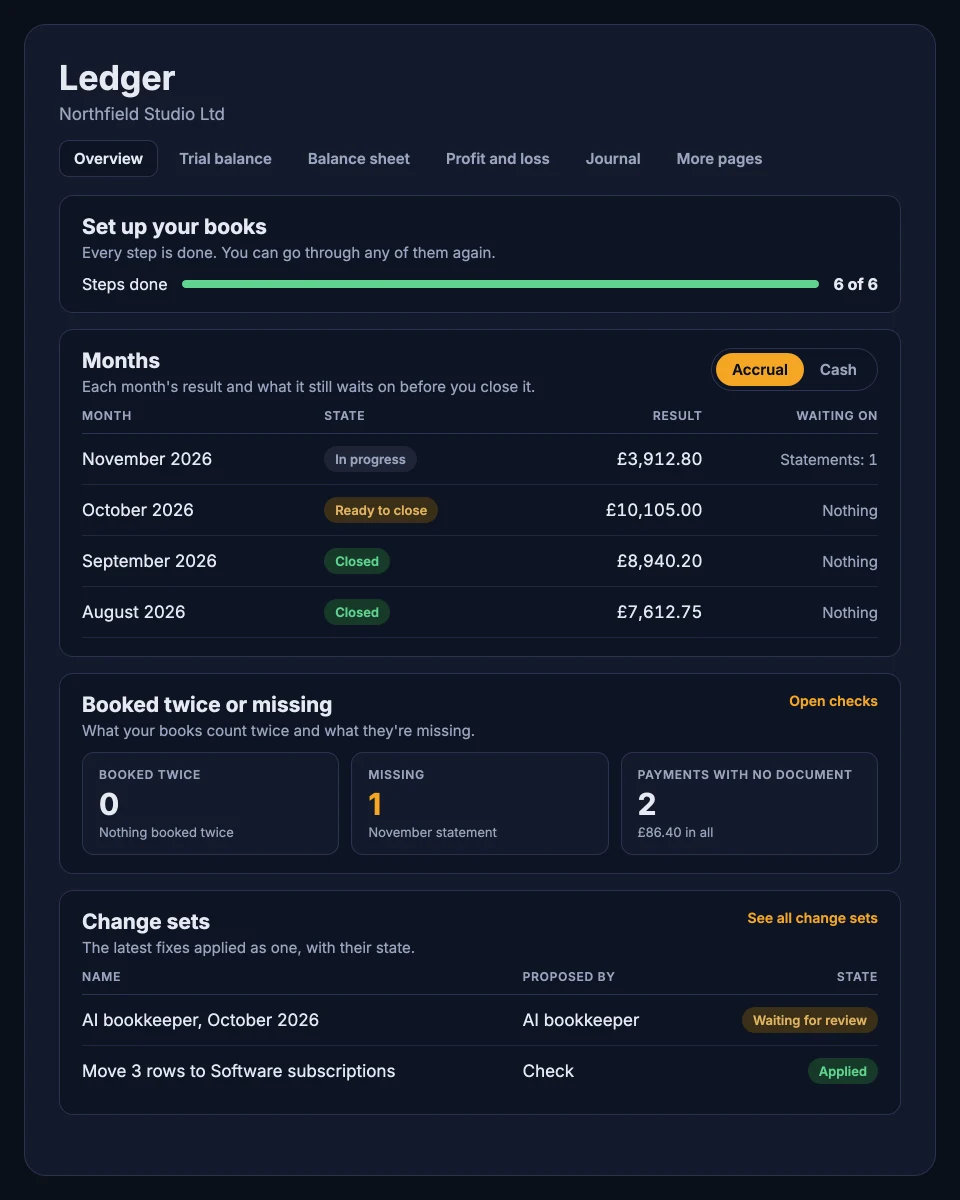
The Months list shows each month's result and what it still waits on. When a month reads Ready to close, close it, and a reminder email tells you when last month is waiting. Period locks keep a filed period fixed: a receipt that turns up later is booked as an adjustment on the first open day, so the VAT quarter you already submitted does not change under you.

At the end of your financial year, Year-end close takes income and expenses to zero and moves the year's result into equity: retained earnings for a limited company, or the owner's or partners' capital for a sole trader or partnership. When your accountant works in another program, export the journal as a CSV for any program, a Xero manual journal or a QuickBooks Online journal import.

Business owner closing the month in SparkReceipt

What bookkeeping software should do for a UK small business

Bookkeeping has two halves. The first is capture: getting every receipt, invoice and bank line into one place with the right date, amount, VAT and category. The second is the books: a double-entry ledger where every transaction lands on two accounts, a trial balance that proves they agree, and the reports your accountant, your bank and HMRC ask for.

Most bookkeeping software makes you do the first half by hand so it can do the second. SparkReceipt started with the first half: receipt scanning, email receipts and the bank statement extractor. The Ledger adds the second half on top, so a receipt you scanned this morning is in your profit and loss and your next VAT return this afternoon.

When you compare bookkeeping software in the UK, five things decide whether it saves you time:

  • The books come from the documents. Each document and bank line becomes its journal entries on its own, and the receipt stays attached to the entry, which is what MTD's digital records are about.
  • It catches mistakes before HMRC does. A duplicate bill overstates the VAT you reclaim. The Ledger's checks look for duplicates and missing statements every day.
  • It works out the VAT return. Boxes 1 to 9 for the standard scheme or the Flat Rate Scheme, with the due date from the VAT return deadlines.
  • It keeps both bases. Cash basis for many sole traders, accruals for companies. The Ledger keeps both, so a change of basis is a click, not a rebuild.
  • It works with your accountant. Your accountant joins free, sees the same Ledger and compares it with their own books.

Who the Ledger is for

Sole traders get a profit figure they can trust all year, ready for Self Assessment and, if your income brings you into it, the quarterly updates of Making Tax Digital for Income Tax that began in April 2026. The sole trader bookkeeping guide covers the habits that keep it easy.

VAT-registered businesses have the return worked out from the same records they keep anyway, with every box traceable to its documents.

Limited companies with an accountant keep the books current between year ends, see the same figures as the accountant and hand over months that are already checked and closed.

If you keep your books in Xero or QuickBooks Online and want to stay there, keep doing so: SparkReceipt still publishes each receipt there with the image attached, and the Ledger can compare its balances with theirs.

More in the Ledger

  • Bank lines booked for you. A tax payment, a loan repayment or money to or from the owner goes to its balance sheet account, and the booking waits for your yes.
  • Loans. Add a business loan on the Loans page, and the Ledger books its interest every month and splits each payment into principal and interest.
  • Fixed assets. Turn on Depreciate this purchase on an Expense, and the Ledger books its depreciation for each financial year of its useful life.
  • The AI bookkeeper. Every night it goes through your open months and proposes its fixes as a change set for each month. Nothing changes until you apply it.
  • Financial statements. At year end the Ledger makes the profit and loss and balance sheet in your country's layout, as a PDF or an Excel file.
  • The mobile app. The reports, checks, change sets and month close work in the iOS and Android app too.

How to start

Open the Ledger in the web app or the mobile app and a short setup asks a few questions once, such as your VAT return period, when your financial year starts and how you handle the VAT you charge, and every Ledger page works while you answer them.

Receipts and Bookkeeping in One Subscription

Capture, matching and the Ledger in one account.

Your accountant joins free

Your first user is included. Each extra user: £0.75/month, billed £9 annually.

Your accountant joins free

Pro

The essentials for keeping your receipts and expenses organised.

£4.92/mo

Total for 1 user · £59.00 billed annually

+ VAT/GST where applicable

Get Started

7-day free trial

50 documents / month

For receipts and invoices

  • AI scanning and categorisation
  • One connected email inbox
  • Bank statement extraction and matching
  • Mileage tracking and expense reports
  • QuickBooks Online, Xero and more
Recommended

Elite

For small businesses with 1 to 40 people.

£9.08/mo

Total for 1 user · £109.00 billed annually

+ VAT/GST where applicable

Get Started

7-day free trial

Unlimited documents*

Everything in Pro, plus:

  • Line-item extraction on every receipt
  • Several connected email inboxes
  • AI Fields for the details you need
  • AI rules for categorising and filing
  • Accounting export templates
  • Trips start when your phone connects to your car

Founder-led setup

Joel Ojala

Joel Ojala, co-founder, sets up SparkReceipt with you, tailored to how you work.

£350one-time setup

+ Elite for 1 user: £9.08/mo, billed annually

£459.00 today, then £109.00 a year

+ VAT/GST where applicable

Get set up with Joel

Annual plan only · No free trial

Everything in Elite

Plus a 60-minute session with Joel and one follow-up. In the session:

  • Your process, mapped at a high level
  • Logins for your team, and any extra users you need
  • Set up inbox scanning for receipts and invoices
  • Connect bank / upload your first statement
  • The phone app for paper receipts
  • Expense categories and your accounting integration
  • Anything else you'd like to go through

Unlimited linked accounts on every plan.

Compare all features

Pro

  • 1 user included. Add teammates any time for a flat fee per user, your accountant joins free on top, unlimited linked accounts
  • 50 documents per month (receipts and invoices, mass upload up to 100 at once)
  • AI scanning and categorisation
  • Automatic email receipt scanning from one connected inbox (Gmail, Outlook, IMAP)
  • Bank statement extraction and receipt matching (PDF, CSV, Excel)
  • The Ledger: double-entry books with profit and loss, balance sheet, month close and VAT return figures
  • Mileage tracker: GPS or manual trips, with per diem
  • Expense claims: submit receipts and trips, approve, mark paid
  • SparkAgent AI assistant, or connect your own AI over MCP
  • Integrations: QuickBooks Online, Xero, Zapier, Make, Pabbly, plus webhooks and API
  • Expense reports and exports: PDF, Excel, CSV, ZIP; 190 currencies

Elite

  • Everything in Pro, plus:
  • Unlimited documents: receipts and invoices, mass upload up to 100 at once
  • Line-item extraction on every receipt
  • Several connected email inboxes with automatic scanning
  • AI Fields: tell the AI exactly what to pull from every document
  • Plain-English AI rules: tell the AI how to categorise and file automatically
  • Trips start when your phone connects to your car
  • Export templates for Sage 50, DATEV, Wave, and Sage 200

Founder-led setup

  • A 60-minute setup session with Joel, co-founder, plus one follow-up session
  • Together we set up your process, team logins, inboxes, bank statements, categories and integrations
  • Everything in Elite, billed annually
  • 1 user included. Add teammates any time for a flat fee per user

Unlimited document scanning on Elite is subject to fair use. Bank statement extraction uses monthly renewable credits. Historical email imports include a free allowance; larger imports use credits, with the cost shown before you start.

Frequently Asked Questions

Bookkeeping software records a business's income and expenses as accounting entries and turns them into reports: a general ledger, a trial balance, a profit and loss account and a balance sheet. In SparkReceipt, the Ledger builds those entries from the receipts, invoices, bank lines and expense claims already in your account, so you do not key them into a second program.

No. The Ledger works out boxes 1 to 9 for the period and shows the due date. You enter the figures in your Making Tax Digital software, and we suggest going through them with your accountant before you file.

Yes. Set your flat rate percentage and the Ledger works out box 1 from it. In your first year of VAT registration, or as a limited cost trader, enter the percentage that applies to you, such as your trade's rate less 1 percentage point, or 16.5%. The input VAT the flat rate already allows for is shown separately so you can see why it is not reclaimed.

Pro and Elite. Both start with a 7-day free trial, and your accountant joins free with the Accountant role.

The account owner, admins and your accountant, in the web app and the mobile app. Members, Supervisors and Contributors do not see it.

Yes. Every document and bank line becomes a balanced journal entry with a debit and a credit, on ledger accounts from your chart of accounts. The trial balance shows the two sides agree, and the Checks flag anything that would throw them off.

You can keep them. SparkReceipt still publishes each receipt to Xero or QuickBooks Online with the image attached, and the Ledger can import your month-end balances from them to compare. If you would rather keep receipts and books in one place, the Ledger gives you the reports, the VAT return figures and the month and year-end close.

Yes. Your subscription includes 1 user, and your accountant joins free with the Accountant role. They see the same Ledger, can import their own month-end balances to compare, and can export the journal as a CSV, a Xero manual journal or a QuickBooks Online journal import.

Both. The Ledger keeps every entry on the accrual and the cash basis at the same time. Your setting picks which one the reports open on, and one click switches between them.

Lock the period once you have filed. Its entries then stay as you reported them, and a later fix is booked as an adjustment on the first open day after the period, so it lands in your next return. Checks that find a mistake propose a change set you can preview, apply and undo for 90 days.

Yes. Pick the date your books start, then import opening balances from Procountor, Xero, QuickBooks Online or a trial balance file, or enter them by hand with suggestions from your bank statements. Journal entries dated from your start date on can be imported from a CSV or Excel file.

Yes. SparkReceipt keeps its own company books in the Ledger and compares them every month with its accountant's books, using the same Accountant's books page you get.

Keep the Receipts. Get the Books.

Get Started
Get Started