
Mileage Allowance Calculator
Estimate your tax saving from business mileage using HMRC's simplified rates.
Estimate only, based on HMRC simplified (flat-rate) mileage rates. Once you use the flat rate for a vehicle you must keep using it for that vehicle. Your actual position depends on your circumstances — check with your accountant or HMRC.
Track every mile automatically
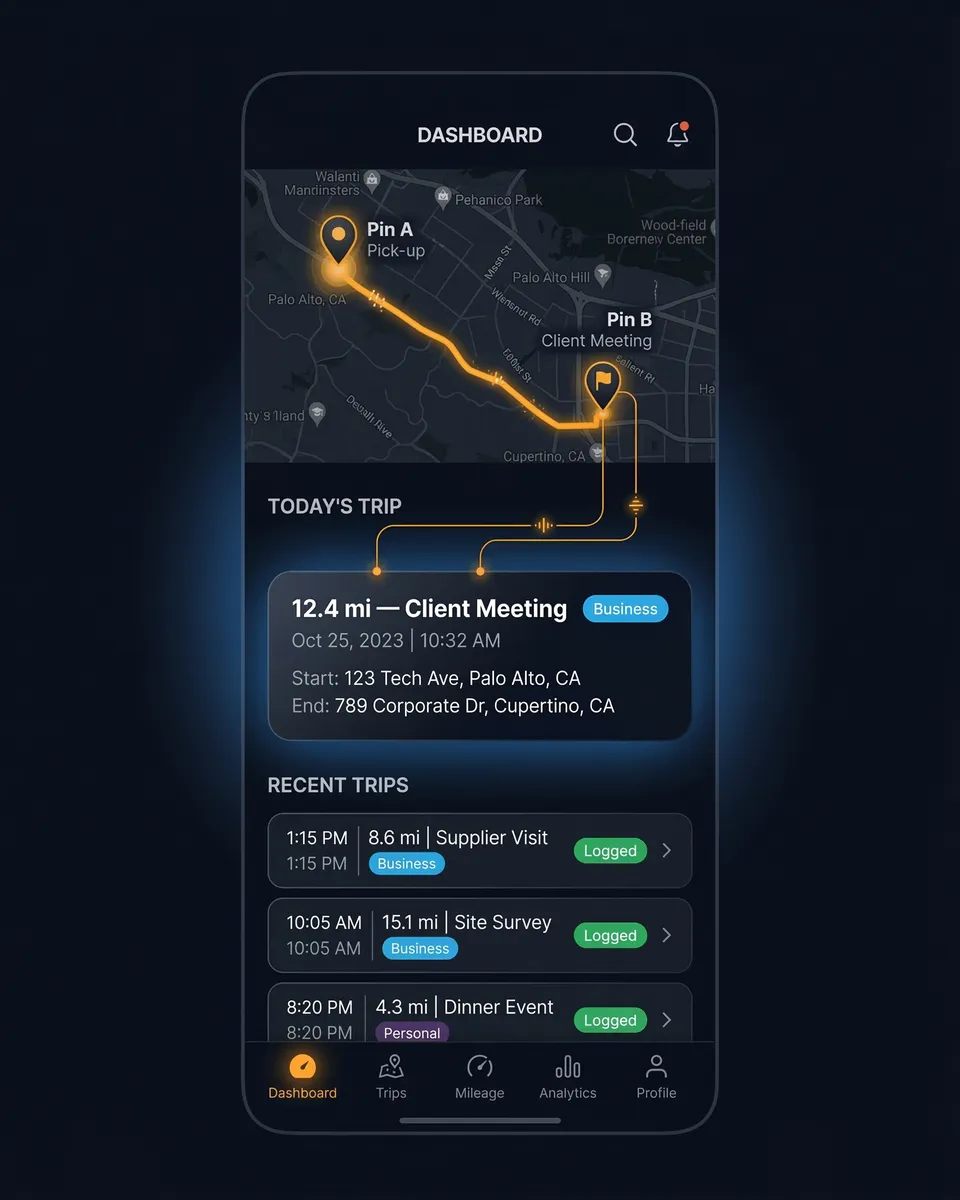
SparkReceipt's mileage tracker records your business trips by GPS or by hand, right in the same app that scans your receipts. Each trip shows what it's worth at the HMRC rate. Available on iPhone, Android, and the web.
How HMRC Simplified Mileage Works
Flat rate per mile, not actual costs
HMRC's simplified expenses let you claim a flat rate for every business mile instead of working out the actual running cost of your vehicle:
- Cars and vans — 55p a mile for the first 10,000 business miles in the tax year, then 25p a mile above that. (The first-10,000 rate rose from 45p to 55p for 2026–27.)
- Motorcycles — 24p a mile, with no threshold.
You can claim parking and toll charges on top of the flat rate. What you cannot claim is your ordinary commute from home to a permanent workplace.
Once you use the flat rate for a particular vehicle, you must keep using it for that vehicle for as long as it's in your business — you can't switch to actual costs partway through.
Simplified vs Actual Costs — Which Is Better?
When each method wins
| Factor | Simplified (flat rate) | Actual costs |
|---|---|---|
| Best for | Most sole traders, higher-mileage drivers | Expensive vehicles, high running costs |
| Record-keeping | A mileage log only | Every fuel, insurance, and repair receipt |
| Capital allowances | Built into the rate | Claimed separately |
| Switching | Locked to the vehicle once chosen | More flexible before you commit |
As a rough guide, 10,000 business miles at 55p is a £5,500 deduction — worth £1,100 off a basic-rate (20%) tax bill, or £2,200 at the higher rate. Whichever method you use, HMRC expects a mileage log with the date, destination, and business purpose of every trip.
Frequently Asked Questions
For 2026–27, HMRC's simplified (flat-rate) mileage for cars and vans is 55p a mile for the first 10,000 business miles in the tax year, then 25p a mile above 10,000. This is an increase from the long-standing 45p first-tier rate. Motorcycles are 24p a mile with no threshold.
Yes. Sole traders can use HMRC's simplified mileage rates as a fixed-rate deduction against business profits instead of working out actual vehicle running costs. Once you use the flat rate for a vehicle, you must keep using it for that vehicle.
The higher rate (55p for 2026–27) applies only to the first 10,000 business miles you drive in the tax year. Every business mile above 10,000 is claimed at 25p. The calculator applies both tiers automatically.
Yes. HMRC expects a record of the date, destination, and business purpose of every business trip, and the miles driven. A digital mileage tracker is accepted — SparkReceipt logs trips by GPS or by hand alongside your receipts.
The flat rate covers the running costs of the vehicle itself. You can still claim parking and toll charges, and other travel such as train or bus fares, separately. Your ordinary commute to a permanent workplace is not claimable.
It depends on your vehicle. The flat rate is simpler and suits most sole traders and higher-mileage drivers. Actual costs can be worth more if you run an expensive vehicle with high fuel, insurance, and repair bills — but they require you to keep every receipt. Work out both in the vehicle's first business year before you commit.