
Mileage Deduction Calculator
See what your business miles are worth at the 2026 IRS rates, then keep the log that proves it. Save the deduction you would otherwise lose to a missing record.
Enter your business miles, pick the tax year and your bracket, and the calculator shows the deduction and the income and self-employment tax it saves. The IRS raised the 2026 business rate mid-year, so the calculator offers both halves and a blended full-year option.
Based on IRS standard mileage rates. Actual savings depend on your individual tax situation.
Miss one drive in ten and $268 of this disappears. The IRS only allows the deduction with a log of each trip's date, destination, purpose, and distance, kept as you go.
Key takeaways
Two rates in 2026
72.5 cents per business mile from January 1 to June 30, 2026, and 76 cents from July 1 (IR-2026-29). Apply each rate to the miles driven in its period, or use the blended full-year option above.
The log is the deduction
The IRS requires a record with the date, destination, business purpose, and distance for each trip, made at or near the time you drove. Without it, the whole deduction can be disallowed in an audit.
It cuts two taxes
Mileage reduces net profit on Schedule C, so it lowers income tax and the 15.3% self-employment tax. At 10,000 miles that is roughly $2,600 back for a 22% bracket.
Standard beats actual for most
The standard rate needs a mileage log only. The actual expense method needs every vehicle receipt plus the log, and locks you in if you pick it first on a car you own.
Every trip logged with the date, route, distance, and purpose
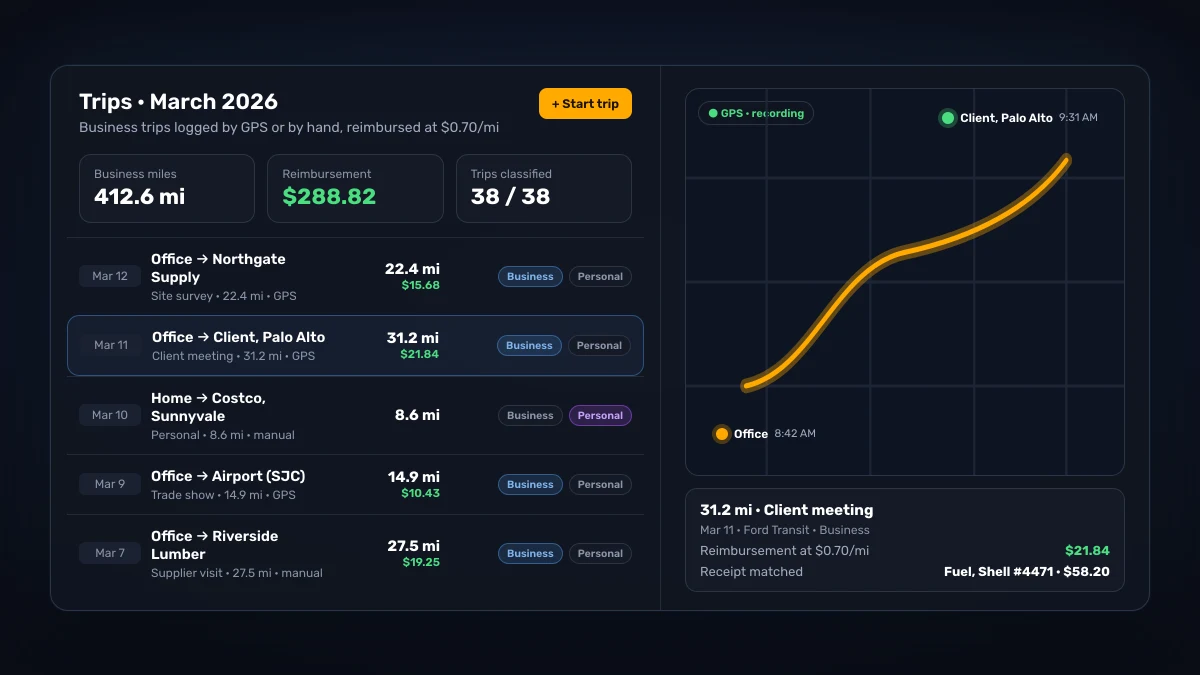
The number above only survives an audit if there is a log behind it. SparkReceipt's mileage tracker records each business trip by GPS or by hand as you drive it, classifies it as business or personal, and stores the date, route, distance, and purpose the IRS asks for. Set a rate per vehicle and each trip shows what it is worth, in the same app that scans your receipts. Available on iPhone, Android, and the web.
Miles next to the receipts they belong with
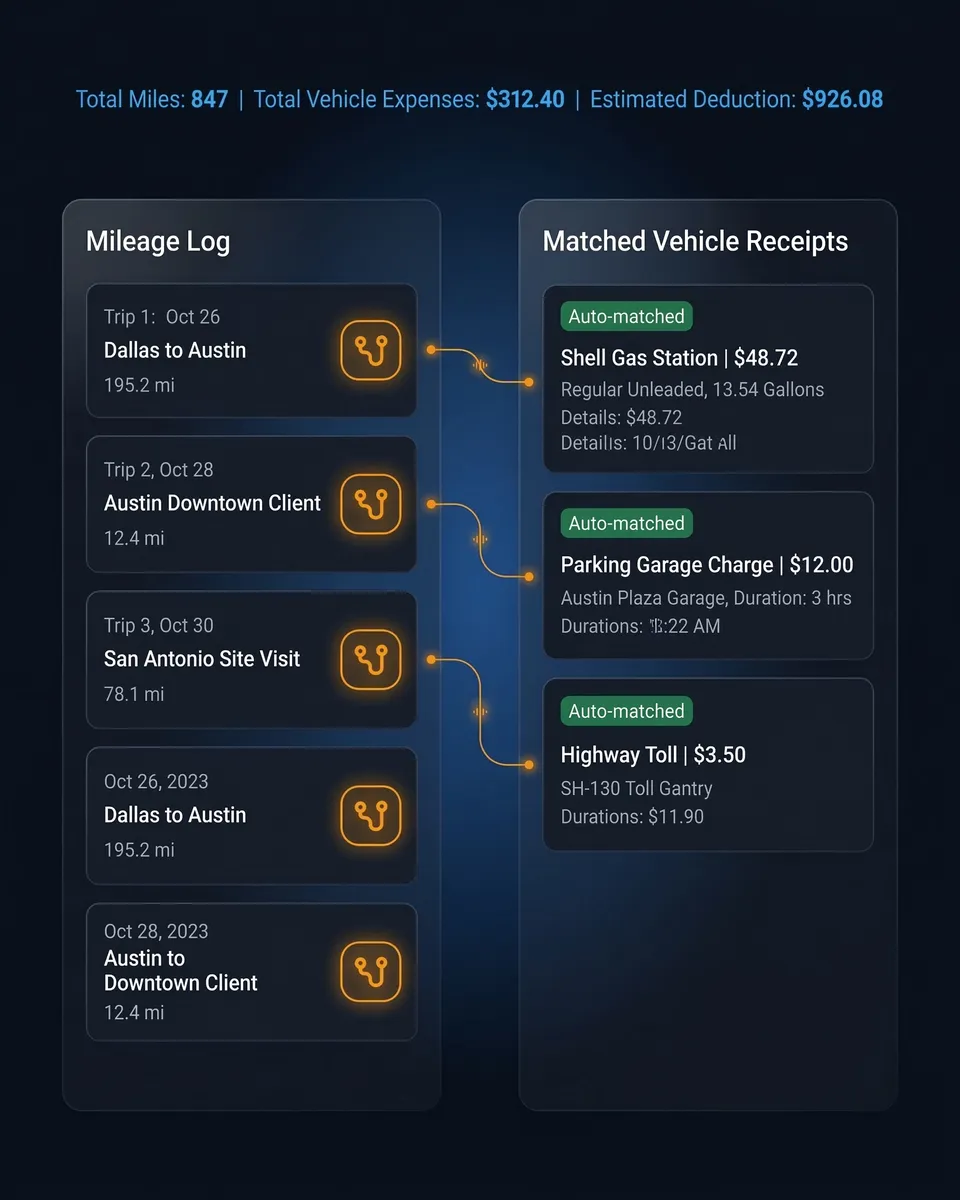
The standard mileage rate covers fuel and wear, but parking, tolls, and the business share of car-loan interest are deductible on top, and they need receipts. Snap them at the counter and the AI reads the merchant, date, and total in seconds. At tax time, trips and receipts export together, or your accountant reviews them in the same account for free.
How the IRS mileage deduction works
The IRS lets you deduct business miles at a flat rate: 70 cents per mile in 2025, then 72.5 cents per mile for January to June 2026 and 76 cents per mile from July 1, 2026, after a mid-year increase. You have two options:
- Standard mileage rate. Multiply your business miles by the IRS rate for the period. Simple, and no receipt tracking for gas or maintenance is needed.
- Actual expense method. Track every vehicle cost (gas, insurance, repairs, depreciation) and deduct the business-use percentage.
Most self-employed workers choose the standard rate because it is simpler and often produces a comparable deduction. The actual expense method can yield more if you drive an expensive vehicle with high maintenance costs. Whichever method you choose, the IRS requires a contemporaneous mileage log with the date, destination, business purpose, and distance for every trip.
Standard mileage vs. actual expenses: which saves more?
| Factor | Standard mileage | Actual expenses |
|---|---|---|
| Best for | High-mileage, fuel-efficient cars | Expensive vehicles, high repair costs |
| Tracking effort | Mileage log only | Every receipt plus the mileage log |
| First-year requirement | Must choose in the first year of use | Can switch from standard later |
| Depreciation | Built into the rate | Claimed separately (MACRS) |
| Lease restrictions | Must use for the entire lease term | Can switch year to year |
Pro tip: calculate both methods in your first year of business use. If the actual expense method gives a bigger deduction, you can still switch back to standard mileage in future years. But if you start with actual expenses on a car you own, you cannot switch to standard mileage for that vehicle. The full comparison with worked numbers is in standard mileage vs. actual expenses.
How to maximize your mileage deduction
Commonly missed deductible trips:
- Driving between job sites or client meetings
- Trips to the office supply store, post office, or bank for business
- Driving to professional development events or conferences
- Travel to a temporary work location (under one year)
- Rideshare and delivery driving (miles between pickups count too)
Not deductible: your regular commute from home to your main office.
Home office exception: if you have a qualifying home office, every business trip from home becomes deductible, since your home is your principal place of business.
The average self-employed worker drives 12,000 to 15,000 business miles per year. At the second-half 2026 rate of 76 cents per mile, that is a $9,120 to $11,400 deduction, saving $1,395 to $1,744 in self-employment tax alone before income tax. The key is consistent tracking: start logging every trip from day one with a mileage tracking app so you never miss a deductible mile. If you drive for an employer and claim the miles back instead, the expense report app for work and travel covers that side.
Frequently Asked Questions
There are two 2026 rates: 72.5 cents per business mile from January 1 to June 30, 2026 (up from 70 cents in 2025), and 76 cents per mile from July 1, 2026, after a mid-year increase. Apply each rate to the miles driven in its period. Medical and moving mileage (active military only) is 20.5 cents per mile, and charitable driving remains at 14 cents per mile.
Generally no. The Tax Cuts and Jobs Act (TCJA) eliminated the unreimbursed employee expense deduction for W-2 employees from 2018 through 2025, and the One Big Beautiful Bill Act (OBBBA) made this permanent. Only self-employed individuals, independent contractors, and business owners can claim the mileage deduction. Employees can still claim miles back from their employer under an accountable plan.
Yes. The IRS requires contemporaneous records with the date of the trip, the destination, the business purpose, and the distance driven. Without a proper log, the IRS can disallow your entire mileage deduction in an audit. Digital mileage tracking apps that record trips as they happen are accepted as valid records.
It depends. If you used standard mileage in the first year you placed a car in business service, you can switch to actual expenses in a later year. If you chose actual expenses first on a car you own, you generally cannot switch to standard mileage for that vehicle. For leased vehicles, you must use the same method for the entire lease term.
Yes. The mileage deduction reduces your net self-employment income on Schedule C, which lowers both your income tax and your self-employment tax (Social Security and Medicare). At the 15.3% SE tax rate, every $1,000 in mileage deductions saves you roughly $141 in SE tax (after the 92.35% adjustment) on top of your income tax savings.
Business mileage includes driving between work locations, trips to clients or customers, travel to business meetings, runs to the bank or post office for business, and trips to buy supplies. Your regular commute from home to a fixed office does not count. If you have a qualifying home office, business trips from home are deductible.
Record each trip when it happens, with the date, where you went, why, and how far. A mileage deduction calculator tells you what the miles are worth; a mileage tracker app like SparkReceipt makes the log automatic by recording trips by GPS, classifying them as business or personal, and exporting them with your receipts at tax time.
Stop Missing Deductible Miles
Get StartedMore Tools and Guides
Home Office Deduction Calculator
Simplified vs. regular method
Self-Employment Tax Calculator
What you owe, and what deductions save
Mileage Tracker
Log trips by GPS or by hand
2026 IRS Mileage Rate
Both 2026 rates and who can claim
Self-Employed Mileage Deduction
Rules, records, and worked examples
Expense Report App for Work
Claiming miles back from an employer