


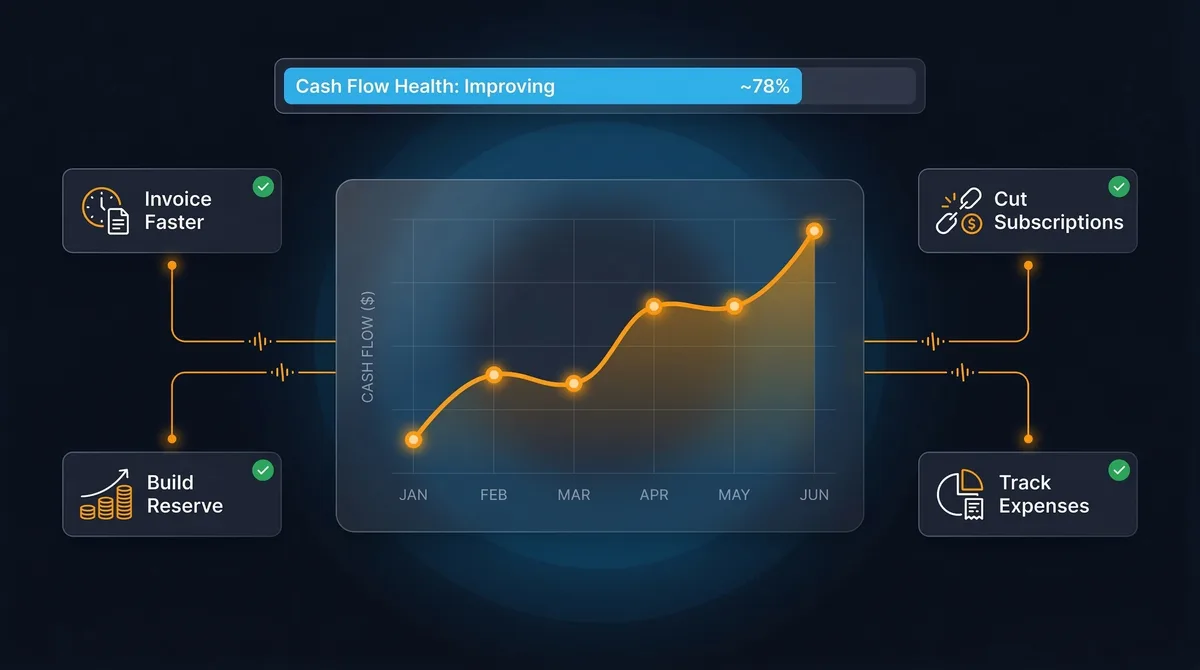
Improving cash flow as a freelancer isn’t about earning more – it’s about managing the timing of money coming in and going out. Even high-earning freelancers struggle with cash flow when payments are delayed, expenses cluster together, or tax season hits.
Here are proven strategies that work for irregular income.
Speed Up Your Inflows
1. Invoice the Same Day You Deliver
Every day between delivery and invoicing is a day added to your payment timeline. If you deliver on March 1 but invoice on March 15 with Net 30 terms, you won’t see cash until mid-April at the earliest. Invoice immediately and you’ve cut two weeks off the wait.
2. Shorten Payment Terms
Net 30 is a convention, not a law. Many clients will accept Net 15 or even Net 7 – especially if you ask at the start of the relationship, not after an invoice is overdue. For new clients, start with shorter terms and extend them once trust is established.
3. Offer Early Payment Incentives
A 2% discount for payment within 10 days (2/10 Net 30) costs you a small amount but dramatically accelerates cash inflow. On a $5,000 invoice, that’s $100 to get paid 20 days earlier – worth it when cash is tight.
4. Require Upfront Deposits
For projects over $2,000, require 25-50% upfront. This isn’t unusual – it’s professional. It also filters out clients who might not pay at all. Frame it as standard practice: “We begin work upon receipt of a 30% deposit.”
5. Use Milestone Billing
For longer projects, don’t wait until completion to invoice. Break the project into phases and bill at each milestone. A 3-month project should generate at least 3 invoices, not 1.
Slow Down Your Outflows
6. Negotiate Vendor Terms
If you’re paying vendors immediately, ask for Net 15 or Net 30 terms. Many are willing, especially for ongoing relationships. Every day you delay an outflow without penalty improves your cash position.
7. Use Credit Cards Strategically
Pay business expenses on a credit card and pay the full balance monthly. This effectively gives you a 30-day float on expenses. Never carry a balance – the interest destroys any cash flow benefit.
8. Audit Recurring Expenses Monthly
Subscriptions creep up. That $29/month tool you tried three months ago and forgot about. The upgraded plan you no longer need. Review every recurring charge monthly. Use SparkReceipt’s AI receipt scanner to capture and categorize all expenses – it makes the audit effortless.
9. Time Large Purchases
Need new equipment? Wait until after a large payment arrives. Need to renew annual subscriptions? Choose renewal dates that align with your highest-income months.
Build a Cash Buffer
10. The 3-Month Reserve Rule
Calculate your average monthly business expenses (rent, subscriptions, insurance, estimated taxes, basic living costs). Multiply by 3. That’s your target cash reserve. Build toward it by setting aside 10-15% of every payment received until you hit the target.
11. Separate Your Money
Maintain at least three accounts:
- Operating account – Where client payments land and business expenses are paid
- Tax reserve – 25-30% of every payment goes here immediately
- Emergency reserve – Your 3-month buffer. Don’t touch it unless you truly need it.
Increase Visibility
12. Track Every Expense Automatically
You can’t improve what you can’t see. SparkReceipt captures receipts via your phone camera, email inbox, and bank statement uploads – then categorizes everything automatically. When you know exactly where money goes, you can find leaks and forecast accurately.
13. Do a Weekly Cash Check
Every Monday, spend 5 minutes answering:
- What’s my current bank balance?
- What payments are expected this week?
- What expenses are due this week?
- Any red flags for the next 30 days?
14. Share Data With Your Accountant
Your accountant can spot cash flow risks you’ll miss. Give them clean, categorized expense data regularly – not just at tax time. SparkReceipt’s free accountant access makes this easy.
Diversify Your Income Timing
15. Mix Project and Retainer Work
Project income is lumpy. Retainer income is predictable. Even one retainer client providing $2,000-3,000/month creates a reliable cash flow base that smooths out the project-to-project swings.
16. Create Recurring Revenue
Maintenance packages, monthly check-ins, ongoing support agreements – any structure that generates regular, predictable payments improves cash flow stability.
Key Takeaways
- Cash flow improvement is about timing, not just earning more
- Speed up inflows: invoice immediately, shorten terms, require deposits
- Slow down outflows: negotiate terms, audit subscriptions, time large purchases
- Build a 3-month cash reserve – it’s your safety net
- Track every expense automatically so you can see your cash flow clearly
- Mix retainer and project work for more predictable cash flow
Related reading: Cash Flow Management for Freelancers and Small Business: The Complete Guide
Try SparkReceipt free
AI-powered receipt scanner and expense tracker for small business.
Get started