



Last year, a freelance graphic designer named Priya earned $68,000 from five different clients. Tax season hit, and she realized she hadn’t set aside a single dollar for taxes. The bill? Over $15,000, plus a $340 underpayment penalty. That’s the reality for thousands of independent contractors every year.
If you’ve recently received your first 1099-NEC or you’ve been freelancing for a while without fully understanding your tax obligations, you’re not alone. Independent contractor taxes work differently from W-2 employee taxes, and nobody teaches you the rules until you owe money.
This guide covers everything: how independent contractor taxes work, the exact rates you’ll pay in 2026, which deductions can shrink your bill, and how to avoid IRS penalties. Whether you’re a freelancer, gig worker, consultant, or rideshare driver, you’ll walk away knowing exactly what you owe and what to do about it.
Consult a qualified tax professional for advice specific to your situation.
What Is an Independent Contractor?
An independent contractor is a self-employed worker who provides services to clients without being classified as an employee. The IRS uses three criteria to determine your classification: behavioral control (do you set your own schedule?), financial control (do you use your own tools and handle your own expenses?), and the type of relationship (is there a written contract rather than employee benefits?).
If you answer yes to most of those, you’re likely an independent contractor.
Common examples include freelance writers, web developers, graphic designers, consultants, rideshare drivers, real estate agents, photographers, and delivery workers. If your clients send you a Form 1099-NEC instead of a W-2, you’re operating as an independent contractor in their eyes.
The key distinction matters for independent contractor taxes. W-2 employees have taxes withheld from every paycheck by their employer. Independent contractors receive their full payment with zero taxes withheld. That means you’re responsible for calculating, saving, and paying your own taxes throughout the year.
How Independent Contractor Taxes Work
Understanding independent contractor taxes starts with knowing what you owe. As a 1099 worker, you’re responsible for two main types of tax: self-employment tax and income tax. Some contractors also owe state income tax depending on where they live. The IRS Self-Employed Tax Center is the official resource, but here’s the practical breakdown.
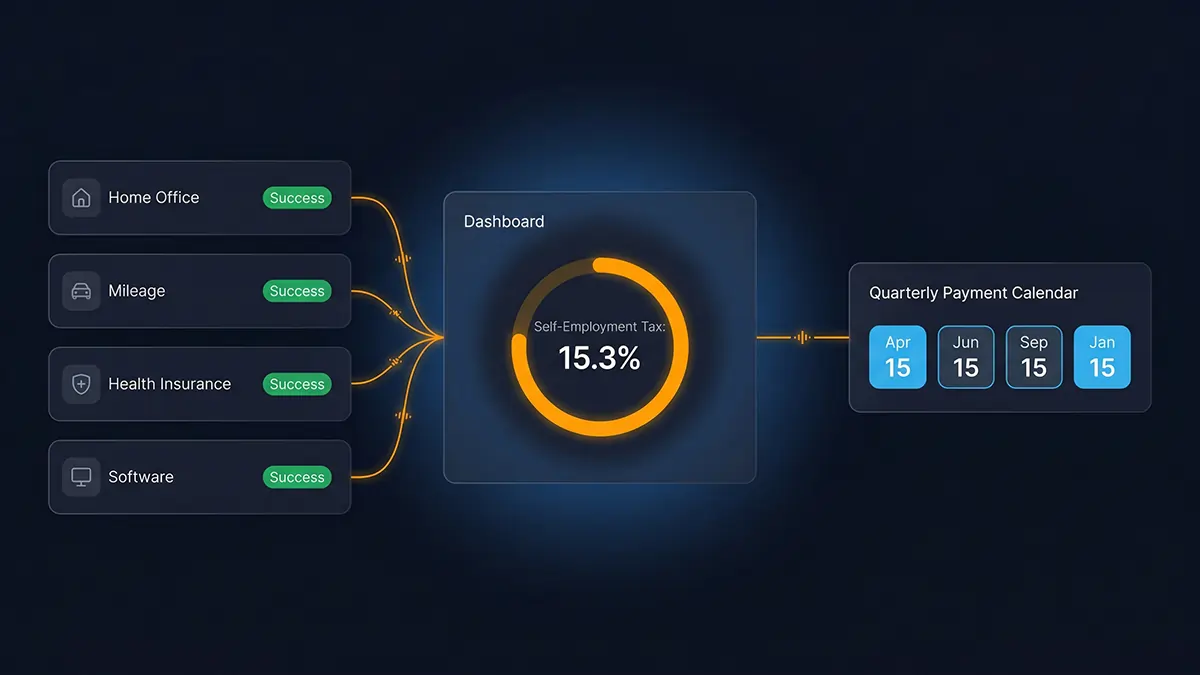
Self-Employment Tax (15.3%)
This is the tax that catches most new contractors off guard. W-2 employees split Social Security and Medicare taxes with their employer, each paying 7.65%. As an independent contractor, you pay both halves.
The self-employment tax rate breaks down like this:
- Social Security: 12.4% on net earnings up to the wage base ($178,200 in 2026)
- Medicare: 2.9% on all net earnings
- Additional Medicare: 0.9% on earnings above $200,000 (single filers)
There’s one adjustment that softens the blow. The IRS lets you calculate SE tax on 92.35% of your net earnings, not the full amount. This simulates the employer-half deduction that W-2 workers receive.
Federal Income Tax
On top of self-employment tax, you owe federal income tax on your net profit. Your tax bracket depends on your total taxable income after deductions.
For 2026, the standard deduction is $15,000 for single filers under the updated OBBBA tax law. Your net self-employment income minus the deductible half of SE tax and any other deductions determines your taxable income, and the standard federal brackets apply.
State Income Tax
If you live in a state with income tax, you’ll owe that too. States like California, New York, and New Jersey add significant percentages on top of federal taxes. Nine states, including Texas, Florida, and Washington, have no state income tax at all.
How Much Should You Set Aside for Taxes?
This is the question every independent contractor asks. The short answer: 25-30% of your net income covers most situations. But the exact amount depends on your income level and deductions.
Here’s what the math looks like at different income levels for a single filer with typical deductions:
| Net SE Income | SE Tax (15.3%) | Federal Income Tax | Total Estimated Tax | Effective Rate |
|---|---|---|---|---|
| $30,000 | $4,238 | ~$1,800 | ~$6,038 | ~20% |
| $50,000 | $7,065 | ~$4,200 | ~$11,265 | ~22.5% |
| $75,000 | $10,597 | ~$7,200 | ~$17,797 | ~23.7% |
| $100,000 | $14,130 | ~$10,800 | ~$24,930 | ~24.9% |
These numbers don’t include state income tax, which can add 3-10% depending on where you live.
Take Marcus, a freelance copywriter in Austin, Texas. He earned $75,000 in net profit last year with $12,000 in business expenses. Because Texas has no state income tax, his total federal obligation came to roughly $17,800. He set aside 25% of each payment, which covered his quarterly estimates comfortably. That discipline saved him from a year-end surprise.
Want an exact number? Use our self-employment tax calculator to see your breakdown in seconds.
Quarterly Estimated Tax Payments
Since no employer withholds taxes from your payments, the IRS expects you to pay as you earn. That means quarterly estimated tax payments, not one lump sum in April.
2026 Due Dates
| Quarter | Income Period | Payment Due |
|---|---|---|
| Q1 | January 1 – March 31 | April 15, 2026 |
| Q2 | April 1 – May 31 | June 15, 2026 |
| Q3 | June 1 – August 31 | September 15, 2026 |
| Q4 | September 1 – December 31 | January 15, 2027 |
How to Calculate Your Quarterly Payment
Two methods work:
Method 1: Prior Year Safe Harbor
Pay 100% of last year’s total tax liability, divided by four. If your adjusted gross income was above $150,000, pay 110% instead. This protects you from underpayment penalties even if you earn more this year.
Method 2: Current Year Estimate
Estimate your income for the quarter, calculate your tax, and pay that amount. This works better if your income varies significantly from year to year.
How to Pay
You can pay through IRS Direct Pay (free, from your bank account), the Electronic Federal Tax Payment System (EFTPS), or by mailing Form 1040-ES with a check. IRS Direct Pay is the fastest option for most independent contractors.
What Happens If You Don’t Pay
The IRS charges an underpayment penalty when you owe more than $1,000 at filing time and haven’t made sufficient quarterly payments. The current penalty rate is approximately 7-8% annualized. On a $5,000 shortfall, that’s roughly $350-400 in penalties on top of what you already owe.
Top 1099 Tax Deductions for Independent Contractors
Deductions are your best tool for lowering your independent contractor tax bill. Every dollar you deduct reduces both your income tax and your self-employment tax. That means $1,000 in 1099 tax deductions saves you roughly $300 or more in taxes.
Here are the deductions most independent contractors should be claiming (see our full tax deductions guide for freelancers for even more):
- Home office expenses
- Vehicle and mileage (72.5¢/mile in 2026)
- Health insurance premiums
- Retirement contributions (SEP IRA, Solo 401k)
- Software, supplies, and equipment
- Professional development
- Business meals (50%)
- Phone and internet (business portion)
- QBI deduction (23% in 2026)
Home Office Deduction
If you use a dedicated space in your home regularly and exclusively for business, you can deduct it. The simplified method allows $5 per square foot, up to 300 square feet ($1,500 maximum). The regular method calculates actual expenses based on the percentage of your home used for business.
Read our complete home office deduction guide for details on both methods.
Vehicle and Mileage
Drive for business? You can deduct 72.5 cents per mile in 2026 using the standard mileage rate, or track actual vehicle expenses (gas, insurance, maintenance, depreciation). Most contractors find the standard rate simpler and often more valuable. Check our self-employed mileage deduction guide for a breakdown of both methods.
Health Insurance Premiums
If you pay for your own health insurance and aren’t eligible for coverage through a spouse’s employer, you can deduct 100% of your premiums. This deduction is taken on your Form 1040, not Schedule C, which means it reduces your income tax but not your SE tax.
Retirement Contributions
Contributing to a SEP IRA (up to 25% of net SE income) or a Solo 401(k) (up to $23,500 in employee contributions, plus 25% employer contributions) reduces your taxable income. These contributions lower your tax bill now and build retirement savings.
Software and Subscriptions
Design tools, project management apps, accounting software, website hosting, domain registrations. If you use it for business, it’s deductible.
Professional Development
Courses, certifications, books, conferences, and workshops related to your business are deductible. This includes online learning platforms and industry events.
Business Meals
You can deduct 50% of meals with clients or business associates when business is discussed. The IRS requires you to document the date, amount, who attended, and the business purpose (see IRS Publication 463 for full rules). Keep the receipt and note those details immediately.
Phone and Internet
If you use your personal phone and internet for business, you can deduct the business-use percentage. If 60% of your phone usage is for business, deduct 60% of the bill.
QBI Deduction (23% in 2026)
Under the One Big Beautiful Bill Act, the Qualified Business Income deduction increased from 20% to 23% for tax years beginning after December 31, 2025 (20% still applies for the 2025 tax year) for 2026. This deduction applies to your net business income and is claimed on your personal return. For a contractor earning $75,000 in net profit, the QBI deduction is worth roughly $17,250 off your taxable income.
Learn more about OBBBA tax changes and the full list of 2026 small business tax deductions.
How to Track Expenses and Maximize Deductions
Here’s a truth that costs independent contractors thousands every year: it’s not the deductions you don’t know about that hurt you. It’s the ones you forget to track.
Consider Jenna, a freelance marketing consultant who earned $85,000 last year. She claimed $6,000 in deductions based on what she could remember and reconstruct from bank statements. After switching to a receipt tracking system, she found she’d missed over $4,200 in legitimate business expenses, including software subscriptions paid from her personal card, Uber rides to client meetings, and a dozen business lunches. That $4,200 in missed deductions cost her roughly $1,300 in extra taxes.
The system that prevents this doesn’t need to be complicated:
- Separate business and personal spending. Use a dedicated business credit or debit card whenever possible.
- Scan every receipt immediately. Paper receipts fade. Digital copies don’t.
- Categorize expenses as they happen. Don’t wait until December to sort 12 months of transactions.
- Review monthly. A 15-minute check each month prevents a 15-hour scramble in April.
- Export reports at tax time. Clean, categorized reports make filing faster and cheaper if you use a tax preparer.
SparkReceipt automates steps 2 through 5. Snap a photo of a receipt, and AI extracts the vendor, amount, date, and tax, then categorizes it automatically. When tax time arrives, export a clean report organized by expense category instead of digging through shoeboxes and email inboxes. You can also use SparkReceipt as a receipt tracker for taxes to build an audit-proof paper trail year-round.
Independent Contractor vs. Employee: Side-by-Side Comparison
Still wondering whether 1099 or W-2 status is better? Here’s how they compare:
| W-2 Employee | Independent Contractor (1099) | |
|---|---|---|
| Tax withholding | Employer withholds from each paycheck | You handle all tax payments |
| Self-employment tax | Split 50/50 with employer (7.65% each) | You pay full 15.3% |
| Business deductions | Limited to standard deduction | All ordinary business expenses deductible |
| Quarterly payments | Not typically required | Required if you owe $1,000+ |
| Tax forms received | W-2 | 1099-NEC |
| Forms you file | 1040 | 1040, Schedule C, Schedule SE |
| Benefits | Often provided (health, retirement, PTO) | You fund your own |
| Income control | Fixed salary or hourly rate | Set your own rates, unlimited earning |
| Schedule | Set by employer | You decide when and how to work |
The bottom line: employees have simpler taxes but less control. Contractors have more complexity but more deductions and more flexibility.
Forms You’ll Need to File
Independent contractor taxes involve several IRS forms:
- Form 1099-NEC: You’ll receive this from each client who paid you $600 or more. It reports your gross income.
- Schedule C (Form 1040): This is where you report your business income and deduct business expenses to calculate net profit.
- Schedule SE (Form 1040): This calculates your self-employment tax based on your Schedule C net profit.
- Form 1040-ES: Use this to calculate and submit quarterly estimated tax payments throughout the year.
- Form 8829: Required if you’re claiming the home office deduction using the regular method.
One important note: you must report all independent contractor income, even if a client didn’t send you a 1099. The IRS threshold for issuing a 1099-NEC is $600, but your obligation to report income starts at $400 in net self-employment earnings.
Common Independent Contractor Tax Mistakes
Filing independent contractor taxes gets easier with experience, but these are the mistakes that cost people the most money:
- Not setting aside money for taxes. If you spend everything you earn, you’ll face a painful bill in April. Automate a transfer of 25-30% from every payment into a separate savings account.
- Missing quarterly payment deadlines. The IRS charges penalties, and those penalties compound. Set calendar reminders for each due date.
- Failing to track deductible expenses. Every missed receipt is money left on the table. A $50 business lunch you forgot to track costs you $15 in unnecessary taxes.
- Mixing personal and business finances. Using one account for everything makes it harder to identify deductions and raises red flags during audits.
- Forgetting the QBI deduction. The 23% Qualified Business Income deduction is one of the largest tax breaks available to independent contractors in 2026. Don’t leave it unclaimed.
- Not keeping receipts. The IRS requires documentation for all business expenses. A receipt scanner eliminates the risk of lost paper receipts.
Frequently Asked Questions
How much tax does an independent contractor pay?
Independent contractors pay 15.3% in self-employment tax (Social Security and Medicare) plus federal income tax based on their tax bracket. The total effective tax rate for most contractors falls between 20% and 30%, depending on income level and deductions.
Do I have to pay taxes if I made less than $600 as a contractor?
Yes. The $600 threshold only determines whether a client must issue you a 1099. If your net self-employment earnings are $400 or more from all sources combined, you must file and pay self-employment tax.
How much should I set aside for 1099 taxes?
Set aside 25-30% of your net income (gross income minus business expenses) for federal taxes. Add your state income tax rate if applicable. For a precise calculation, use our self-employment tax calculator.
What happens if I don’t pay quarterly estimated taxes?
The IRS charges an underpayment penalty, currently around 7-8% annualized on the amount you should have paid. You can avoid penalties by paying at least 100% of your prior year’s tax liability through quarterly payments (110% if your AGI exceeded $150,000).
Can I deduct business expenses as an independent contractor?
Yes. All ordinary and necessary business expenses are deductible on Schedule C. This includes home office costs, mileage, health insurance premiums, software, supplies, professional development, and business meals (at 50%). Every deduction reduces both your income tax and self-employment tax.
Is it better to be a W-2 employee or an independent contractor?
It depends on your situation. Contractors earn more per hour (since clients don’t pay benefits), have more deductions available, and control their schedule. But they also carry the full 15.3% SE tax burden and handle their own benefits. For many skilled professionals, the tax advantages and income potential of contracting outweigh the complexity.
Take Control of Your Independent Contractor Taxes
Once you understand how independent contractor taxes work, the system is straightforward:
- Know your rates. Self-employment tax is 15.3%. Budget 25-30% total.
- Pay quarterly. Four payments spread the burden and avoid penalties.
- Track everything. Every deductible expense reduces what you owe.
- Claim the QBI deduction. 23% off your qualified business income in 2026.
The contractors who overpay are the ones who don’t track expenses consistently. The ones who get penalized are the ones who skip quarterly payments. Both problems are preventable with the right system.
Start by calculating your self-employment tax to see exactly what you owe. Then set up a system to track your expenses throughout the year so every deduction makes it onto your return.
This article provides general tax information for educational purposes. Consult a qualified tax professional for advice specific to your situation.
Try SparkReceipt free
AI-powered receipt scanner and expense tracker for small business.
Get started