
Itemized Receipt: What It Is, What It Must Show, and When You Need One
 Written by Sampsa Vainio
An itemized receipt lists each item or service you paid for with its own price, together with the seller's name, the date, the tax and the total. The slip from the card terminal shows only the total. That difference decides whether a receipt can prove a tax deduction, an expense claim or an FSA claim.
This guide covers what it must show, an annotated example, when the IRS, your employer or your FSA administrator needs one, and how to get one when all you kept was the card slip.
What is an itemized receipt?
It is a receipt that breaks a purchase into its lines. It answers "what did you buy", where a card slip only answers "how much did you pay". A complete itemized receipt shows:
- The seller: business name and, usually, address
- The date, and often the time
- Each item or service: a description, the quantity and the price
- The subtotal, the tax, and any tip, fee or discount as separate amounts
- The total and how you paid (card type and last four digits, cash, gift card)
In the UK and Australia the same document is spelled an itemised receipt. The meaning is the same.
Itemized receipt vs regular receipt
Most purchases produce two or three records, and only one of them is itemized:
| What it shows | Itemized | Card terminal slip | Card or bank statement line |
|---|---|---|---|
| Seller | Full name and address | Name, often abbreviated | Name, often abbreviated or coded |
| Date | Yes | Yes | Yes (posting date) |
| Each item and its price | Yes | No | No |
| Tax as a separate amount | Yes | Rarely | No |
| Total paid | Yes | Yes | Yes |
| Proves what you bought | Yes | No | No |
A non itemized receipt is any receipt that shows a total without the items: the "customer copy" from a restaurant card reader, a tap-to-pay slip, a digital wallet notification or a statement line. It proves you paid. It doesn't show what for, so "HARBOR OFFICE SUP $103.31" can't tell anyone whether you bought printer ink for the business or a phone charger for yourself. The guide on credit card statements vs receipts covers when a statement can and can't stand in for a receipt.
Contactless payment has made this more common, not less. Tap to pay, self-checkout and "do you want a receipt?" mean many purchases leave only the slip or nothing at all, unless you ask for the full receipt or take the email version.
Itemized receipt example
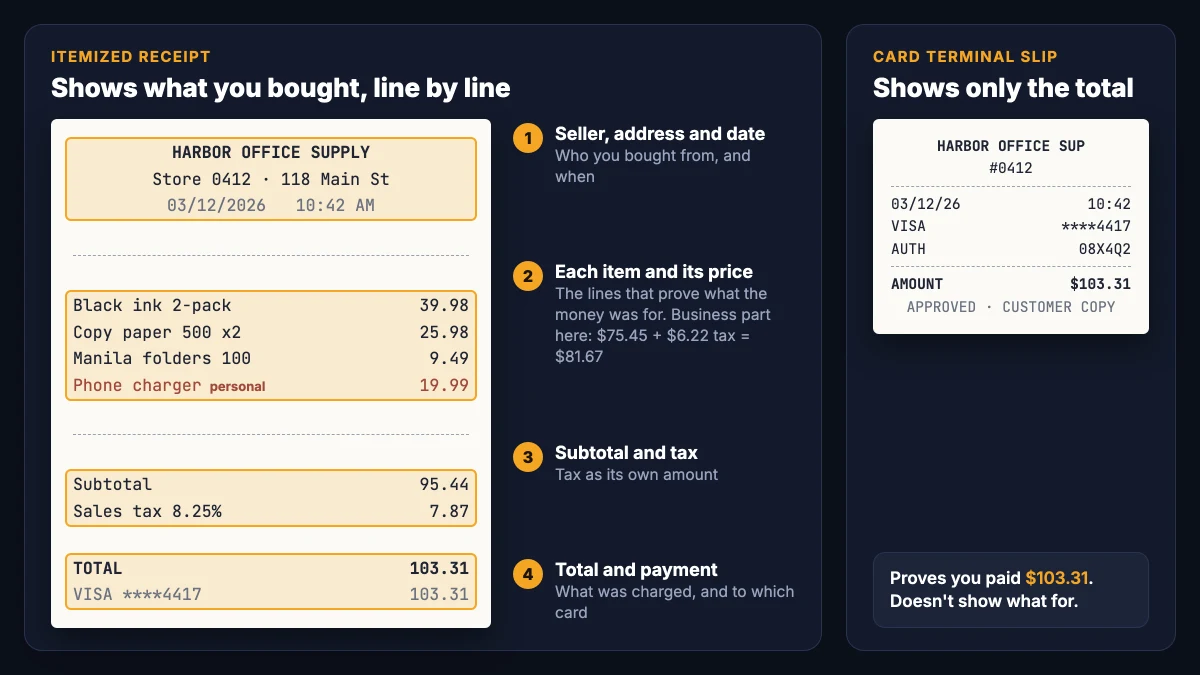
On the left is a typical one from an office supply store. Reading it top to bottom:
- Seller, address and date: Harbor Office Supply, store 0412, with the date and time of the sale.
- Each item and its price: black ink cartridges ($39.98), two reams of copy paper ($25.98), manila folders ($9.49) and a phone charger ($19.99).
- Subtotal and tax: $95.44 before tax, $7.87 sales tax at 8.25%.
- Total and payment: $103.31 on a Visa ending 4417.
The card slip on the right is the same purchase as the terminal printed it: seller, date, card and $103.31. Nothing else.
The line items are what make the receipt useful. If the phone charger was personal, the business part of this purchase is the ink, paper and folders: $75.45, plus $6.22 of the tax on those items, so $81.67. Only the itemized version lets you show that split. With the card slip alone you either claim the whole $103.31, which overstates the expense, or you have nothing that shows which part was business.
When you need an itemized receipt
For your taxes
IRS Publication 463 says documentary evidence is ordinarily adequate when it shows the amount, date, place and essential character of the expense. For two common expenses it spells out what the receipt itself must show:
- A hotel receipt must show the hotel's name and location, the dates you stayed, and separate amounts for charges such as lodging, meals and telephone calls. A folio with one total isn't enough.
- A restaurant receipt must show the restaurant's name and location, the number of people served, and the date and amount. If the bill includes items other than food and beverages, the receipt must show that.
The same publication sets an exception: for travel, meal and gift expenses other than lodging that are under $75, you don't need documentary evidence, though you still need the record of what, when, where and why. Lodging needs the receipt at any amount. The IRS $75 receipt rule explains the exception, and the business meal receipt requirements cover the five details a meal record needs.
For everything else, the IRS expects records that show the amount and that the expense was for the business. A receipt that lists the items does both in one document, which is why the guide to IRS receipt requirements recommends asking for one at every business purchase.
For employer reimbursement
Expense policies commonly ask for an itemized receipt for reimbursement on meals and hotel stays. The employer needs the lines to check what the total covered: alcohol, a per-person meal limit, or personal hotel charges such as the minibar or a movie, which most policies don't reimburse. Under an accountable plan, employees have to substantiate expenses to the employer for the reimbursement to stay tax-free, and the receipt with the lines on it is the usual way to do it. The expense report guide shows how the receipts and the report fit together.
For FSA and HSA claims
A health FSA can only reimburse an expense that is substantiated by an independent third party: a receipt or statement that describes the product or service, the date and the amount (IRS Notice 2006-69). Your own description doesn't count. A card slip from the optician fails the "describes the product" part, which is why FSA administrators reject it and ask for the full receipt. It is also why people look for these receipts from glasses retailers, pharmacies and dental offices: the provider's detailed receipt or statement is what the claim needs.
An HSA works differently: you don't submit a claim, but you keep the records yourself to show that each distribution paid for a qualified medical expense (IRS Publication 969). The same detailed receipt is the record. See HSAs for the self-employed for how the account works.
Mixed purchases: why the lines matter
Buying business and personal items in one basket is normal at Amazon, Costco, Target, Walmart and office supply stores. Only the business portion is deductible or reimbursable, and the full receipt is the only document that shows which lines that is.
Three habits keep mixed purchases clean:
- Pay separately when you can. Two transactions with two receipts are easier to prove than one split later.
- Mark the business lines on the receipt, or note the business subtotal next to it.
- Keep the full receipt, not only the slip. If you only keep one record, keep the one with the lines.
How to get the full receipt
At checkout
- Ask for it. At a store, ask for the full receipt when the terminal prints the card slip. At a restaurant, ask for the itemized check (the bill that lists what was ordered) as well as the card slip.
- Take the email receipt when it's offered. Emailed receipts are usually itemized and don't fade, and a digital copy is a valid record: the IRS accepts electronic records that are accurate, legible and kept for as long as the paper would be (see digital receipts and Rev. Proc. 97-22).
- At a hotel, ask for the folio at checkout. It lists each night and each charge separately, which is the format the IRS describes.
After the fact
- Online orders: the order history has the itemized invoice. See how to get an itemized Amazon receipt, a Walmart receipt or Home Depot receipts.
- Store purchases: many retailers can reprint a receipt from the date, the card or the loyalty account, and some keep in-store purchases in their app.
- Restaurants: call and ask for a reprint of the check. Most point-of-sale systems can find it by date and amount.
- Hotels: ask the front desk to email the folio.
- Rides: the Uber and Lyft receipts in the app are itemized by fare, fees and tip.
If you can't get one, write down what you bought and the business purpose on or next to the card slip, the same day if you can. It is weaker evidence than the receipt itself, but much better than a total with no explanation. The guide to lost receipt reconstruction covers what else you can use.
Keep every line item, not only the total
Thermal paper fades, and a total in a spreadsheet loses the lines that made the receipt worth keeping. Capturing the receipt when you get it solves both.
With SparkReceipt you take a photo of the receipt and the AI reads the seller, date, tax and total, and files it under a category. On Elite, line-item extraction reads every line too, so a mixed basket can be split across categories, or the personal line left out, with the receipt image attached to each part. Emailed receipts come in itemized from your inbox through email receipts, and the transaction manager matches each card charge to its receipt, so the charges that still have only a slip behind them stand out. Plans are on the pricing page, both with a 7-day free trial.
Frequently Asked Questions
For some expenses the IRS lists details that only a receipt listing the items can show. A hotel receipt must show separate amounts for lodging, meals and other charges, and a restaurant receipt must show the number of people served and whether it includes anything other than food and drink. Travel, meal and gift expenses under $75 don't need a receipt, except lodging, but you still need a record of what, when, where and why. For other expenses, an itemized receipt is the most reliable proof that the purchase was for the business.
No. A statement line shows the seller, the date and the total, but not what you bought. It corroborates a payment; it doesn't replace the receipt itself, especially for meals, travel, mixed purchases and FSA claims.
A receipt that shows a total without listing the items: the card terminal slip, a tap-to-pay confirmation or a digital wallet notification. It proves you paid but not what you paid for.
Usually, yes. Online orders keep an itemized invoice in the order history, many stores can reprint a receipt from the date, card or loyalty account, restaurants can reprint the check, and hotels can email the folio. Ask as soon as you notice; reprints get harder the older the purchase is.
The British and Australian spelling of the same term. It means the same thing: a receipt that lists each item with its price, the tax and the total.
Capture each receipt when you get it, before it fades or gets lost, and keep the lines with it rather than only the total. SparkReceipt reads the seller, date, tax and total from a photo or an emailed receipt, reads every line on Elite, and matches each card charge to its receipt, so you can see which purchases still need an itemized receipt.