
Expense Reimbursement: How It Works for Small Businesses
 Written by Sampsa Vainio
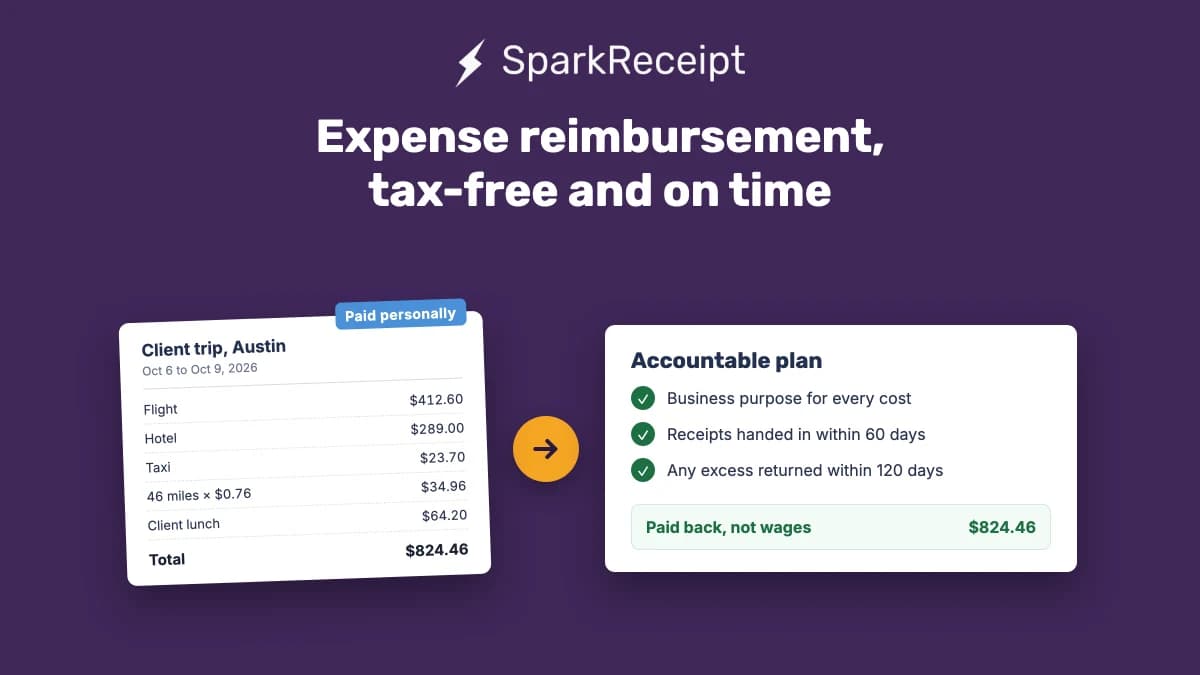
What is expense reimbursement, and is it taxable? Expense reimbursement is a business paying back an employee, owner, or contractor for a business cost they paid with their own money. Under an IRS accountable plan, the payment is not wages: no income tax withholding, no Social Security or Medicare tax, nothing in box 1 of the W-2. Without one, the same payment is taxable pay. The plan needs three things: a business expense, receipts handed in on time, and any excess returned.
SparkReceipt is a receipt and expense app for small businesses. Its expense claims let the person who paid put the receipts they covered and their business trips on one claim, send it for one approval, and get it marked paid once the money has gone out. SparkReceipt runs on iPhone, Android and the web. Every plan includes 1 user, your accountant joins free, and Pro and Elite both start with a 7-day free trial.
What expense reimbursement means
A reimbursement repays a cost someone has already paid. The flight booked on a personal card for a client visit, the parking at a supplier's yard, the printer cartridges picked up on the way to the office: the employee paid, and the business owes them the money back. That is different from a salary or a bonus, which pay for work, and different from an allowance, which hands over a fixed sum whether or not anything was spent.
Reimbursable expenses are the costs the business would have paid itself if it had been at the counter. The IRS frames it as expenses with a "business connection", paid or incurred while performing services for the employer, in Publication 463. Travel, transportation, business mileage, supplies, and meals with clients are the usual categories. A personal purchase made on the same trip is not reimbursable, which is why an itemized receipt matters when one basket holds both.
In a small business, reimbursement is often informal: someone hands over a pile of receipts, the owner adds them up, and a bank transfer goes out. The tax result of that habit depends on whether it meets the IRS definition of an accountable plan.
Is expense reimbursement taxable?
Not if it is paid under an accountable plan. IRS Publication 15 is direct: "Amounts paid under an accountable plan aren't wages and aren't subject to income, social security, Medicare, and FUTA taxes." Payments under a nonaccountable plan "are wages and are treated as supplemental wages", taxed like any other pay.
An arrangement is an accountable plan when it requires all three of these:
| Rule | What it means in practice |
|---|---|
| Business connection | The expense was paid or incurred while working for the business, and the payment covers that expense rather than standing in for wages |
| Substantiation | The employee accounts for the expense with receipts and a record of what it was for, within a reasonable period |
| Return of excess | Any amount paid beyond the substantiated expenses goes back to the business within a reasonable period |
Source: IRS Publication 15, Employee business expense reimbursements and Publication 463, chapter 6.
The plan does not have to be filed anywhere. It is the way your business pays people back, and a short written policy is the easiest evidence that it exists. Our guide to the accountable plan covers the regulation behind it, and the companion post on writing an expense reimbursement policy gives you a one-page template.
What the difference costs: a worked example
Take an employee who spends $1,200 of their own money on a client trip in 2026 and is paid back in full.
Under an accountable plan, with receipts handed in on time, the employee receives $1,200. The business pays $1,200 and deducts it as a business expense. No payroll tax applies to either side.
Under a nonaccountable plan, the same $1,200 is supplemental wages:
| Item | Rate | Amount |
|---|---|---|
| Employee Social Security | 6.2% | $74.40 |
| Employee Medicare | 1.45% | $17.40 |
| Federal income tax withheld at the optional flat supplemental rate | 22% | $264.00 |
| Employer Social Security and Medicare | 7.65% | $91.80 |
The rates come from Publication 15 for 2026: Social Security at 6.2% and Medicare at 1.45% for each side, and the optional flat 22% rate for supplemental wages. The employee takes home $844.20 of the $1,200 before any state tax, and the business pays $1,291.80 instead of $1,200. FUTA can add to the employer's cost if the employee is still under the $7,000 FUTA wage base for the year. All of that for the same receipts, handed in late or not at all.
The timing rules: 30, 60, and 120 days
"Reasonable period" depends on the facts, but Publication 463 gives a safe harbor that counts as reasonable regardless of them, and Publication 15 lists the same deadlines:
| Step | Safe-harbor deadline |
|---|---|
| Advance paid to the employee | Within 30 days of when the expense is paid or incurred |
| Employee accounts for the expense | Within 60 days after it was paid or incurred |
| Employee returns any excess | Within 120 days after the expense |
The alternative is a periodic statement: at least quarterly, the business asks each employee to account for or return outstanding amounts, and they do so within 120 days of the statement.
Miss the window and the unsubstantiated part flips. Publication 15 says the excess "is treated as paid under a nonaccountable plan" and is "subject to income, social security, Medicare, and FUTA taxes for the first payroll period following the end of the reasonable period of time." A shoebox of receipts handed in at year end is the classic way to fall outside the safe harbor.
What an employee has to hand in
Accounting for an expense means giving the business the same records the IRS would want to see. Publication 463 describes it as "a statement of expense, an account book, a diary, or a similar record" kept "at or near the time" of each expense, together with documentary evidence such as receipts.
A receipt is adequate when it shows the amount, date, place, and essential character of the expense. Publication 463 lets you skip documentary evidence for an expense under $75, except lodging, and for transportation where a receipt is not readily available. The record of what the cost was for is still required, and asking for a receipt every time is simpler, because the $75 rule excuses only the receipt, and the record of the expense is still required.
For business driving, the record is a mileage log with the date, miles, destination, and business purpose of each trip. Paying at or below the IRS standard mileage rate, 72.5 cents per mile for January to June 2026 and 76 cents from July 1, keeps the reimbursement tax-free without fuel receipts. Mileage reimbursement has the full rules for employers.
Do reimbursements need to go through payroll?
They can, but they don't have to. Reimbursements under an accountable plan are not wages, so you can pay them by bank transfer outside the payroll run. If you add one to a paycheck, Publication 15 requires you to show it separately: "If a single payment includes both wages and an expense reimbursement, you must specify the amount of the reimbursement." It still stays out of box 1 of the W-2.
Nonaccountable payments are the opposite. They go through payroll as supplemental wages with withholding, and they appear on the W-2. One more trap from Publication 463: an arrangement that pays employees back by reducing their reported wages is treated as nonaccountable, "because you are entitled to receive the full amount of your pay whether or not you have any business expenses."
Some states also require employers to reimburse necessary business expenses, whatever the federal tax treatment. If you have employees in more than one state, check each state's labor department rules.
Reimbursing independent contractors
Contractors are not employees, so the accountable-plan wage rules do not apply to them. What matters is whether the contractor accounts to you for the expense. Publication 463 says that if a contractor adequately accounts for reimbursed amounts, "you don't have to report the amounts on an information return." If they don't, the reimbursement is part of what you paid them for their services.
That decides the 1099. The Form 1099-NEC instructions count a "travel reimbursement for which the nonemployee did not account to the payer" toward nonemployee compensation, and for payments made in 2026 the reporting threshold is $2,000 or more. Our guide to 1099 vs W-2 workers covers the classification itself.
Paying yourself back as the owner
A sole proprietor, or the owner of a single-member LLC taxed as a sole proprietorship, doesn't reimburse themselves: you and the business are the same taxpayer, so you deduct the cost on Schedule C. An owner who is also an employee of a corporation is different. An S corporation owner on a W-2 is reimbursed under the same accountable-plan rules as anyone else, and the accountable plan guide works through the home office, phone, and mileage example.
How SparkReceipt fits
The rules above come down to two records: the receipt, captured when the money was spent, and a dated trail of who submitted what and when it was paid. SparkReceipt keeps both. Receipts are scanned on the phone or pulled from the inbox as they happen, trips come from the mileage tracker, and an expense claim gathers what one person paid for. A Supervisor, Admin, or Owner approves it or sends it back with a reason, and the claim is marked paid with the date once the money has gone out. The claim's history shows when each step happened, which is the timeline the 60-day and 120-day windows ask about.
SparkReceipt doesn't move money, and it doesn't decide tax treatment. You pay the person back the way you already do, and your accountant decides how the plan is set up. An approved claim can be published to QuickBooks Online or Xero as one bill payable to the person, with the receipts attached.
Frequently asked questions
What are reimbursable expenses?
Business costs an employee, owner, or contractor paid with their own money while working for the business: travel, business mileage, supplies, and client meals are the common ones. Personal purchases, commuting, and anything your expense policy excludes are not reimbursable tax-free.
Is expense reimbursement taxable income?
Not when it is paid under an accountable plan: the reimbursement is not wages and is not subject to income tax withholding or Social Security and Medicare tax. Under a nonaccountable plan, it is taxable wages and appears on the employee's W-2.
How long does an employee have to submit receipts?
The IRS safe harbor counts substantiation within 60 days after the expense as reasonable, and the return of any excess within 120 days. A business can set a shorter deadline in its own policy.
Do I have to reimburse employees for expenses?
Federal tax law doesn't require it, but the Fair Labor Standards Act does not let required work expenses push an employee's pay below the minimum wage or cut into required overtime pay. Under 29 CFR 531.35, wages have to be paid "free and clear". Some states go further and require reimbursement of necessary business expenses.
Should expense reimbursements be on a 1099?
Only when a contractor doesn't account to you for the expenses. Accounted-for reimbursements stay off the information return. Unaccounted reimbursements count toward nonemployee compensation, reported on Form 1099-NEC once the year's total reaches $2,000 for payments made in 2026.
Can software handle expense reimbursement for a small team?
Software can keep the receipts, the approval, and the record of payment in one place, which is what an accountable plan depends on. In SparkReceipt each person submits an expense claim, an approver signs off, and the claim is marked paid. Your business still moves the money itself and decides, with your accountant, how expense reimbursement is set up.
Key takeaways
- Expense reimbursement repays a business cost someone covered with their own money. Under an accountable plan it is not wages and not taxed.
- An accountable plan needs a business connection, receipts handed in within a reasonable period, and any excess returned.
- The safe harbor is 60 days to substantiate and 120 days to return excess. Unsubstantiated amounts become taxable wages.
- On a $1,200 trip in 2026, losing accountable-plan treatment means $355.80 withheld from the employee's pay for income tax, Social Security, and Medicare, and $91.80 more in payroll tax for the business.
- Contractors who account for their expenses keep the reimbursement off the 1099-NEC. Those who don't have it counted as pay.
- Keep the receipt, the purpose, and a dated record of approval and payment for every claim.