
Expense Reimbursement Policy for Small Business (Template)
 Written by Sampsa Vainio
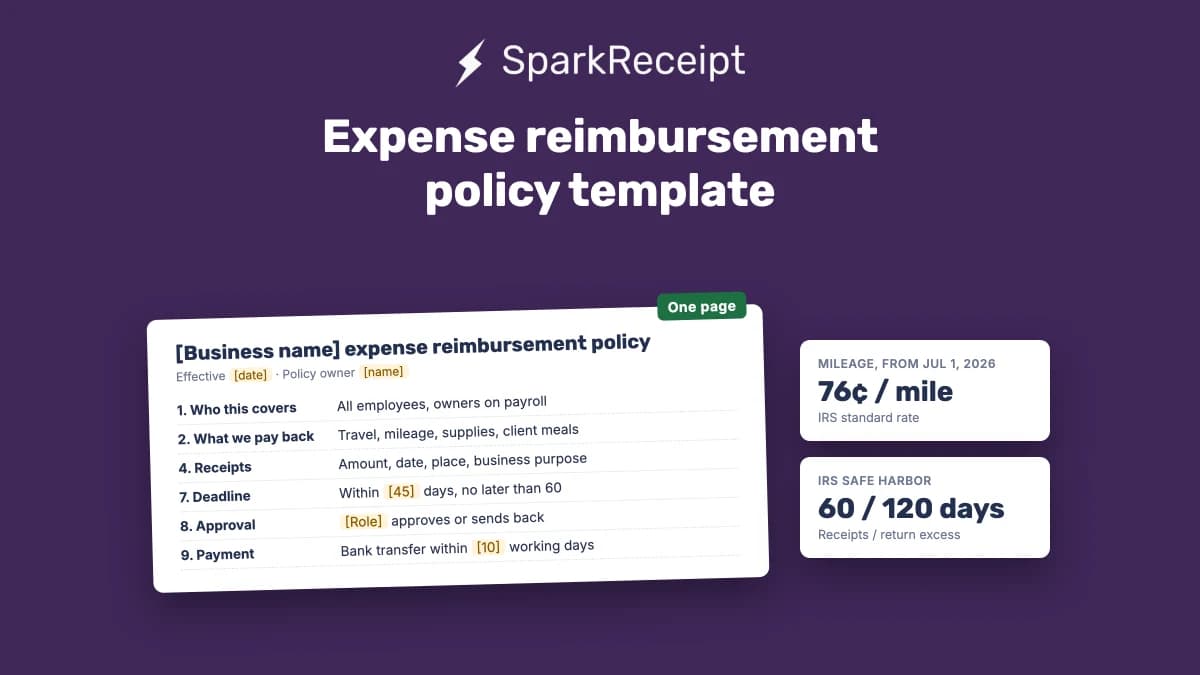
What should an expense reimbursement policy include? For a small US business, one page covers it: who the policy applies to, which costs you pay back and which you don't, the receipts and records you need, the mileage rate, who approves, the deadlines, and how and when you pay. Those deadlines and records are what make the arrangement an IRS accountable plan, which keeps reimbursements tax-free. A template you can copy is further down.
SparkReceipt is a receipt and expense app for small businesses. Its expense claims let each person put the receipts they paid themselves and their business trips on one claim, send it for one approval, and get it marked paid. SparkReceipt runs on iPhone, Android and the web. Every plan includes 1 user, your accountant joins free, and Pro and Elite both start with a 7-day free trial.
Why a small business needs a written policy
If your business pays people back already, the routine probably looks like this: someone pays for parking or a client lunch, hands over the receipt, and gets paid back. The policy writes that habit down so it holds up in two places.
The first is the tax treatment. A reimbursement is tax-free to the employee only when it is paid under an accountable plan: the expense has a business connection, the employee accounts for it within a reasonable period, and any excess is returned. IRS Publication 15 says amounts paid under such a plan "aren't wages and aren't subject to income, social security, Medicare, and FUTA taxes." The regulation doesn't require a written document, but a written policy is the clearest evidence that the plan exists and how it works.
The second is fairness inside the team. When the rules live in the owner's head, two people with the same receipt get different answers. A one-page expense reimbursement policy settles the questions before they turn into arguments: is the hotel minibar covered, which mileage rate applies, and how long can a receipt sit in a drawer.
Our guide to how expense reimbursement works covers the tax side in more depth, including a worked example of what losing accountable-plan treatment costs.
What to put in an expense reimbursement policy
Ten sections cover a business of two to fifty people. Keep each one short.
| Section | What it settles | Where the rule comes from |
|---|---|---|
| Who it covers | Employees, owners on payroll, and whether contractors are included | Your choice |
| What is reimbursed | Travel, mileage, supplies, client meals, and any other categories | Your choice, within business purpose |
| What is not reimbursed | Personal items, commuting, fines, upgrades | Your choice |
| Receipts and records | Receipt, date, amount, place, and business purpose for each expense | IRS Publication 463 |
| Mileage | The rate per mile and the trip details to log | Your choice, at or below the IRS rate to stay tax-free |
| Meals and travel limits | Per-day caps or per diem rates, if you use them | Your choice, with GSA per diem rates as an option |
| Approval | Who signs off and what they check | Your choice |
| Deadlines | How soon after the expense a claim must come in | IRS safe harbor: 60 days |
| Payment | How and when you pay people back | Your choice |
| Advances and excess | How advances are accounted for and returned | IRS safe harbor: 120 days |
Two of those rows carry IRS weight. Publication 463 treats substantiation within 60 days after the expense and the return of any excess within 120 days as a reasonable period, whatever the facts. Set your deadlines at or inside those windows and the timing test takes care of itself.
Receipts: ask for all of them
Publication 463 lets an employee skip documentary evidence for an expense under $75, except lodging, as long as the record of the expense is kept. Asking for every receipt is simpler, because the $75 rule excuses only the receipt, the record is still required, and a receipt settles later questions. An itemized receipt is worth asking for on meals and hotels, where personal items hide inside the total.
Mileage: pick a rate and log every trip
Reimbursing at or below the IRS standard mileage rate keeps mileage tax-free without fuel receipts. For 2026 the IRS rate is 72.5 cents per mile from January 1 to June 30 and 76 cents from July 1. Each trip still needs the date, miles, destination, and business purpose. Our post on mileage reimbursement has the employer rules in full.
Company cards are not reimbursements
If the business pays with a company card, the employee is owed nothing. Say in the policy that company-card purchases are reconciled against their receipts and not claimed back, so the same cost is not paid twice.
Expense reimbursement policy template
Copy the text below into a document, replace each bracket with your own choice, and share it with each person who spends money for the business. It is written to meet the accountable-plan rules, but it is not legal or tax advice: have your accountant read it before you adopt it.
[Business name] expense reimbursement policy
Effective date: [date]. Policy owner: [name and role].
1. Who this covers. This policy applies to all employees of [Business name], including owners on payroll. [Contractors are reimbursed only when their contract says so, and only for expenses they account for under section 4.]
2. What we pay back. We reimburse reasonable costs you pay with your own money while working for [Business name], including:
- Travel for work, including fares, parking, tolls, and lodging.
- Business mileage in your own vehicle, at the rate in section 5.
- Supplies and equipment bought for the business, up to [$ amount] without prior approval.
- Meals with clients or while traveling overnight for work, up to [$ amount] per person per day.
- [Other categories you pay back.]
3. What we don't pay back. Personal items, travel between home and your regular workplace, fines and penalties, alcohol [unless with a client], travel upgrades, and anything bought with a company card.
4. Receipts and records. For each expense, submit the receipt and a short note of what it was for. The receipt must show the amount, date, and place. For mileage, record the date, miles, start and end points, and the business purpose of each trip. Claims without a receipt are paid only if [role] approves a written explanation.
5. Mileage rate. We reimburse business miles at [the IRS standard mileage rate in effect on the date of the trip / a rate of $ per mile].
6. How to claim. Submit your expenses on [an expense claim in SparkReceipt / the company expense form] [monthly / after each trip]. One claim may hold several expenses and trips.
7. Deadline. Submit each expense within [45] days of paying it, and no later than 60 days. Expenses submitted after 60 days may be paid as taxable wages or not at all.
8. Approval. [Role] approves each claim or sends it back with a reason. Claimants don't approve their own claims [except the owner].
9. Payment. Approved claims are paid by [bank transfer / with the next payroll, shown separately from wages] within [10] working days of approval.
10. Advances. If you receive an advance, account for it under section 4 within 60 days of the expense and return any unspent amount within 120 days of the expense.
11. Questions. Ask [name] before you spend if you are unsure whether a cost is covered.
The brackets are the decisions that differ from one business to the next. Fill them in once, and revisit the policy when the IRS mileage rate changes or when you add a category.
Rules your policy can't override
A policy sets your own rules, inside limits set by law.
Federal tax rules. Reimbursements outside the accountable-plan conditions become taxable wages, whatever your policy says. Publication 463 adds one specific trap: an arrangement that pays people back by reducing their reported wages is treated as nonaccountable, because the employee is entitled to the full pay whether or not they had expenses.
Minimum wage. Under the Fair Labor Standards Act, wages must be paid "free and clear" (29 CFR 531.35). If your policy leaves an employee paying for tools or costs the job requires, and that pushes their pay for the week below the minimum wage, or cuts into overtime pay owed, the shortfall is a violation. A policy that pays back required work costs avoids the problem.
State law. Some states require employers to reimburse necessary business expenses, including mileage, regardless of the federal tax treatment. If you employ people in more than one state, check each state's labor department rules before you set the limits in sections 2 and 5.
An expense reimbursement policy example in practice
Here is the template at work in a six-person landscaping business that pays mileage at the IRS rate, asks for claims monthly, and set its deadline at 45 days.
In August 2026 one crew lead drives 120 business miles in her own truck, pays $18.00 for parking at a client site, and buys lunch for a client for $42.50. On September 10 she submits one claim:
| Item | Detail | Amount |
|---|---|---|
| Mileage | 120 miles × $0.76 (IRS rate from July 1, 2026) | $91.20 |
| Parking | Client site, receipt attached | $18.00 |
| Client lunch | Itemized receipt, client named in the note | $42.50 |
| Total | $151.70 |
Every expense is within 60 days, each has a receipt or a mileage record, and the owner approves the claim on September 12. The business pays $151.70 by bank transfer on September 15. Nothing goes on her W-2. The business deducts the mileage and parking in full and the client lunch under the usual 50% limit for business meals, and the reimbursement itself is tax-free to her either way.
How to run the policy without chasing paper
A policy only works if the receipts exist when the claim is due. In SparkReceipt each person scans a receipt on their phone at the counter, or lets emailed receipts come in from their inbox, and logs business trips in the mileage tracker. At the end of the month they put the receipts they paid themselves and their trips on an expense claim and submit it. A Supervisor, Admin, or Owner approves it or sends it back with a reason, and the claim is marked paid with the date once the money has gone out.
SparkReceipt doesn't check claims against your policy: there are no spending limits or policy rules in the app, and the approver reads the claim against the policy. It also doesn't move money. What it keeps is the record the policy asks for: the receipt image, what each cost was for, who approved it, and when it was paid. An approved claim can be published to QuickBooks Online or Xero as one bill payable to the person.
Frequently asked questions
Is an expense reimbursement policy required by law?
No federal law requires a written policy. The IRS accountable-plan rules don't require a document either, but a written expense reimbursement policy is the clearest evidence that your arrangement meets them. Some states have their own reimbursement rules for employers.
What is the difference between an expense policy and an accountable plan?
An accountable plan is the IRS's name for a reimbursement arrangement that meets three conditions: business connection, substantiation within a reasonable period, and the return of any excess. An expense policy is the document where your business writes its version of those conditions down, together with its own limits and approval steps.
How long should employees have to submit expenses?
Publication 463 treats accounting within 60 days after an expense as reasonable, so set a deadline at or inside 60 days. A monthly claim keeps every expense well inside that window.
Should the policy cover contractors?
Only if their contracts promise reimbursement. When a contractor accounts to you for an expense, Publication 463 says you don't report the amount on an information return. When they don't, the reimbursement counts as part of what you paid them, on Form 1099-NEC once the year's total reaches $2,000 for 2026 payments.
Can I reimburse at more than the IRS mileage rate?
You can, but the amount above the IRS rate is reported as taxable wages on the employee's W-2. Reimbursing at the IRS rate keeps mileage simple and tax-free.
What should an expense reimbursement policy template include?
The ten sections in this guide: who it covers, what is and isn't reimbursed, receipts and records, the mileage rate, meal and travel limits, approval, deadlines, payment, and advances. The template above has each of them with brackets for your own choices, so your expense reimbursement policy fits on one page.
Key takeaways
- One page is enough: who is covered, what is paid back, what isn't, the records needed, the mileage rate, approval, deadlines, and payment.
- Deadlines at or inside 60 days for receipts and 120 days for returning advances keep reimbursements inside the IRS safe harbor.
- Ask for every receipt, even under $75, and log date, miles, destination, and purpose for each business trip.
- Company-card purchases are reconciled against receipts, not reimbursed.
- The policy sits inside federal tax rules, the minimum-wage rule, and any state reimbursement law. Have your accountant read it before you adopt it.