
Small Business Bookkeeping Statistics: When Businesses File Their Receipts
 Written by Joel Ojala
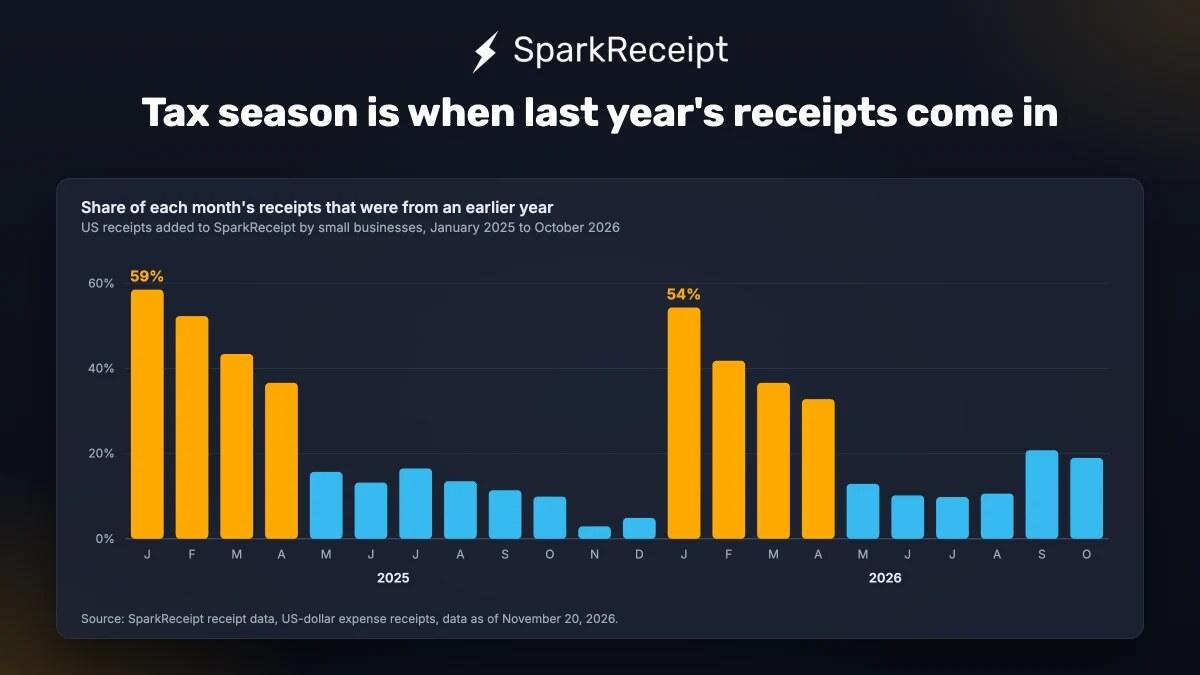
Most small business receipts are filed within days of the purchase, but almost a third come in months later. In SparkReceipt data for the year to November 19, 2026, 46% of 1,103,628 US receipts were added within a week of the purchase and 31% more than three months after it. Of the receipts small businesses dated in 2025, 32% were added after the year ended and 13% after the April 15, 2026 filing deadline.
Tax season is when the backlog clears. In January 2026, 54% of the receipts businesses added were from 2025 or earlier, and in the two weeks before Tax Day they added about a third more receipts a day than over the rest of the year.
SparkReceipt is an expense app for small businesses and self-employed people. They photograph, upload or forward their receipts and invoices so their books are ready at tax time, and every receipt carries both its purchase date and the day it was added. That lets us measure when receipts get filed. The figures below are totals only.
Key findings
- 46% of small business receipts are filed within a week of the purchase, and 26% on the same day.
- 31% are filed more than three months after the purchase, and 10% more than a year after.
- 32% of the receipts small businesses dated in 2025 were added after December 31, 2025, and 13% after the April 15, 2026 filing deadline.
- In January 2026, 54% of the receipts added were from the year before. By May the share was down to 13%.
- Small businesses added about a third more receipts a day in the two weeks before Tax Day 2026 than over the rest of the year: 4,533 a day against 3,416.
- Receipts added from the phone app come in a median of 6 days after the purchase. Receipts uploaded on the web come a median of 92 days after.
- Businesses that use SparkReceipt all year add receipts in a median of 33 of the 52 weeks. 15% add more than a quarter of their year's receipts in a single day.
How long after a purchase do small businesses file the receipt?
| How the receipt arrived | Same day | 1 to 7 days | 8 to 30 days | 31 to 90 days | 91 to 365 days | Over a year | Median days |
|---|---|---|---|---|---|---|---|
| All receipts | 26% | 20% | 12% | 11% | 21% | 10% | 13 |
| Added in the phone app | 27% | 25% | 13% | 10% | 18% | 6% | 6 |
| By email | 35% | 20% | 8% | 11% | 18% | 9% | 3 |
| Uploaded on the web | 7% | 11% | 15% | 17% | 35% | 16% | 92 |
These are 1,103,628 receipts added between November 20, 2025 and November 19, 2026 by 9,805 businesses. The median receipt is filed 13 days after the purchase.
The way a receipt arrives tells you who is keeping up and who is catching up. More than half of the receipts added from the phone are filed within a week. Uploads on the web are where backlogs get cleared: half of them are more than three months old. Email has the most same-day receipts (35%), and also a long tail: 27% are more than 90 days old, because email history extraction brings in months of past receipts when an inbox is first connected.
How many receipts are filed after the tax year ends?
| When receipts dated in 2025 were added | Share |
|---|---|
| By December 31, 2025 | 68.0% |
| January 1 to March 31, 2026 | 15.5% |
| April 1 to April 15, 2026 | 3.3% |
| After April 15, 2026 | 13.3% |
These are 771,590 receipts dated in 2025 from 11,046 businesses, counted up to November 19, 2026. Two thirds were in SparkReceipt by the end of the year. 2,150 businesses added 2025 receipts after the April 15 filing deadline. Some of them may have filed on an extension, which runs to October 15, and some joined SparkReceipt later in 2026 and brought last year's receipts with them.
When is tax season for receipts?
| Month added | Share from an earlier year, 2025 | Share from an earlier year, 2026 | Receipts per business, 2026 |
|---|---|---|---|
| January | 58.5% | 54.3% | 29.6 |
| February | 52.3% | 41.8% | 27.8 |
| March | 43.4% | 36.6% | 31.5 |
| April | 36.6% | 32.8% | 30.9 |
| May | 15.7% | 12.9% | 25.6 |
| June | 13.2% | 10.2% | 24.5 |
| July | 16.5% | 9.8% | 28.2 |
| August | 13.5% | 10.6% | 29.8 |
| September | 11.4% | 20.8% | 40.4 |
| October | 9.9% | 19.0% | 45.2 |
| November | 2.9% | ||
| December | 4.9% |
From January to April, between a third and a half of the receipts businesses add are from the previous year, most likely last year's books being finished for the tax return. After April the share falls to about one in eight. Receipts per business are a fairer comparison across months than raw totals, because the number of businesses on SparkReceipt grew through both years.
In the two weeks before the April 15, 2026 deadline, businesses added 4,533 receipts a day, against 3,416 a day for the rest of 2026 to November 19. The number of businesses adding receipts each day rose less, by 9%, so most of the rise came from each business adding more receipts.
Do small businesses keep up with receipts every week?
Of the 1,308 businesses that used SparkReceipt for the whole year, the median one added receipts in 33 of the 52 weeks and on 58 days. A quarter added receipts in 47 weeks or more, close to every week, and a quarter in 19 weeks or fewer.
40% added receipts in at least 40 weeks of the year. At the other end, 15% added more than a quarter of their year's receipts on a single day, and 3% more than half. For them the receipts pile up and get done in one sitting.
What days of the week do small businesses spend on?
| Day of the purchase | Share of receipts |
|---|---|
| Monday | 15.5% |
| Tuesday | 15.3% |
| Wednesday | 15.4% |
| Thursday | 15.2% |
| Friday | 16.1% |
| Saturday | 12.1% |
| Sunday | 10.5% |
Friday is the busiest day for purchases, and 23% of receipts are from a weekend.
If you're behind on your receipts
If you're behind, the record usually still exists. Your bank and card statements list every purchase, merchants keep order histories, and old emailed receipts are still in your inbox. The catch-up bookkeeping guide works through a backlog from the bank statement, lost receipt reconstruction covers purchases with no receipt left, and how long to keep receipts explains why last year's receipts still matter.
How we counted
- The base is expense receipts in US dollars in SparkReceipt. Sample documents, bank statement lines, drafts and deleted documents are left out, and so are our own and test accounts.
- The purchase date is the date read from the receipt. Dates more than two years before the upload, or after it, are treated as misreads and left out.
- "Added" is the day the receipt reached SparkReceipt, in UTC. A receipt brought in by email history extraction counts on the day it was brought in.
- The yearly habits count only the 1,308 businesses that added receipts in both the first and the last 30 days of the year to November 19, 2026, so businesses that joined or left during the year don't skew them.
- Every figure has at least 50 businesses behind it. No business can be identified from them.
- SparkReceipt users are businesses that chose an expense app, so the figures describe SparkReceipt's customers, not every small business. Businesses that keep no records at all are not in them.
Data as of November 20, 2026.
About SparkReceipt
SparkReceipt, founded in 2023, is an expense app for small businesses, self-employed people and their accountants. The receipt scanner reads paper receipts from a photo, email receipts brings receipts and invoices in from your inbox, and every receipt can be matched to its bank transaction and published to QuickBooks Online or Xero. For press questions, contact Joel Ojala at joel@sparkreceipt.com.